

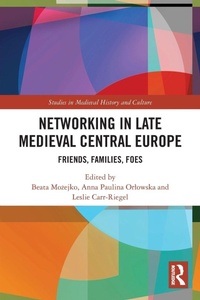
Networking in Late Medieval Central Europe
Friends, Families, Foes
1st Edition
Published on 26. August 2024
Book
Paperback/Softback
214 pages
978-1-032-24422-8 (ISBN)
Description
Exploring the formation of networks across late medieval Central Europe, this book examines the complex interaction of merchants, students, artists, and diplomats in a web of connections that linked the region. These individuals were friends in business ventures, occasionally families, and not infrequently foes. No single activity linked them, but rather their interconnectivity through matrices based in diverse modalities was key. Partnerships were not always friendship networks, art was sometimes passed between enemies, and families created for financial gain. Taking an interdisciplinary approach, the chapters focus on inclusion and exclusion within intercultural networks, both interpersonal and artistic, using a wide spectrum of source materials and methodological approaches.
The concept of friends is considered broadly, not only as connections of mutual affection but also simply through business relationships. Families are considered in terms of how they helped or hindered local integration for foreigners and the matrimonial strategies they pursued. Networks were also deeply impacted by rivalry and hostility.
The concept of friends is considered broadly, not only as connections of mutual affection but also simply through business relationships. Families are considered in terms of how they helped or hindered local integration for foreigners and the matrimonial strategies they pursued. Networks were also deeply impacted by rivalry and hostility.
More details
Series
Language
English
Place of publication
London
United Kingdom
Publishing group
Taylor & Francis Ltd
Target group
Professional and scholarly
Academic
Illustrations
1 s/w Tabelle, 37 s/w Photographien bzw. Rasterbilder, 37 s/w Abbildungen
1 Tables, black and white; 37 Halftones, black and white; 37 Illustrations, black and white
Dimensions
Height: 234 mm
Width: 156 mm
Thickness: 13 mm
Weight
363 gr
ISBN-13
978-1-032-24422-8 (9781032244228)
Copyright in bibliographic data and cover images is held by Nielsen Book Services Limited or by the publishers or by their respective licensors: all rights reserved.
Schweitzer Classification
Other editions
Additional editions
Beata Mozejko | Anna Orlowska | Leslie Carr-Riegel
Networking in Late Medieval Central Europe
Friends, Families, Foes
Book
02/2023
1st Edition
Routledge
€186.10
Shipment within 10-20 days
Beata Mozejko | Anna Orlowska | Leslie Carr-Riegel
Networking in Late Medieval Central Europe
Friends, Families, Foes
E-Book
02/2023
1st Edition
Routledge
€55.49
Available for download
Beata Mozejko | Anna Orlowska | Leslie Carr-Riegel
Networking in Late Medieval Central Europe
Friends, Families, Foes
E-Book
02/2023
1st Edition
Routledge
€55.49
Available for download
Persons
Beata Mozejko ?(University of Gdansk) is Professor of History specializing in medieval history and the auxiliary sciences of history; the author of other 150 papers, articles, and monographs, including "Peter von Danzig, The story of Great Caravel 1462-1475" (Brill 2020); member of the Bureau of Committee on Historical Sciences of the Polish Academy of Sciences (2020-2023); and member of the Committee of Gdansk Encyklopedia (Gedanopedia).
Anna Paulina Orlowska studied history and history of arts at University in Warsaw and Christian-Albrecht-University in Kiel. In Kiel, she worked on her PhD on an account book from Gdansk written in the first half of fifteenth century. After defending her thesis in 2015, she went to the Institute of History Polish Academy of Sciences in Warsaw. Now she works at the Institute for Comparative Urban History in Muenster, Germany, where she develops the Historical Town Atlasses based on the said ontology.
Leslie Carr-Riegel received her doctorate in Medieval Studies from the Central European University in 2021. She has historically focused on waste management, medieval trade relations between Poland and Italy, and legal history, but is mostly dedicated to teaching the next generation of scholars. She has worked as a fellow with the Medici Archive Project, the Princeton Global History Project, and the Kaete Hamburger Kolleg at the University of Muenster.
Anna Paulina Orlowska studied history and history of arts at University in Warsaw and Christian-Albrecht-University in Kiel. In Kiel, she worked on her PhD on an account book from Gdansk written in the first half of fifteenth century. After defending her thesis in 2015, she went to the Institute of History Polish Academy of Sciences in Warsaw. Now she works at the Institute for Comparative Urban History in Muenster, Germany, where she develops the Historical Town Atlasses based on the said ontology.
Leslie Carr-Riegel received her doctorate in Medieval Studies from the Central European University in 2021. She has historically focused on waste management, medieval trade relations between Poland and Italy, and legal history, but is mostly dedicated to teaching the next generation of scholars. She has worked as a fellow with the Medici Archive Project, the Princeton Global History Project, and the Kaete Hamburger Kolleg at the University of Muenster.
Content
Introduction / Gaudeamus igitur in Bononia dum sumus: a network of Polish students in Italy in the late Middle Ages / A Venetian merchant in Poland: the life and times of Pietro Bicherano / How to Develop a Trade Network as a Newcomer without Getting Married? Examples from the Account Book of Danzig Merchant Johan Pyre / Marriage networks and building structures of power within the urban communities between the Drava River and the Adriatic Sea: a comparative approach / Inclusion and exclusion. Intercultural relationships in Old Warsaw in the fifteenth and sixteenth centuries in light of the municipal registers / The diplomacy of Sigismund of Luxembourg in the dispute between the Teutonic Knights and Poland-Lithuania / The coat of arms of Louis II, King of Hungary and Bohemia, in the choir of Barcelona Cathedral. The role and significance of the Jagiellonian dynasty in the nineteenth assembly of the Order of the Golden Fleece in 1519 / Rome, Rostock and a remote region: Livonian bishops. / 9.What links the Last Judgment triptych by Hans Memling with Florence, Rome, Nuremberg, Breisach and Cracow? / Across boundaries. Artistic exchange (painting, sculpture) in the area between Gdansk (Danzig) and Koenigsberg in the late Middle Ages / Distant enemies, yet allies in art? Remarks on supposed artistic relations between fourteenth-century Prussia and the Islamic and Byzantine cultures in the Middle East / Late medieval networks of faith: the West and the East. Fortified urbanity and religion in fifteenth-century illuminations produced in France