

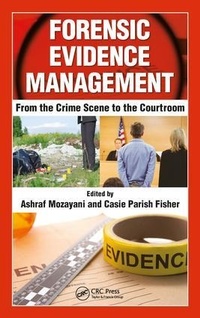
Forensic Evidence Management
From the Crime Scene to the Courtroom
1st Edition
Published on 7. December 2017
Book
Hardback
191 pages
978-1-4987-7718-6 (ISBN)
Description
"Evidence management has become a crucial component for the law enforcement community. I truly believe this book is essential in assisting criminal investigators and a valuable resource for managing evidence."-Jeremiah Sullivan, Chairman, Board of Directors, Texas Division of the International Association for Identification; Senior Crime Scene Specialist (Retired). Austin Police Department
As technology and technical applications continue to advance in the forensic sciences, the undertakings at crime scenes have become even more critical. Crime scene investigators must ensure that evidence is properly collected, document, packaged, and stored in a manner that maximizes the ability of laboratories to derive meaning and results from the evidence provided them.
Forensic Evidence Management: From the Crime Scene to the Courtroom provides best practices policies for forensic science entities and their employees to maintain chain of custody and evidence integrity throughout the course of evidence collection, storage, preservation, and processing.
The focus of the book will be to address the issues related with evidence handling and analysis inside the forensic laboratory, in particular, and to offer best practices and guidelines from leading forensic experts in the field. Forms of evidence covered include biological, chemical, trace, firearm, toolmark, fingerprint, and a host of others types recovered at crime scenes. The book concludes with a chapter on ethics, bias, and ethical practices in evidence handling in the field and laboratory analysis.
Test Bank and PowerPointTM slides are available for download from the Taylor & Francis ancillary Web site for qualifying course adopters.
As technology and technical applications continue to advance in the forensic sciences, the undertakings at crime scenes have become even more critical. Crime scene investigators must ensure that evidence is properly collected, document, packaged, and stored in a manner that maximizes the ability of laboratories to derive meaning and results from the evidence provided them.
Forensic Evidence Management: From the Crime Scene to the Courtroom provides best practices policies for forensic science entities and their employees to maintain chain of custody and evidence integrity throughout the course of evidence collection, storage, preservation, and processing.
The focus of the book will be to address the issues related with evidence handling and analysis inside the forensic laboratory, in particular, and to offer best practices and guidelines from leading forensic experts in the field. Forms of evidence covered include biological, chemical, trace, firearm, toolmark, fingerprint, and a host of others types recovered at crime scenes. The book concludes with a chapter on ethics, bias, and ethical practices in evidence handling in the field and laboratory analysis.
Test Bank and PowerPointTM slides are available for download from the Taylor & Francis ancillary Web site for qualifying course adopters.
Reviews / Votes
Forensic Evidence Management: From the Crime Scene to the Courtroom serves as a valuable overview ... a comprehensive outline for all evidence types and a resource for law enforcement, crime scene investigators, scientists, and administrators."-Forensic Science Review, January 2019More details
Language
English
Place of publication
Bosa Roca
United States
Publishing group
Taylor & Francis Inc
Target group
Professional and scholarly
Academic and Professional Practice & Development
Product notice
sewn/stitched
Cloth over boards
Illustrations
66 s/w Abbildungen, 60 s/w Photographien bzw. Rasterbilder, 6 s/w Zeichnungen, 6 s/w Tabellen
6 Tables, black and white; 6 Line drawings, black and white; 60 Halftones, black and white; 66 Illustrations, black and white
Dimensions
Height: 234 mm
Width: 163 mm
Thickness: 18 mm
Weight
249 gr
ISBN-13
978-1-4987-7718-6 (9781498777186)
Copyright in bibliographic data and cover images is held by Nielsen Book Services Limited or by the publishers or by their respective licensors: all rights reserved.
Schweitzer Classification
Other editions
Additional editions
Ashraf Mozayani | Casie Parish-Fisher
Forensic Evidence Management
From the Crime Scene to the Courtroom
Book
03/2021
1st Edition
CRC Press
€104.30
Shipment within 15-20 days
Ashraf Mozayani | Casie Parish-Fisher
Forensic Evidence Management
From the Crime Scene to the Courtroom
E-Book
11/2017
1st Edition
CRC Press
€94.99
Available for download
Ashraf Mozayani | Casie Parish-Fisher
Forensic Evidence Management
From the Crime Scene to the Courtroom
E-Book
11/2017
1st Edition
CRC Press
€94.99
Available for download
Persons
Dr. Ashraf Mozayani has been an internationally recognized forensic scientist for more than twenty years. She is the Executive Director of Forensic Sciences and a professor at Texas Southern University. She is also Senior Forensic Science Advisor and Instructor for the International Criminal Investigative Training Assistance Program (ICITAP), under the aegis of the Criminal Division of the U.S. Department of Justice.
Casie Parish Fisher has previously worked as a crime scene technician with the Austin Police Department and as a DNA analyst at the Texas Department of Public Safety CODIS Laboratory. For the past 7 years, she has been the Director of the Forensic Science Program at St. Edward's University where she oversees two degree programs.
Casie Parish Fisher has previously worked as a crime scene technician with the Austin Police Department and as a DNA analyst at the Texas Department of Public Safety CODIS Laboratory. For the past 7 years, she has been the Director of the Forensic Science Program at St. Edward's University where she oversees two degree programs.
Content
Foreword 1. Crime Scene Dynamics [Michael Kessler and Casie Parish Fisher] 2. Evidence Tracking and Secure Storage [Cassie Velasquez] 3. Evidence Management of Fingerprints [Jack Flanders] 4. Biological Evidence: Collection, Transportation and Preservation [Nathalie Zahra] 5. Sexual Assault Evidence: Collection Techniques [Laurie Charles] 6. Evidence Management Best Practices in Medicolegal Death Investigation [Dr. Jason Wiersema, Michal Pierce, Allison Woody, and Michelle Sanford] 7. General Principles and Techniques of Trace Evidence Collection [Patrick Buzzini and Jorn Chi-Chung Yu] 8. Firearms Evidence: Documentation, Collection and Preservation [Jay M. Stuart] 9. Introduction to Drug Evidence Handling Procedures [Jasmine Drake] 10. Evidence Collection and Management for Forensic Toxicology Analysis [Ashraf Mozayani] 11. Questioned Documents [Claire Williamson] 12. Forensic Digital Evidence [Zeno Geradts] 13. Evidence Collection for Arson Cases [Kenneth Wilson] 14. Forensic Art and Imaging: Best Practices for Evidence Handling [Catyana Falsetti, Anthony Falsetti, and Sandra Enslow] 15. Ethical Issues, Bias and Other Challenges to Forensic Evidence Management [Carol Henderson, Ryan Swafford, and Adam Itzkowitz]