

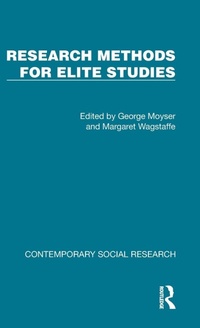
Research Methods for Elite Studies
1st Edition
Published on 30. June 2025
Book
Hardback
280 pages
978-1-041-06582-1 (ISBN)
Description
Elites are crucial groups of people in all but the very simplest societies. Whether one is concerned with politics and government, the economy, or the wider culture and structure of society, they are the people who occupy the central positions of influence that, in turn, enable them to help shape the character and direction of the whole society.
But who exactly are they, and how does one study them? In sharp contrast to the ordinary citizenry, the methodology for the study of elites was contentious and under-developed at the time. Originally published in 1987, Research Methods for Elite Studies provided a wide-ranging survey of the techniques, problems, issues and practicalities of elite research. These are explored through case studies conducted by a range of experts, all personally involved in the field of elite research about which they write. Methodology here is not divorced from substance, but vividly set in its context by the researchers.
Research Methods for Elite Studies is directed to all social scientists who seek to understand the working of the powerful in society. In particular, those concerned with political power, with the functioning of social and political institutions, with economic enterprises, and above all with the diverse variety of leaders in society, will find the volume essential reading.
But who exactly are they, and how does one study them? In sharp contrast to the ordinary citizenry, the methodology for the study of elites was contentious and under-developed at the time. Originally published in 1987, Research Methods for Elite Studies provided a wide-ranging survey of the techniques, problems, issues and practicalities of elite research. These are explored through case studies conducted by a range of experts, all personally involved in the field of elite research about which they write. Methodology here is not divorced from substance, but vividly set in its context by the researchers.
Research Methods for Elite Studies is directed to all social scientists who seek to understand the working of the powerful in society. In particular, those concerned with political power, with the functioning of social and political institutions, with economic enterprises, and above all with the diverse variety of leaders in society, will find the volume essential reading.
More details
Series
Language
English
Place of publication
London
United Kingdom
Publishing group
Taylor & Francis Ltd
Target group
College/higher education
Adult education, General, and Postgraduate
Dimensions
Height: 222 mm
Width: 145 mm
Thickness: 19 mm
Weight
494 gr
ISBN-13
978-1-041-06582-1 (9781041065821)
Copyright in bibliographic data and cover images is held by Nielsen Book Services Limited or by the publishers or by their respective licensors: all rights reserved.
Schweitzer Classification
Other editions
Additional editions
George Moyser | Margaret Wagstaffe
Research Methods for Elite Studies
E-Book
06/2025
Routledge
€73.99
Available for download
George Moyser | Margaret Wagstaffe
Research Methods for Elite Studies
E-Book
06/2025
Routledge
€73.99
Available for download
Persons
Dr. George Moyser is Professor Emeritus of Political Science at the University of Vermont. He holds a Ph.D from the University of Michigan. He has served as Research Director on several funded projects in the fields of political participation and religion and politics. He has published several books and numerous articles in professional journals.
Margaret Wagstaffe was, at the time of original publication, a Research Associate in the Department of Government at the University of Manchester.
Margaret Wagstaffe was, at the time of original publication, a Research Associate in the Department of Government at the University of Manchester.
Content
Preface. 1. Studying Elites: Theoretical and Methodological Issues George Moyser and Margaret Wagstaffe Part I: Political and Social Elites 2. Surveying National Elites in the Federal Republic of Germany Ursula Hoffmann-Lange 3. Studying Members of the United States Congress Barbara Sinclair and David Brady 4. Interviewing Party-Political Elites in Italy Geoffrey Pridham 5. Studying a Religious Elite: The Case of the Anglican Episcopate Kenneth Medhurst and George Moyser 6. Oral History as an Instrument of Research into Scottish Educational Policy-Making Charles Raab Part II: Economic Elites 7. The Fly on the Wall of the Inner Sanctum: Observing Company Directors at Work John Winkler 8. The Study of a Business Elite and Corporate Philanthropy in a United States Metropolitan Area Joseph Galaskiewicz 9. Working on Directors: Some Methodological Issues Peter Brannen Part III: Defensive Elites 10. The Threatened Elite: Studying Leaders in an Urban Community Margaret Wagstaffe and George Moyser 11. Elite Studies in a 'Paranocracy': The Northern Ireland Case Paul Arthur 12. The Study of Soviet and East-European Elites Christopher Binns 13. Interview Political Elites in Taiwan Moshe M. Czudnowski. Bibliography. Index.