

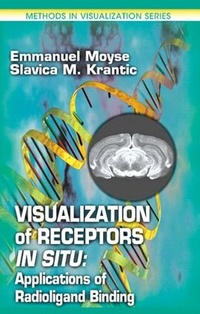
Visualization of Receptors In Situ
Applications of Radioligand Binding
1st Edition
Will be published approx. on 30. November 2000
Book
Hardback
204 pages
978-0-8493-0042-4 (ISBN)
Description
Radioligand binding in situ is the most sensitive method for detecting available receptors; the success and reliability of this approach are determined by a number of technical requirements and constraints. Based on the authors' fifteen years of experience in the field, Visualization of Receptors In Situ: Applications of Radioligand Binding explicitly details these procedures - often not encountered in the original research papers - helping the reader overcome the challenges associated with this powerful technique.
More details
Series
Language
English
Place of publication
Bosa Roca
United States
Publishing group
Taylor & Francis Inc
Target group
Professional and scholarly
Professional
Illustrations
19 s/w Photographien bzw. Rasterbilder, 7 s/w Tabellen
7 Tables, black and white; 19 Halftones, black and white
Dimensions
Height: 254 mm
Width: 178 mm
Weight
586 gr
ISBN-13
978-0-8493-0042-4 (9780849300424)
Copyright in bibliographic data and cover images is held by Nielsen Book Services Limited or by the publishers or by their respective licensors: all rights reserved.
Schweitzer Classification
Other editions
Additional editions
Emmanuel Moyse | Slavica M. Krantic
Visualization of Receptors In Situ
Applications of Radioligand Binding
E-Book
11/2000
CRC Press
€311.99
Available for download
Emmanuel Moyse | Slavica M. Krantic
Visualization of Receptors In Situ
Applications of Radioligand Binding
E-Book
11/2000
CRC Press
€311.99
Available for download
Persons
Emmanuel Moyse, Slavica M Krantic
Content
LIGHT MICROSCOPY. Ligand Labeling with Radioisotopes. Tissue Preparation for Light Microscopy. Radioligand Binding Assay on Frozen Tissue Sections. Film (Dry) Radioautography. Liquid Emulsion (Wet) Radioautography. Quantification of Radioautographic Labeling. ELECTRON MICROSCOPY. Choice of Radioligand. Tissue Preparation. Radioligand Binding Assay on Thick Tissue Slices. Embedding and Ultrathin Sectioning. Radioautography. Coloration and Contrasting of Ultrathin Sections. Analysis and Quantification of Radioautographic Labeling.