

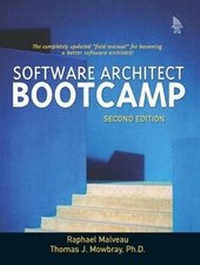
Software Architect Bootcamp
2nd Edition
Published on 18. December 2003
Book
Paperback/Softback
368 pages
978-0-13-141227-9 (ISBN)
Description
Hands-on exercises, real-life war stories, and a take-no-prisoners attitude madethe first edition of this book among the most popular software architecturebooks in the market. This timely second edition retains those popularcharacteristics, with added treatment to reflect the latest trends anddevelopments in the world of software development. Software architecturecontinues to grow as a discipline as more and more development organizationshave recognized that solid architecture begets successful projects. This newedition is ideal for software professionals who want to learn how to be asuccessful software architect. The authors teach you how to avoid timeconsumingpitfalls and costly errors through a solid architecture strategy.
More details
Edition
2nd edition
Language
English
Place of publication
Upper Saddle River
United States
Publishing group
Pearson Education (US)
Target group
College/higher education
Dimensions
Height: 234 mm
Width: 181 mm
Thickness: 25 mm
Weight
708 gr
ISBN-13
978-0-13-141227-9 (9780131412279)
Schweitzer Classification
Other editions
Previous edition
Raphael Malveau | Thomas J. Mowbray
Software Architect Bootcamp
Book
10/2000
Prentice Hall
€48.27
Article exhausted; check for reprint
Persons
RAPHAEL MALVEAU, a software architect and consultant based in Alexandria, VA, currently serving as Technical Director for SRA International working to modernize several mission-critical enterprise systems in the Federal government. Previously, as Chief Scientist and Strategic Architect at both startup and major established IT companies, he engineered advanced component architecture best practices that led to the creation of several industry-leading software products.
DR. THOMAS J. MOWBRAY is the Chairman of the Component Management Group and Founding Board member of the Worldwide Institute of Software Architects. He is the author of four books on distributed components and software architecture.
DR. THOMAS J. MOWBRAY is the Chairman of the Component Management Group and Founding Board member of the Worldwide Institute of Software Architects. He is the author of four books on distributed components and software architecture.
Content
Preface.
1. Introduction.
Defining Software Architecture. The Need for the Software Architect. Goals.
2. Military History.
Software Architecture Approaches. The Architectural Paradigm Shift. The Need for Software Architecture. Zachman Framework. Reference Model for Open Distributed Processing. Enterprise Architecture Standards. Design Patterns. AntiPatterns. Software Design-Level Model. Conclusions.
3. Software Architecture: Basic Training.
Object-Oriented Technology. Component-Oriented Technology. Technology Ownership. Client-Server Technology. Internet Technology. Architectural Layers and When to Use Them. Software Application Experience. Technology and Application Architecture. Applying Standards to Application Systems. Distributed Infrastructures. Conclusions.
4. Software Architecture: Going to War.
Software Architecture Paradigm Shift. Doing Software Incorrectly. Doing Software Correctly: Enterprise Architecture Development. Bottom Line: Time, People, and Money. Conclusions.
5. Software Architecture: Drill School.
Architecture Versus Programming. Managing Complexity Using Architecture. Systems Integration. Making the Business Case. Architectural Linkage to Software Development. Conclusions.
6. Leadership Training.
Leadership Is a Necessary, Learnable Skill. The Architect as Team Builder. Always Insist on Excellence in Deliverables. Architect's Walkthrough. Project Management Basics. Architect's Role Versus Project Management. Conclusions.
7. Software Architecture: Jump School.
Process. Creating New Processes. Teamwork. Conclusions.
8. Communications Training.
Communications Challenges. Responsibility-Driven Development. Communication Responsibilities. Handling Feedback. Evolution of Software Design Notations. Unified Modeling Language Notation. Model-Driven Architecture. Conclusions. Exercises #.
9. Software Architecture: Intelligence Operations.
Architectural Mining. Architectural Iteration. Architectural Judgment. Conclusions.
10. Software Architecture: Psychological Warfare.
Alternative Learning. Internal Control. Expectation Management. Psychology of Truth. Software Envisioning. Reference Models and Human Psychology. Example: Reference Selling. Psychology of Ownership. Psychological Akido. Conclusions.
11. Software Architecture: Career Advice.
Read, Read, Read. Word of Caution. Making a Name. Becoming an Expert. Conclusions.
Appendix A. Architecture Example: Test Results Reporting System.
Appendix B. Design Templates and Examples.
Appendix C. Glossary of Software Architecture Terminology.
Appendix D. Acronyms.
Appendix E. Bibliography.
Index.
1. Introduction.
Defining Software Architecture. The Need for the Software Architect. Goals.
2. Military History.
Software Architecture Approaches. The Architectural Paradigm Shift. The Need for Software Architecture. Zachman Framework. Reference Model for Open Distributed Processing. Enterprise Architecture Standards. Design Patterns. AntiPatterns. Software Design-Level Model. Conclusions.
3. Software Architecture: Basic Training.
Object-Oriented Technology. Component-Oriented Technology. Technology Ownership. Client-Server Technology. Internet Technology. Architectural Layers and When to Use Them. Software Application Experience. Technology and Application Architecture. Applying Standards to Application Systems. Distributed Infrastructures. Conclusions.
4. Software Architecture: Going to War.
Software Architecture Paradigm Shift. Doing Software Incorrectly. Doing Software Correctly: Enterprise Architecture Development. Bottom Line: Time, People, and Money. Conclusions.
5. Software Architecture: Drill School.
Architecture Versus Programming. Managing Complexity Using Architecture. Systems Integration. Making the Business Case. Architectural Linkage to Software Development. Conclusions.
6. Leadership Training.
Leadership Is a Necessary, Learnable Skill. The Architect as Team Builder. Always Insist on Excellence in Deliverables. Architect's Walkthrough. Project Management Basics. Architect's Role Versus Project Management. Conclusions.
7. Software Architecture: Jump School.
Process. Creating New Processes. Teamwork. Conclusions.
8. Communications Training.
Communications Challenges. Responsibility-Driven Development. Communication Responsibilities. Handling Feedback. Evolution of Software Design Notations. Unified Modeling Language Notation. Model-Driven Architecture. Conclusions. Exercises #.
9. Software Architecture: Intelligence Operations.
Architectural Mining. Architectural Iteration. Architectural Judgment. Conclusions.
10. Software Architecture: Psychological Warfare.
Alternative Learning. Internal Control. Expectation Management. Psychology of Truth. Software Envisioning. Reference Models and Human Psychology. Example: Reference Selling. Psychology of Ownership. Psychological Akido. Conclusions.
11. Software Architecture: Career Advice.
Read, Read, Read. Word of Caution. Making a Name. Becoming an Expert. Conclusions.
Appendix A. Architecture Example: Test Results Reporting System.
Appendix B. Design Templates and Examples.
Appendix C. Glossary of Software Architecture Terminology.
Appendix D. Acronyms.
Appendix E. Bibliography.
Index.