

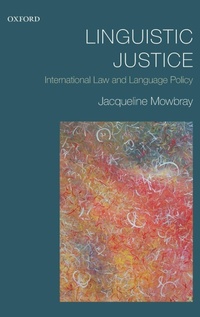
Linguistic Justice
International Law and Language Policy
Published on 25. October 2012
Book
Hardback
248 pages
978-0-19-964661-6 (ISBN)
Description
Globalization and migration are producing societies of increasing linguistic diversity. At the same time, English is achieving unprecedented global dominance, smaller languages are becoming 'extinct' at an alarming rate, and ethnic tensions in countries from Belgium to Tibet continue to centre on questions of language. Against this background, the issue of how to ensure justice between speakers of different languages becomes a pressing social concern. Matters of 'linguistic justice' are therefore drawing increasing scholarly attention across a range of disciplines.
How does international law contribute to linguistic justice? This book explores that question by conducting a comprehensive, interdisciplinary examination of international law on language, analysing the many disparate fields of international law which affect language use both directly (human rights, cultural heritage laws, and EU legislation, for example) and indirectly (international trade law and international labour standards, among others). Moving beyond the technical analysis of legal provisions, the book explores the conceptual framework which underpins international law on language, unearthing underlying assumptions and ideas about what constitutes a 'just' language policy from a legal perspective. In doing so, the book draws on the methodology of sociologist Pierre Bourdieu, whose ideas of 'habitus' and 'field' offer a way of understanding the changing significance of language to human identity, and the way in which language becomes a focal point for the exercise of social power. This analysis reveals the limitations of contemporary international law on language, and charts a course towards the achievement of greater 'linguistic justice'.
How does international law contribute to linguistic justice? This book explores that question by conducting a comprehensive, interdisciplinary examination of international law on language, analysing the many disparate fields of international law which affect language use both directly (human rights, cultural heritage laws, and EU legislation, for example) and indirectly (international trade law and international labour standards, among others). Moving beyond the technical analysis of legal provisions, the book explores the conceptual framework which underpins international law on language, unearthing underlying assumptions and ideas about what constitutes a 'just' language policy from a legal perspective. In doing so, the book draws on the methodology of sociologist Pierre Bourdieu, whose ideas of 'habitus' and 'field' offer a way of understanding the changing significance of language to human identity, and the way in which language becomes a focal point for the exercise of social power. This analysis reveals the limitations of contemporary international law on language, and charts a course towards the achievement of greater 'linguistic justice'.
More details
Language
English
Place of publication
Oxford
United Kingdom
Target group
College/higher education
Dimensions
Height: 240 mm
Width: 161 mm
Thickness: 18 mm
Weight
540 gr
ISBN-13
978-0-19-964661-6 (9780199646616)
Copyright in bibliographic data and cover images is held by Nielsen Book Services Limited or by the publishers or by their respective licensors: all rights reserved.
Schweitzer Classification
Other editions
Additional editions
Jacqueline Mowbray
Linguistic Justice: International Law and Language Policy
International Law and Language Policy
E-Book
10/2012
1st Edition
OUP Oxford
€123.49
Available for download
Jacqueline Mowbray
Linguistic Justice: International Law and Language Policy
International Law and Language Policy
E-Book
10/2012
1st Edition
OUP Oxford
€138.89
Available for download
Person
Jacqueline Mowbray is a Senior Lecturer in Law at the University of Sydney. She also teaches on the European Regional Master's Degree in Democracy and Human Rights in South-East Europe, based in Sarajevo. She is a graduate of the Universities of Queensland (BA/LLB (Hons)), Melbourne (LLM) and Cambridge (LLM (Hons), PhD).
Content
Introduction ; 1. Language in Education: Context and Complexity ; 2. Language in Culture and the Media: Complexity and Change ; 3. Language and Work: Systematic Disadvantage ; 4. Language and the State: The Politics of Language ; 5. Language and Participation in Public Life: Democracy and Doxa ; Conclusion