

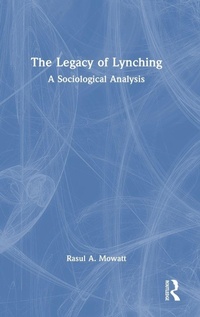
The Legacy of Lynching
A Sociological Analysis
1st Edition
Will be published approx. on 31. July 2026
Book
Hardback
368 pages
978-1-041-26758-4 (ISBN)
Description
The Legacy of Lynching provides a critical social theory of the history of lynching as a pedagogy of social and political violence, power, and control (to identify-find-kill-display the body of the racial Other). The theory emphasizes the final stage of display as what truly constitutes a lynching and differentiates it from other forms of violence (race riots, recreational murder, racial hunting, bombings, and disappearances) and challenges other definitions of lynching (hanging, mob violence, extra-judicial, and racial terror). The book examines the socio-historical record of lynching in the United States, with additional attention to lynching activity and imagery of Australia, Britain, France, Germany, and India, to surface the nature of lynching as a public spectacle with important critical social and political dimensions that enact power in visible ways across racialized bodies, peoples, and spaces.
Lynching, in this book, is presented not just as a historical phenomenon or as a set of artifacts (picture postcards, shreds of clothing, pieces of rope, and other ephemeral), but also as a cultural production of State power and control that shapes social and political institutions, public spaces, and social memory. This socio-historical record of lynching, as such, reveals not only the mechanisms of previous instantiations of racialized power schemas (pogroms, ethnic cleansing, and genocide) but also the ongoing encoding of control and colonization of public life. Through a thorough re-reading and reworking of the history of lynching and its ongoing, contemporary afterlife, the book reconceptualizes the nature and ramifications of the phenomenon in various forms of media like film, television, social media platforms, gaming, graphic novels, fictional novellas, and even fashion. As such, it will be an important resource for podcasters, journalists, students, instructors, researchers, and readers in sociology, social theory, political sociology, historical sociology, American history and American studies, cultural studies, Race and ethnicity studies, and geography.
Lynching, in this book, is presented not just as a historical phenomenon or as a set of artifacts (picture postcards, shreds of clothing, pieces of rope, and other ephemeral), but also as a cultural production of State power and control that shapes social and political institutions, public spaces, and social memory. This socio-historical record of lynching, as such, reveals not only the mechanisms of previous instantiations of racialized power schemas (pogroms, ethnic cleansing, and genocide) but also the ongoing encoding of control and colonization of public life. Through a thorough re-reading and reworking of the history of lynching and its ongoing, contemporary afterlife, the book reconceptualizes the nature and ramifications of the phenomenon in various forms of media like film, television, social media platforms, gaming, graphic novels, fictional novellas, and even fashion. As such, it will be an important resource for podcasters, journalists, students, instructors, researchers, and readers in sociology, social theory, political sociology, historical sociology, American history and American studies, cultural studies, Race and ethnicity studies, and geography.
Reviews / Votes
'Rasul Mowatt's A Legacy of Lynching could not have arrived at a more needed time to discursively and materially confront the organized disvowal of racialized violence in the United States. It is written with great moral clarity, urgency, and copious illustration connecting the spectacle of lynching to the history of the banality of racist evil in the country. Most importantly the book gives a long perspective that connects the senseless and lawless murder of contemporary racialized African American victims such as George Floyd, Michael Brown, Breonna Taylor and Tyre Nicholls to an unequal substructure of persistent discriminatory acts, violent expropriation and exclusion. By mapping out these continuities, Mowatt forces the contemporary reader to confront the disturbing and unfinished history of racial terror and its persistent afterlife in present day America.'-Cameron McCarthy, Emeritus Professor, Center for Global Studies and College of Education's Educational Policy, Leadership & Organization, University of Illinois at Urbana-Champaign, author of World of Contradictions: Culture and Identity in the Roiling of Globalizations and Spaces of New Colonialism: Reading Schools, Museums, and Cities in the Tumult of Globalization.
'The Legacy of Lynching is a sober, yet necessary examination of an often misunderstood American tradition. Not only does Rasul Mowatt manage to debunk many of our preconceived notions about this phenomenon, but his work adds historical context, human perspective and factual evidence that will enlighten every reader.'
-Michael Harriot, journalist, public historian, and author of the New York Times' best selling, Black AF History: The Un-Whitewashed Story of America.
More details
Language
English
Place of publication
London
United Kingdom
Publishing group
Taylor & Francis Ltd
Target group
College/higher education
Professional and scholarly
Academic, Undergraduate Advanced, and Undergraduate Core
Illustrations
195 s/w Photographien bzw. Rasterbilder, 195 s/w Abbildungen
195 Halftones, black and white; 195 Illustrations, black and white
Dimensions
Height: 234 mm
Width: 156 mm
ISBN-13
978-1-041-26758-4 (9781041267584)
Copyright in bibliographic data and cover images is held by Nielsen Book Services Limited or by the publishers or by their respective licensors: all rights reserved.
Schweitzer Classification
Other editions
Additional editions
E-Book
approx. 07/2026
Routledge
€32.99
Available for download
Book
approx. 07/2026
1st Edition
Routledge
€31.50
Not yet published
E-Book
approx. 07/2026
Routledge
€32.99
Available for download
Person
Rasul A. Mowatt is Professor and Researcher who studies State violence and the geographies of Race for the Department of Sociology and Anthropology at North Carolina State's College of Humanities and Social Sciences, USA. Before joining NC State, Rasul served on Indiana University's faculty in the Departments of American Studies and Geography for 17 years and previously taught at the University of Illinois, Urbana-Champaign. He is the author of The Geographies of Threat and the Production of Violence (2021), co-author of Laundering Black Rage: The Washing of Black Death, People, Property, and Profits (2024) and The City of Hip-Hop: New York, the Bronx, and a Peace Meeting (2025).
Content
Introduction: A Legacy of Lynching 1. The Culture of Lynching 2. The History of Lynching 3. The Nation of Lynching 4. The Research of Lynching 5. The Memory of Lynching 6. The Protest of Lynching 7. The Message of Lynching 8. The Geography of Lynching Conclusion: The Lies of Lynching