

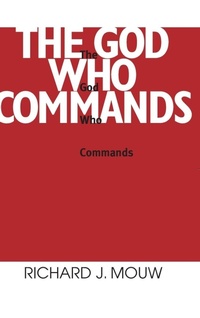
God Who Commands, the
Published on 31. January 1990
Book
Hardback
222 pages
978-0-268-01019-5 (ISBN)
Description
In this book Richard J. Mouw, one of the foremost thinkers in the field of Christian ethics, develops a constructive theological ethic, employing primarily Calvinist themes. Exploring issues that are at the intersection of philosophical and theological discussions, he sets forth an ethical perspective in which obedience to divine commands occupies a central place.
After responding to some secularist objections to divine command theory, Mouw looks at the ways in which treatments of divine authority relate to contemporary philosophical discussions of moral justification. He then discusses the divine command perspective, turning to a specific examination of the Reformation emphasis on "naked selfhood." He defends Reformational selfhood against critiques of Protestantism and explores the differences and similarities between the conceptions of moral selfhood portrayed in classical Calvinism and recent existentialism.
Examining Protestant, and especially Calvinist, emphases on divine command, Mouw argues that a divine command perspective need not be viewed as antithetical to the claims made by recent defenders of "narrativist" ethics. He explores the ways in which differing intratrinitarian emphases influence Christian moral experience, and he argues that a strong God-the-Father emphasis needs to be supplemented by perspectives that attend more to divine "nearness," as in contemporary feminism and Pentecostalism. He concludes with some reflections on the way in which a divine command ethical perspective speaks in positive ways to the contemporary moral quest.
After responding to some secularist objections to divine command theory, Mouw looks at the ways in which treatments of divine authority relate to contemporary philosophical discussions of moral justification. He then discusses the divine command perspective, turning to a specific examination of the Reformation emphasis on "naked selfhood." He defends Reformational selfhood against critiques of Protestantism and explores the differences and similarities between the conceptions of moral selfhood portrayed in classical Calvinism and recent existentialism.
Examining Protestant, and especially Calvinist, emphases on divine command, Mouw argues that a divine command perspective need not be viewed as antithetical to the claims made by recent defenders of "narrativist" ethics. He explores the ways in which differing intratrinitarian emphases influence Christian moral experience, and he argues that a strong God-the-Father emphasis needs to be supplemented by perspectives that attend more to divine "nearness," as in contemporary feminism and Pentecostalism. He concludes with some reflections on the way in which a divine command ethical perspective speaks in positive ways to the contemporary moral quest.
Reviews / Votes
"...a striking and first-rate contribution to contemporary ethics...for those who wish to understand what is most distinctive and most compelling in the development of Calvinist ethics." -Alasdair MacIntyre, University of Notre Dame"Mouw's way of posing the complex issues in fresh clear ways always illumines them, and his incisive distinctions and insights will challenge others to revise their understandings of divine command ethics." -The Journal of Religion
"Mouw succeeds admirably in his fundamental task of elucidating the Calvinist tradition of ethics. . . . Those who take the Reformed tradition seriously, or those who wish to understand it, would do well to consult this work." -Theology Today
"This is an excellent book, astutely crafted and argued. Mouw has reintroduced divine command morality to contemporary Christian ethics, and his work should be central in the dialogue he encourages." -The Christian Century
"Mouw's book is a valuable contribution to contemporary ethics by a scholar whose profound love for the God of revelation is evident on every page." -New Oxford Review
"Richard Mouw probes, from a Calvinist tradition, the place of obedience to a divine command. . . . Mouw suggests that a Calvinist perspective on moral theology can profit from an openness to some contemporary developments, particularly narrativist ethics, feminist thought and the insights gained from the charismatic movement." -America
More details
Language
English
Place of publication
Notre Dame IN
United States
Target group
College/higher education
Dimensions
Height: 235 mm
Width: 157 mm
Thickness: 17 mm
Weight
482 gr
ISBN-13
978-0-268-01019-5 (9780268010195)
Copyright in bibliographic data and cover images is held by Nielsen Book Services Limited or by the publishers or by their respective licensors: all rights reserved.
Schweitzer Classification
Other editions
Additional editions
Richard J. Mouw
God Who Commands, the
E-Book
10/2020
1st Edition
University of Notre Dame Press
€55.99
Available for download
Person
Richard J. Mouw, provost and professor of Christian philosophy and ethics at Fuller Theological Seminary, has published many books, including Distorted Truth.