

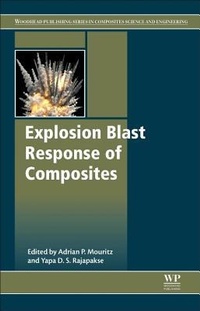
Explosion Blast Response of Composites
Published on 24. May 2017
Book
Paperback/Softback
432 pages
978-0-08-102092-0 (ISBN)
Description
Explosion Blast Response of Composites contains key information on the effects of explosions, shock waves, and detonation products (e.g. fragments, shrapnel) on the deformation and damage to composites. The book considers the blast response of laminates and sandwich composites, along with blast mitigation of composites (including coating systems and energy absorbing materials).
Broken down under the following key themes: Introduction to explosive blast response of composites, Air explosion blast response of composites, Underwater explosion blast response of composites, and High strain rate and dynamic properties of composites, the book deals with an important and contemporary topic due to the extensive use of composites in applications where explosive blasts are an ever-present threat, such as military aircraft, armoured vehicles, naval ships and submarines, body armour, and other defense applications.
In addition, the growing use of IEDs and other types of bombs used by terrorists to attack civilian and military targets highlights the need for this book. Many terrorist attacks occur in subways, trains, buses, aircraft, buildings, and other civil infrastructure made of composite materials. Designers, engineers and terrorist experts need the essential information to protect civilians, military personnel, and assets from explosive blasts.
Broken down under the following key themes: Introduction to explosive blast response of composites, Air explosion blast response of composites, Underwater explosion blast response of composites, and High strain rate and dynamic properties of composites, the book deals with an important and contemporary topic due to the extensive use of composites in applications where explosive blasts are an ever-present threat, such as military aircraft, armoured vehicles, naval ships and submarines, body armour, and other defense applications.
In addition, the growing use of IEDs and other types of bombs used by terrorists to attack civilian and military targets highlights the need for this book. Many terrorist attacks occur in subways, trains, buses, aircraft, buildings, and other civil infrastructure made of composite materials. Designers, engineers and terrorist experts need the essential information to protect civilians, military personnel, and assets from explosive blasts.
More details
Language
English
Place of publication
Cambridge
United Kingdom
Publishing group
Elsevier Science & Technology
Target group
Professional and scholarly
Designers and manufacturing industry of composites for aircraft, rail carriages, ships, buildings, bridges, and body armour, armoured vehicles; Researchers in composite materials, composite structures, energy absorbing systems, dynamic and high strain rate, safety and reliability; Homeland security and military and defence agencies
Product notice
Paperback (trade)
Unsewn / adhesive bound
Dimensions
Height: 228 mm
Width: 149 mm
Thickness: 25 mm
Weight
808 gr
ISBN-13
978-0-08-102092-0 (9780081020920)
Copyright in bibliographic data and cover images is held by Nielsen Book Services Limited or by the publishers or by their respective licensors: all rights reserved.
Schweitzer Classification
Other editions
Additional editions
Adrian P. Mouritz | Yapa D. S. Rajapakse
Explosion Blast Response of Composites
E-Book
05/2017
Woodhead Publishing
€275.00
Available for download
Persons
Professor Mouritz is a world-leading expert on composite materials, having worked in field as an academic and defence researcher for over 25 years and published 5 books, nearly 20 book chapters and over 150 journal papers on composites. Dr Mouritz is a leading authority on the explosive blast response of composite materials and structures. Dr. Rajapakse is a world-leading expert on composite materials for naval ships, and has led the solid mechanics research program at the United States Office of Naval Research for over 20 years. Dr Rajapakse has led one of the largest research programs into the explosive blast response and blast mitigation of composite materials.
Content
1. Introduction to explosive blast loading of composites
2. Physics of air, underwater and fragmentation blast loading of structures
3. Blast impact survivability - A life of deforming, fracturing and fragmenting
4. Blast loading of fibre reinforced composite structures
5. Response of glass fibre reinforced polymer laminates and sandwich structures to explosive blast loading in air
6. The dynamic behaviour of composite panels subjected to air blast loading: Experiment and theory
7. Effect of explosive blast loading on the microstructure of polymer composites and sandwich structures
8. Computational methods to predict the non-linear dynamic response of blast loaded laminated composite plates
9. Computational modeling of damage in heterogeneous materials at micro/meso length scales under shock loading
10. Explosive blast response of composites following seawater immersion
11. Comparative assessment of the explosive blast response of composite and metals used on naval ships
12. Design and modelling of bio-inspired lightweight composite panels for blast and impact resistance
13. Air and underwater blast performance of composite materials
14. Observations and modelling of the response of composite plates to underwater blast
15. Shock initiated damage and instabilities in underwater structures
16. Analytical and computational modelling of the response of composite plates to underwater blast
17. Experimental techniques and testing of lightweight naval structures against primary weapons effects
18. High strain rate and blast response of syntactic foam cores and sandwich composites
19. Study of hydrodynamic ram effect on composite structures
20. Blast mitigation of defence structures using protective water containers
2. Physics of air, underwater and fragmentation blast loading of structures
3. Blast impact survivability - A life of deforming, fracturing and fragmenting
4. Blast loading of fibre reinforced composite structures
5. Response of glass fibre reinforced polymer laminates and sandwich structures to explosive blast loading in air
6. The dynamic behaviour of composite panels subjected to air blast loading: Experiment and theory
7. Effect of explosive blast loading on the microstructure of polymer composites and sandwich structures
8. Computational methods to predict the non-linear dynamic response of blast loaded laminated composite plates
9. Computational modeling of damage in heterogeneous materials at micro/meso length scales under shock loading
10. Explosive blast response of composites following seawater immersion
11. Comparative assessment of the explosive blast response of composite and metals used on naval ships
12. Design and modelling of bio-inspired lightweight composite panels for blast and impact resistance
13. Air and underwater blast performance of composite materials
14. Observations and modelling of the response of composite plates to underwater blast
15. Shock initiated damage and instabilities in underwater structures
16. Analytical and computational modelling of the response of composite plates to underwater blast
17. Experimental techniques and testing of lightweight naval structures against primary weapons effects
18. High strain rate and blast response of syntactic foam cores and sandwich composites
19. Study of hydrodynamic ram effect on composite structures
20. Blast mitigation of defence structures using protective water containers