

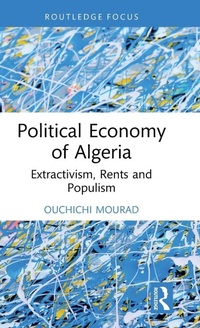
Political Economy of Algeria
Extractivism, Rents and Populism
1st Edition
Will be published approx. on 18. December 2025
Book
Hardback
120 pages
978-1-041-12592-1 (ISBN)
Description
Algeria, the largest country in North Africa, is geopolitically significant due to its strategic location and natural resources. Despite its potential, the country remains entrenched in a rent-based economy, heavily dependent on hydrocarbon exports, a situation that has persisted since its independence in 1962.
This book provides a comprehensive analysis of Algeria's complex politico-economic system, focusing on its rentier and extractivist nature. The study examines the historical evolution of Algeria's economy, beginning with the ambitious yet ultimately unsuccessful industrialization efforts of the 1960s and 1970s. This failure led to the country's specialization in the extraction and export of hydrocarbons. Subsequent reforms aimed at transitioning to a market economy have failed to break the country's dependency on oil revenues, instead deepening its rentier and extractivist characteristics. The book critically explores the limitations of applying conventional economic and political science frameworks to analyze the Algerian economy. It argues that these disciplines, developed within the context of Western capitalism, are insufficient to fully capture the unique dynamics of an economy like Algeria's, where the market plays a marginal role, and state-controlled rents dominate wealth distribution. To address these challenges, the book adopts the concept of extractivism, originally developed in Latin American contexts, to better understand the interplay between political struggles, social movements, and economic practices in Algeria. It posits that Algeria is both a rentier and an extractivist state, with these two aspects reinforcing each other and hindering the development of a productive economy.
The book will be of interest to readers of political economy, Middle East and North African studies and international politics.
This book provides a comprehensive analysis of Algeria's complex politico-economic system, focusing on its rentier and extractivist nature. The study examines the historical evolution of Algeria's economy, beginning with the ambitious yet ultimately unsuccessful industrialization efforts of the 1960s and 1970s. This failure led to the country's specialization in the extraction and export of hydrocarbons. Subsequent reforms aimed at transitioning to a market economy have failed to break the country's dependency on oil revenues, instead deepening its rentier and extractivist characteristics. The book critically explores the limitations of applying conventional economic and political science frameworks to analyze the Algerian economy. It argues that these disciplines, developed within the context of Western capitalism, are insufficient to fully capture the unique dynamics of an economy like Algeria's, where the market plays a marginal role, and state-controlled rents dominate wealth distribution. To address these challenges, the book adopts the concept of extractivism, originally developed in Latin American contexts, to better understand the interplay between political struggles, social movements, and economic practices in Algeria. It posits that Algeria is both a rentier and an extractivist state, with these two aspects reinforcing each other and hindering the development of a productive economy.
The book will be of interest to readers of political economy, Middle East and North African studies and international politics.
More details
Series
Language
English
Place of publication
London
United Kingdom
Publishing group
Taylor & Francis Ltd
Target group
College/higher education
Professional and scholarly
Academic and Postgraduate
Illustrations
10 s/w Tabellen, 19 s/w Zeichnungen, 5 s/w Photographien bzw. Rasterbilder, 24 s/w Abbildungen
10 Tables, black and white; 19 Line drawings, black and white; 5 Halftones, black and white; 24 Illustrations, black and white
Dimensions
Height: 222 mm
Width: 145 mm
Thickness: 11 mm
Weight
319 gr
ISBN-13
978-1-041-12592-1 (9781041125921)
Copyright in bibliographic data and cover images is held by Nielsen Book Services Limited or by the publishers or by their respective licensors: all rights reserved.
Schweitzer Classification
Other editions
Additional editions
E-Book
12/2025
1st Edition
Routledge
€31.49
Available for download
E-Book
12/2025
1st Edition
Routledge
€31.49
Available for download
Person
Mourad Ouchichi is a professor of political science, born on October 7, 1975, in Ath Laaziz, Bouira, Algeria. He is currently a lecturer at the University of Bejaia, Algeria. Professor Ouchichi pursued academic research in economics with a specialization in development studies and earned a PhD in political science from the Institute of Political Studies in Lyon, France.
With a dual background in economics and political science, his research primarily explores development-related issues through the lens of institutional analysis. His scholarly work focuses particularly on the dynamics of rentier states, with a special emphasis on the North African context. He is also engaged in comparative research on the sociology of state economic practices.
Professor Ouchichi has contributed to numerous collaborative publications in both Algeria and France and has authored many scientific articles.
With a dual background in economics and political science, his research primarily explores development-related issues through the lens of institutional analysis. His scholarly work focuses particularly on the dynamics of rentier states, with a special emphasis on the North African context. He is also engaged in comparative research on the sociology of state economic practices.
Professor Ouchichi has contributed to numerous collaborative publications in both Algeria and France and has authored many scientific articles.
Content
Introduction 1. Extractivism, the resource curse and the vicissitudes of the rentier State: introductory thoughts 2. Is Algeria an extractive and rentier country? Statistics to prove it 3. The administered economy: 1962-1988 4. From structural adjustment to the transition freeze (1994-2023) 5. Renewable s energy development policies in Algeria: towards the reinforcement of rents? Conclusion Index