

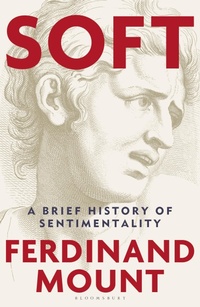
Soft
A Brief History of Sentimentality
Published on 11. September 2025
Book
Hardback
320 pages
978-1-3994-2188-1 (ISBN)
Description
'[An] erudite, immensely entertaining book...Mount makes for a delightful guide' -- Literary Review
From troubadours to Twitter: a thousand years of feelings, fads and furious sentiment, from renowned essayist Ferdinand Mount.
Whatever we think we feel, you can be sure that the past has had a part to play in it. In Soft, Ferdinand Mount tells the millennium-long history of emotion through delightful snapshots, often mischievous storytelling and a masterly command of history.
Mount explores the shifting importance societies have placed on empathy for the misfortunes of others. Each seismic moment, Mount argues, from the French Revolution to Civil Rights, has had a corresponding sentimental revolution that has fuelled great political turning points and come to define human civilization.
But no one wants to be accused of being sentimental; its detractors call it soppy, effeminate and populist - the stuff of soap operas and pop songs. The Reformation tried to stamp out excessive emotion, the Victorians resolutely maintained their stiff upper lips and no one loathed sentimentality more than the modernists - and yet, today, Mount argues it is not the stoics who are ruling the roost: we are living in an age of emotion.
From the Occitan poets of the 12th century to Paul McCartney' songs, and modern debates around woke, this is a witty insight into the story of emotions and the way they have swayed human history.
From troubadours to Twitter: a thousand years of feelings, fads and furious sentiment, from renowned essayist Ferdinand Mount.
Whatever we think we feel, you can be sure that the past has had a part to play in it. In Soft, Ferdinand Mount tells the millennium-long history of emotion through delightful snapshots, often mischievous storytelling and a masterly command of history.
Mount explores the shifting importance societies have placed on empathy for the misfortunes of others. Each seismic moment, Mount argues, from the French Revolution to Civil Rights, has had a corresponding sentimental revolution that has fuelled great political turning points and come to define human civilization.
But no one wants to be accused of being sentimental; its detractors call it soppy, effeminate and populist - the stuff of soap operas and pop songs. The Reformation tried to stamp out excessive emotion, the Victorians resolutely maintained their stiff upper lips and no one loathed sentimentality more than the modernists - and yet, today, Mount argues it is not the stoics who are ruling the roost: we are living in an age of emotion.
From the Occitan poets of the 12th century to Paul McCartney' songs, and modern debates around woke, this is a witty insight into the story of emotions and the way they have swayed human history.
Reviews / Votes
Reads like an elegant love letter to the human heart itself. * The Spectator * Mount's canvas is far broader and more densely crowded than is indicated by this brief review. There is much to agree with in the book...Again and again he refutes the doomsters and the naysayers, and does so with good humour, warmth and wit. -- John Banville * The Times * Mount is absolutely gripping when he writes about the historical backlashes against sentimentalism. * Telegraph * Soft is a compassionate, compelling and entertainingly eccentric survey of collective psychology and the madness of crowds. -- Frances Wilson * TLS * As cultural criticism, Soft is persuasively entertaining. -- Hannah Rose Woods * Observer * [An] erudite, immensely entertaining book...Mount makes for a delightful guide. * Literary Review * Highly readable... Splendidly readable...written with his characteristic verve and style, Mount's book...is timely. * Financial Times * [A] superb study. * The Tablet * [An] erudite, immensely entertaining book... I have seldom read a work of cultural history that made me laugh out loud as frequently as this one did... * News Beep * A magisterial, personal reflection on the freedom to express our feelings in all their gushy beauty. * Kirkus Reviews * This is both a thoughtful study and, as befits its subject, frequently moving. -- Richard Sennett * TLS Books of the Year 2025 * Witty, robust defence of the power of sentimentality to effect change. * Irish Examiner * I didn't cry after reading this splendid book, but I was entertained and I did laugh quite a lot. * Church Times *More details
Language
English
Place of publication
London
United Kingdom
Publishing group
Bloomsbury Publishing PLC
Product notice
With dust jacket
Illustrations
34 black and white images interspersed throughout the book.
Dimensions
Height: 242 mm
Width: 157 mm
Thickness: 31 mm
Weight
520 gr
ISBN-13
978-1-3994-2188-1 (9781399421881)
Copyright in bibliographic data and cover images is held by Nielsen Book Services Limited or by the publishers or by their respective licensors: all rights reserved.
Schweitzer Classification
Other editions
Additional editions
E-Book
09/2025
1st Edition
Bloomsbury Continuum
€16.99
Available for download
Person
Ferdinand Mount was Political Editor of The Spectator and Editor of The Times Literary Supplement. For two years he was head of Margaret Thatcher's think-tank - The Number 10 Policy Unit. He is an authority on politics today, and writes regularly for The Times Literary Supplement and the London Review of Books.
His most recent titles include Kiss Myself Goodbye: The Many Lives of Aunt Munca and Big Caesars and Little Caesars: How They Rise and How They Fall, from Julius Caesar to Boris Johnson.
His most recent titles include Kiss Myself Goodbye: The Many Lives of Aunt Munca and Big Caesars and Little Caesars: How They Rise and How They Fall, from Julius Caesar to Boris Johnson.
Content
Introduction: The Unforgivable Sin
CHAPTER ONE: The First Sentimental Revolution
Inventing Love - Passionate about the Passion - This Vale of Tears - The Power of Soft
CHAPTER TWO: The New Stony Age
A Lament for Walsingham - The Dowsing Rod - Chilling with Michelangelo
CHAPTER THREE: The Second Sentimental Revolution
The Man Who Invented Me Too - Love Divine, All Loves Excelling - The Continental Version - The Dawn of Toleration - The
Three Scottish Sympathizers - Movers, Shakers and Quakers
CHAPTER FOUR: Manliness Rules OK
Reacting into Reaction - Women Can Be Manly, Too - The Dry Imperial Eye
CHAPTER FIVE: Mr Popular Sentiment
The Case of Charles Dickens - Uncle Tom and Aunt Phillis - Victor Hugo, Helas!
CHAPTER SIX: The Great Estranging
The Dilemma of The Doctor - On or About December 1910 - The Revolt Against the Masses
CHAPTER SEVEN: The Third Sentimental Revolution
1963 and All That - It's a Private Matter - It's a Crime to Discriminate - Murdered for a Song - Tears on the Turf - 6 September 1997
Picture Credits and Permissions
Notes
Further Reading
Acknowledgements
Index
CHAPTER ONE: The First Sentimental Revolution
Inventing Love - Passionate about the Passion - This Vale of Tears - The Power of Soft
CHAPTER TWO: The New Stony Age
A Lament for Walsingham - The Dowsing Rod - Chilling with Michelangelo
CHAPTER THREE: The Second Sentimental Revolution
The Man Who Invented Me Too - Love Divine, All Loves Excelling - The Continental Version - The Dawn of Toleration - The
Three Scottish Sympathizers - Movers, Shakers and Quakers
CHAPTER FOUR: Manliness Rules OK
Reacting into Reaction - Women Can Be Manly, Too - The Dry Imperial Eye
CHAPTER FIVE: Mr Popular Sentiment
The Case of Charles Dickens - Uncle Tom and Aunt Phillis - Victor Hugo, Helas!
CHAPTER SIX: The Great Estranging
The Dilemma of The Doctor - On or About December 1910 - The Revolt Against the Masses
CHAPTER SEVEN: The Third Sentimental Revolution
1963 and All That - It's a Private Matter - It's a Crime to Discriminate - Murdered for a Song - Tears on the Turf - 6 September 1997
Picture Credits and Permissions
Notes
Further Reading
Acknowledgements
Index