

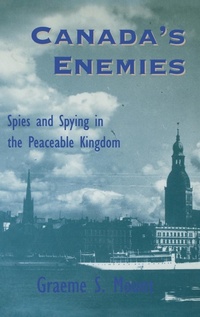
Canada's Enemies
Spies and Spying in the Peaceable Kingdom
Will be published approx. on 25. February 1993
Book
Hardback
160 pages
978-1-55002-190-5 (ISBN)
Description
In 1898, Spanish spies based in Montreal, Halifax, and Victoria monitored the United States war effort against their homeland, while U.S. counter-intelligence officials watched the Spaniards. Neither the Americans nor the Spaniards sought Canadian permission for these activities.
Britain's enemies (and often America's enemies) have also been Canada's enemies. Without the heroic counter-intelligence of the mysterious Agent X, Irish Americans at the turn of the century might have blasted British Columbia's legislature and the Esquimalt naval base the way they blasted the Welland Canal.
During World War I, counter-intelligence failed to stop German agents who bombed the Windsor-Walkerville area as well as the CPR bridge on the Maine-New Brunswick border. Meanwhile, Canadian security officials ran around in a state of frantic frustration because of German "conspiracies" along the Ontario-New York State border imagined by Sir Courtney bennett, British consul-general in New york City. After the war, American moles in a Latvian post office monitored mail between Canadian Communists and Moscow.
In the thirties, a Finnish-Canadian clergyman spied on Sudbury's Red Finns for the United States consultate inNorth Bay, and Hitler's consuls maintained surveillance of Canadian politicians and German dissidents in Canada. During World War II, Canadian authorities intercepted the mail of envoys from Vichy-France, suspected of spying for Germany, and from Franco's Spain, suspected of spying for Japan.
In the 1960s, the CIA not only observed Cubans in Canada, but also watched the situation in Quebec and used a Canadian diplomat to collect information on North Vietnam.
Some of this history has merged from previously ignored and newly declassified documents from European, American, and Canadian archives. These newly revealed details show that Canada is an interesting place, both for what Canadians do elsewhere and for what foreigners do in Canada. Also, once readers have seen the kinds of activities in which friends engage, they may be less surprised at what enemies have done.
Britain's enemies (and often America's enemies) have also been Canada's enemies. Without the heroic counter-intelligence of the mysterious Agent X, Irish Americans at the turn of the century might have blasted British Columbia's legislature and the Esquimalt naval base the way they blasted the Welland Canal.
During World War I, counter-intelligence failed to stop German agents who bombed the Windsor-Walkerville area as well as the CPR bridge on the Maine-New Brunswick border. Meanwhile, Canadian security officials ran around in a state of frantic frustration because of German "conspiracies" along the Ontario-New York State border imagined by Sir Courtney bennett, British consul-general in New york City. After the war, American moles in a Latvian post office monitored mail between Canadian Communists and Moscow.
In the thirties, a Finnish-Canadian clergyman spied on Sudbury's Red Finns for the United States consultate inNorth Bay, and Hitler's consuls maintained surveillance of Canadian politicians and German dissidents in Canada. During World War II, Canadian authorities intercepted the mail of envoys from Vichy-France, suspected of spying for Germany, and from Franco's Spain, suspected of spying for Japan.
In the 1960s, the CIA not only observed Cubans in Canada, but also watched the situation in Quebec and used a Canadian diplomat to collect information on North Vietnam.
Some of this history has merged from previously ignored and newly declassified documents from European, American, and Canadian archives. These newly revealed details show that Canada is an interesting place, both for what Canadians do elsewhere and for what foreigners do in Canada. Also, once readers have seen the kinds of activities in which friends engage, they may be less surprised at what enemies have done.
Reviews / Votes
"Graeme S. Mount's book on 'spies and spying' in Canada shows the surprising paucity of effort by and against the country." * Greenwich Times *More details
Language
English
Place of publication
Toronto
Canada
Target group
Professional and scholarly
Product notice
Cloth over boards
Dimensions
Height: 240 mm
Width: 161 mm
Thickness: 14 mm
Weight
440 gr
ISBN-13
978-1-55002-190-5 (9781550021905)
Copyright in bibliographic data and cover images is held by Nielsen Book Services Limited or by the publishers or by their respective licensors: all rights reserved.
Schweitzer Classification
Other editions
Additional editions
E-Book
01/1993
Dundurn Press
€9.49
Available for download
E-Book
01/1993
1st Edition
Dundurn
€33.49
Available for download
Person
Graeme S. Mount has taught at Laurentian university, Sudbury, Ontario, since 1969; he has been a professor in the hsitory department since 1985. While co-authoring An Introduction to Canadian-American Relations with E.E. Mahant, he became interested in intelligence history. Professor Mount is married and has two sons.
Content
Foreword; The Huis and Where They Came From; The Formation of the Hui Zu; The Fate of the Hui During and After the Qing Dynasty; Further Assimilation of Minorities and its effects of Muslims; How the Hui Zu Lives in China; Influential Muslim Personalities; Admiral Zheng He and His Achievements; Contributions of the Chinese Muslims; The Staunchness of the Chinese Muslims.