

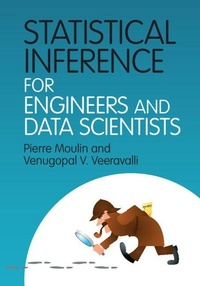
Statistical Inference for Engineers and Data Scientists
Published on 22. November 2018
Book
Hardback
418 pages
978-1-107-18592-0 (ISBN)
Description
This book is a mathematically accessible and up-to-date introduction to the tools needed to address modern inference problems in engineering and data science, ideal for graduate students taking courses on statistical inference and detection and estimation, and an invaluable reference for researchers and professionals. With a wealth of illustrations and examples to explain the key features of the theory and to connect with real-world applications, additional material to explore more advanced concepts, and numerous end-of-chapter problems to test the reader's knowledge, this textbook is the 'go-to' guide for learning about the core principles of statistical inference and its application in engineering and data science. The password-protected solutions manual and the image gallery from the book are available online.
Reviews / Votes
'This book presents a rigorous and comprehensive coverage of the concepts underlying modern statistical inference, and provides a lucid exposition of the fundamental concepts. A distinguishing feature of the book is the large number of thoughtfully constructed examples, which go a long way towards aiding the reader in understanding and assimilating the concepts. As no particular domain expertise is assumed other than probability theory, the book should be widely accessible to a broad readership.' Kannan Ramchandran, University of California, Berkeley 'A wide-ranging, rigorous, yet accessible account of hypothesis testing and estimation, the pillars of statistical signal processing, communications, and data science at large.' Tsachy Weissman, STMicroelectronics Chair, Founding Director of the Stanford Compression Forum, Stanford University, CaliforniaMore details
Language
English
Place of publication
Cambridge
United Kingdom
Target group
Professional and scholarly
Illustrations
Worked examples or Exercises
Dimensions
Height: 250 mm
Width: 175 mm
Thickness: 27 mm
Weight
904 gr
ISBN-13
978-1-107-18592-0 (9781107185920)
Copyright in bibliographic data and cover images is held by Nielsen Book Services Limited or by the publishers or by their respective licensors: all rights reserved.
Schweitzer Classification
Other editions
Additional editions
Pierre Moulin | Venugopal V. Veeravalli
Statistical Inference for Engineers and Data Scientists
E-Book
11/2018
Cambridge University Press
€64.99
Available for download
Pierre Moulin
Statistical Inference for Engineers and Data Scientists
E-Book
11/2018
Cambridge University Press
€55.49
Available for download
Persons
Pierre Moulin is a professor in the ECE Department at the University of Illinois, Urbana-Champaign. His research interests include statistical inference, machine learning, detection and estimation theory, information theory, statistical signal, image, and video processing, and information security. Moulin is a Fellow of the Institute of Electrical and Electronics Engineers (IEEE), and served as a Distinguished Lecturer for the IEEE Signal Processing Society. He has received two best paper awards from the IEEE Signal Processing Society and the US National Science Foundation CAREER Award. He was founding Editor-in-Chief of the IEEE Transactions on Information Security and Forensics. Venugopal V. Veeravalli is the Henry Magnuski Professor in the ECE Department at the University of Illinois, Urbana-Champaign. His research interests include statistical inference and machine learning, detection and estimation theory, and information theory, with applications to data science, wireless communications and sensor networks. Veeravalli is a Fellow of the Institute of Electrical and Electronics Engineers (IEEE), and served as a Distinguished Lecturer for the IEEE Signal Processing Society. Among the awards he has received are the IEEE Browder J. Thompson Best Paper Award, the National Science Foundation CAREER Award, the Presidential Early Career Award for Scientists and Engineers (PECASE), and the Wald Prize in Sequential Analysis.
Content
1. Introduction; Part I. Hypothesis Testing: 2. Binary hypothesis testing; 3. Multiple hypothesis testing; 4. Composite hypothesis testing; 5. Signal detection; 6. Convex statistical distances; 7. Performance bounds for hypothesis testing; 8. Large deviations and error exponents for hypothesis testing; 9. Sequential and quickest change detection; 10. Detection of random processes; Part II. Estimation: 11. Bayesian parameter estimation; 12. Minimum variance unbiased estimation; 13. Information inequality and Cramer-Rao lower bound; 14. Maximum likelihood estimation; 15. Signal estimation.