

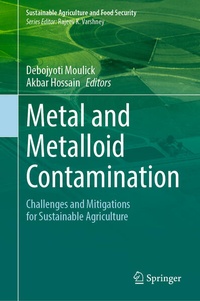
Metal and Metalloid Contamination
Description
This book brings together the consequences and mitigation strategies of metal and metalloid contamination in agroecosystem alone or in combinations with adversities imposed by climate fluctuations. It explores the molecular responses of crops to metal exposure on a genomic, transcriptomic and metabolomic levels. It also discusses the complex interactions between reactive oxygen, nitrogen, and sulfur species and heavy metal toxicity while highlighting the pivotal role of secondary metabolites in mitigating this metal-induced toxicity and accumulation. Further, the book also covers defense mechanisms in crops, and the impact of soil supplements and nanotechnology-based interventions in reducing metal toxicity. It also explores the power of artificial intelligence, machine learning and IoT-driven technologies in detecting and monitoring this environmental pollution. Finally, it implements bioavailability-based risk assessments for soil heavy metals and discusses the strategies to mitigate the consequences of toxic metals contamination in the food chain.
This book is an essential resource for researchers, agronomists, environmental scientists, and policymakers dedicated to advancing sustainable agricultural practices in the face of heavy metal contamination.
More details
Other editions
Additional editions
Persons
Dr. Debojyoti Moulick is a graduate in microbiology and post-graduate in biotechnology. He was awarded M.Phil. and Ph.D. degrees in environmental science by University of Kalyani, West Bengal, India. After this, he worked as a post-doctoral fellow at Assam University, Silchar, India. Dr. Moulick has experience in biomonitoring, seed priming technology and phytotoxicity, grain quality analysis etc. in soil-water-crop agroecosystem. He has published 50+ research and review articles and book chapters with international publishers.
Dr. Akbar Hossain is presently working as a Principal Scientist at Bangladesh Wheat and Maize Research Institute (BWMRI), Bangladesh. Dr. Hossain obtained his PhD degree from the Institute of Ecology and Biological Sciences, Astrakhan State University, Astrakhan, Russian Federation and post-doc from BCKV-India. The research interest and expertise of Dr. Hossain are on climate change impact assessment on food security, plant physiology, defense mechanisms against stress, crop management, soil conservation, agricultural engineering, weed management and conservation agriculture, crop modelling etc. He has authored more than 500 national and international journal publications.
Content
Chapter 1. The interplay between climatic variables and heavy metal concentration in the agricultural soil: A review.- Chapter 2. Bio-genic, Agri-waste, and Urban-derived Biochar in minimizing HMs load in crops.- Chapter 3. Heavy metal and metalloid contamination in livestock meat in Uganda: A review of the current state, implications to the food system and potential remedies.- Chapter 4. Crop defence mechanisms (agronomic, transgenic, and CRISPR-Cas9) to alleviate/minimize metal/metalloid-induced toxicity and accumulation.- Chapter 5. Role of co-contaminants in modulating heavy metal induced toxicity and accumulation in crops.- Chapter 6. Crop Defense Mechanisms to Mitigate Heavy Metal and Metalloid Toxicity and Accumulation: Agronomic, Transgenic, and CRISPR-Cas9 Approaches.- Chapter 7. Environmental threats of agrochemicals and metals in agriculture ecosystem: Current challenges and nanotechnology-based solutions.- Chapter 8. ROS, RNS, and RSS Interactions in Heavy Metal/Metalloid Induced Toxicity and Accumulation in Plants.- Chapter 9. Role of Secondary Metabolites in Lessening Heavy Metal/Metalloid-Induced Toxicity and Accumulation.- Chapter 10. Arsenic Bioavailability in Contaminated Soils: Role of Microbial Interactions and Nano-Remediation Approaches.- Chapter 11. Role of sulfur supplements in minimizing heavy metal toxicity and accumulation in crop plants.- Chapter 12. Role of soil supplements (integrated nutrient management, biochar) in minimizing heavy metal/metalloid induced toxicity and accumulation.- Chapter 13. Nano-Selenium as a Dual-Action Agent: Heavy Metal Detoxification and Plant Growth Promoter in Polluted Agroecosystems.- Chapter 14. Chromium Tolerant Rhizosphere Microbiomes Engineered Consortia for Enhanced Bioremediation in Industrial Waste Sites.- Chapter 15. Heavy Metal Hazard: Navigating the Toxic Terrain of Food Chains and Sustainable Solutions.- Chapter 16. Crop Defense Mechanisms to Minimize Heavy Metal Induced Toxicity and Accumulation.- Chapter 17. Metal-Resilient Crops: Agronomic Innovations and Biotechnological Breakthroughs.- Chapter 18. Efficacy of Bio- and Nano-Sensors in Monitoring Heavy Metal Contamination: Innovations and Challenges.- Chapter 19. Integrative omics approaches to enhance crop tolerance to metal(loid) toxicity: unraveling molecular mechanisms and adaptive strategies.- Chapter 20. Dietary Exposure of Toxic Heavy Metals: Consequences and Mitigation Strategies.