

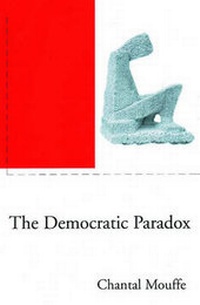
The Democratic Paradox
Published on 17. July 2000
Book
Hardback
160 pages
978-1-85984-758-9 (ISBN)
Description
From the theory of "deliberative democracy" to the politics of the "third way," the present Zeitgeist is characterised by an attempt to negate the inherently conflictual nature of democratic politics. Political thought and practice are stifled by a misconceived search fro consensus and the promotion of a bland social unanimity which, as Chantal Mouffe shows, far from being the sign of progress, constitute a serious threat for democratic institutions. Indeed, in many countries this 'consensus of the centre' is providing a platform for the growth of populist right-wing parties which, by presenting themselves as the only 'anti-establishment' forces, are trying to occupy the terrain of contestation deserted by the left.
Taking issue with the work of John Rawls and Jurgen Habermas on one side, and with the tenets of the third way as practised by Tony Blair and theorised by Anthony Giddens on the other, Mouffe brings to the fore the paradoxical nature of modern liberal democracy. Against those who affirm that, with the demise of the left/right divide, antagonism has been eliminated from contemporary post-industrial societies and that an all-inclusive politics has become possible, she argues that the category of the 'adversary' plays a central role in the very dynamics of modern democracy. Drawing on the work of Wittgenstein and Derrida, and engaging with the provocative theses of Carl Schmitt, she proposes a new understanding of democracy in terms of 'agonistic pluralism' which acknowledges the ineradicability of antagonism and the impossibility of a final resolution of conflicts.
Taking issue with the work of John Rawls and Jurgen Habermas on one side, and with the tenets of the third way as practised by Tony Blair and theorised by Anthony Giddens on the other, Mouffe brings to the fore the paradoxical nature of modern liberal democracy. Against those who affirm that, with the demise of the left/right divide, antagonism has been eliminated from contemporary post-industrial societies and that an all-inclusive politics has become possible, she argues that the category of the 'adversary' plays a central role in the very dynamics of modern democracy. Drawing on the work of Wittgenstein and Derrida, and engaging with the provocative theses of Carl Schmitt, she proposes a new understanding of democracy in terms of 'agonistic pluralism' which acknowledges the ineradicability of antagonism and the impossibility of a final resolution of conflicts.
More details
Series
Language
English
Place of publication
London
United Kingdom
Target group
College/higher education
Dimensions
Height: 198 mm
Width: 140 mm
Thickness: 18 mm
Weight
268 gr
ISBN-13
978-1-85984-758-9 (9781859847589)
Copyright in bibliographic data and cover images is held by Nielsen Book Services Limited or by the publishers or by their respective licensors: all rights reserved.
Schweitzer Classification
Other editions
New editions
Chantal Mouffe
The Democratic Paradox
Book
06/2009
Verso Books
€19.00
Article not available at the moment
Person
Chantal Mouffe is a Senior Research Fellow at the Centre for the Study of Democracy at the University of Westminster. Her books include The Return of the Political; Hegemony and Socialist Strategy (with Ernesto Laclau); The Dimensions of Radical Democracy; Gramsci and Marxist Theory; Deconstruction and Pragmatism; The Democratic Paradox; and The Challenge of Carl Schmitt, all from Verso.