

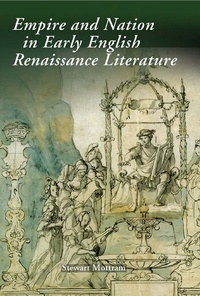
Empire and Nation in Early English Renaissance Literature
Published on 16. October 2008
Book
Hardback
262 pages
978-1-84384-182-1 (ISBN)
Description
Sensitive readings of Renaissance texts offer new insights into the perception of imperialism in the sixteenth century.
The complex topics of colonialism, empire and nation run throughout English Renaissance literature. Here, the author moves beyond recent work on England's "British" colonial interests, arguing for England's self-image in the sixteenth century as an "empire of itself", part of a culture which deliberately set itself apart from Britain and Europe. In the first section of the book he explores England's self-image as empire in the Arthurian and classical pageants of two Tudor royal entries into the City of London: Charles V's in 1522 and Anne Boleyn's in 1533. Part Two focuses on the culture of English Bible-reading and its influence on England's imperial self-image in the Tudor period. He offers fresh new readings of texts by Richard Morison, William Tyndale, John Bale, Nicholas Udall, and William Lightfoot, among other authors represented.
Dr STEWART MOTTRAM is Research Lecturer, Institute for Medieval and Early Modern Studies, Aberystwyth University.
The complex topics of colonialism, empire and nation run throughout English Renaissance literature. Here, the author moves beyond recent work on England's "British" colonial interests, arguing for England's self-image in the sixteenth century as an "empire of itself", part of a culture which deliberately set itself apart from Britain and Europe. In the first section of the book he explores England's self-image as empire in the Arthurian and classical pageants of two Tudor royal entries into the City of London: Charles V's in 1522 and Anne Boleyn's in 1533. Part Two focuses on the culture of English Bible-reading and its influence on England's imperial self-image in the Tudor period. He offers fresh new readings of texts by Richard Morison, William Tyndale, John Bale, Nicholas Udall, and William Lightfoot, among other authors represented.
Dr STEWART MOTTRAM is Research Lecturer, Institute for Medieval and Early Modern Studies, Aberystwyth University.
Reviews / Votes
An erudite and informative study that makes a valuable contribution to our understanding of early Tudor literature. * REFORMATION & RENAISSANCE REVIEW * A thorough historical study [with] many absorbing details. * STUDIES IN ENGLISH LITERATURE * Mottram's book performs a useful service in calling our attention to the ways the English nation was an intelligible prospect in the mid-Tudor period: that alongside colonial machinations were insular ones as well. * JOURNAL OF BRITISH STUDIES * No one interested in the forms and fictions of nationhood in English Renaissance literature can overlook this book. Students of empire and nation-building will find much to ponder here, and those interested in ideas of commonwealth and republic will also discover early evidence of an interest in alternative forms of government after empire and on the eve of empire, that is, in the wake of Rome and on the threshold of an expanding Britain, when postcolonial England first found its feet and forged its identity. * REVIEW OF ENGLISH STUDIES *More details
Series
Language
English
Place of publication
Cambridge
United Kingdom
Publishing group
Boydell & Brewer Ltd
Target group
Professional and scholarly
Product notice
Cloth over boards
Illustrations
1 s/w Abbildung
1 b/w illus.
Dimensions
Height: 234 mm
Width: 156 mm
Weight
1 gr
ISBN-13
978-1-84384-182-1 (9781843841821)
Copyright in bibliographic data and cover images is held by Nielsen Book Services Limited or by the publishers or by their respective licensors: all rights reserved.
Schweitzer Classification
Other editions
Additional editions
Stewart Mottram
Empire and Nation in Early English Renaissance Literature
E-Book
10/2008
1st Edition
De Gruyter
€48.99
Available for download
Content
Introduction: Empire and this `Englyshe or Bryttyshe nacyon'
England's Empire Apart: The Entry of Charles V and Henry VIII (1522)
Royal Supremacy and the Rhetoric of Empire: Anne Boleyn's 1533 Entry
Richard Morison: Rebellion and the Rhetoric of Nationhood
Enter England: John Bale's King Johan
Commonwealth in Crisis: Nicholas Udall's Respublica
Conclusion: William Lightfoot and the Legacy of England's Empire Apart
Bibliography
Index
England's Empire Apart: The Entry of Charles V and Henry VIII (1522)
Royal Supremacy and the Rhetoric of Empire: Anne Boleyn's 1533 Entry
Richard Morison: Rebellion and the Rhetoric of Nationhood
Enter England: John Bale's King Johan
Commonwealth in Crisis: Nicholas Udall's Respublica
Conclusion: William Lightfoot and the Legacy of England's Empire Apart
Bibliography
Index