

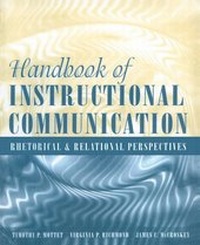
Handbook of Instructional Communication
Rhetorical and Relational Perspectives
1st Edition
Published on 15. July 2005
Book
Paperback/Softback
336 pages
978-0-205-39614-6 (ISBN)
Description
Written to address the contemporary challenges facing teachers and trainers in traditional and non-traditional settings, this text offers a comprehensive collection of research focusing on the role and effects of communication in instructional environments. With accessible research for students, teachers, and educational leaders, The Handbook of Instructional Communication enhances an individual's ability to understand instructional communication research, plan and conduct instructional communication research, practice effective instructional communication, and consult with other teachers and trainers about their use of instructional communication.
More details
Language
English
Place of publication
New York
United States
Publishing group
Taylor & Francis Inc
Target group
Professional and scholarly
Dimensions
Height: 235 mm
Width: 191 mm
Weight
590 gr
ISBN-13
978-0-205-39614-6 (9780205396146)
Copyright in bibliographic data and cover images is held by Nielsen Book Services Limited or by the publishers or by their respective licensors: all rights reserved.
Schweitzer Classification
Persons
Timothy P. Mottet, Texas State University - San Marcos
Virginia P. Richmond, West Virginia University
James C. McCroskey, University of Alabama, Birmingham
Virginia P. Richmond, West Virginia University
James C. McCroskey, University of Alabama, Birmingham
Content
Preface.
I. FOUNDATIONS.
1. Foundations of Instructional Communication.
Timothy P. Mottet
Steven A. Beebe
2. Instructional Communication: The Historical Perspective.
James C. McCroskey
Linda L. McCroskey
II. RHETORICAL PERSPECTIVES.
3. Understanding the Audience, Student Communication Traits.
James C. McCroskey
Virginia P. Richmond
4. Understanding the Source: Teacher Credibility and Aggressive Communication Traits.
Scott A. Myers
Matthew M. Martin
5. Instructional Message Variables.
Joseph L. Chesebro
Melissa Bekelja Wanzer
6. Teachers' Influence Messages.
K. David Roach
Virginia P. Richmond
Timothy P. Mottet
III. RELATIONAL PERSPECTIVES.
7. Students' Influence Messages.
Timothy P. Mottet
Steven A. Beebe
Cathy Fleuriet
8. Teacher Immediacy and the Teacher-Student Relationship.
Virginia P. Richmond
Derek R. Lane
James C. McCroskey
9. Teacher and Student Affinity-Seeking in the Classroom.
Ann Bainbridge Frymier
Melissa Bekelja Wanzer
10. College Teacher Misbehaviors.
Mary B. McPherson
Patricia Kearney
Timothy G. Plax
11. Student Resistance.
Patricia Kearney
Timothy G. Plax
Mary B. McPherson
IV. RESEARCH, THEORY, AND ASSESSMENT.
12. Conducting Instructional Communication Research.
James C. McCroskey
Linda L. McCroskey
13. Theorizing About Instructional Communication.
Timothy P. Mottet
Ann Bainbridge Frymier
Steven A. Beebe
14. Assessing Instructional Communication.
Timothy P. Mottet
Virginia P. Richmond
James C. McCroskey
I. FOUNDATIONS.
1. Foundations of Instructional Communication.
Timothy P. Mottet
Steven A. Beebe
2. Instructional Communication: The Historical Perspective.
James C. McCroskey
Linda L. McCroskey
II. RHETORICAL PERSPECTIVES.
3. Understanding the Audience, Student Communication Traits.
James C. McCroskey
Virginia P. Richmond
4. Understanding the Source: Teacher Credibility and Aggressive Communication Traits.
Scott A. Myers
Matthew M. Martin
5. Instructional Message Variables.
Joseph L. Chesebro
Melissa Bekelja Wanzer
6. Teachers' Influence Messages.
K. David Roach
Virginia P. Richmond
Timothy P. Mottet
III. RELATIONAL PERSPECTIVES.
7. Students' Influence Messages.
Timothy P. Mottet
Steven A. Beebe
Cathy Fleuriet
8. Teacher Immediacy and the Teacher-Student Relationship.
Virginia P. Richmond
Derek R. Lane
James C. McCroskey
9. Teacher and Student Affinity-Seeking in the Classroom.
Ann Bainbridge Frymier
Melissa Bekelja Wanzer
10. College Teacher Misbehaviors.
Mary B. McPherson
Patricia Kearney
Timothy G. Plax
11. Student Resistance.
Patricia Kearney
Timothy G. Plax
Mary B. McPherson
IV. RESEARCH, THEORY, AND ASSESSMENT.
12. Conducting Instructional Communication Research.
James C. McCroskey
Linda L. McCroskey
13. Theorizing About Instructional Communication.
Timothy P. Mottet
Ann Bainbridge Frymier
Steven A. Beebe
14. Assessing Instructional Communication.
Timothy P. Mottet
Virginia P. Richmond
James C. McCroskey