

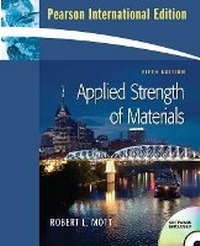
Applied Strength of Materials
International Edition
5th Edition
Published on 15. May 2008
Book
Mixed media product
800 pages
978-0-13-208281-5 (ISBN)
Description
For undergraduate, introductory level courses in Statics and Strength of Materials, in departments of Mechanical Engineering Technology, Civil Engineering Technology, Construction Engineering Technology or Manufacturing Engineering Technology
This text features a strong presentation of the fundamentals of strength of materials (or mechanics of materials) integrated with an emphasis on applications to many fields of engineering and engineering technology. The approach to mathematics use in the book satisfies both those programs where calculus use is expected and those for which college algebra and trigonometry are the prerequisite skills needed by the students.
This text features a strong presentation of the fundamentals of strength of materials (or mechanics of materials) integrated with an emphasis on applications to many fields of engineering and engineering technology. The approach to mathematics use in the book satisfies both those programs where calculus use is expected and those for which college algebra and trigonometry are the prerequisite skills needed by the students.
More details
Edition
5th edition
Language
English
Place of publication
United States
Publishing group
Pearson Education (US)
Target group
College/higher education
Dimensions
Height: 251 mm
Width: 202 mm
Thickness: 25 mm
Weight
1250 gr
ISBN-13
978-0-13-208281-5 (9780132082815)
Copyright in bibliographic data and cover images is held by Nielsen Book Services Limited or by the publishers or by their respective licensors: all rights reserved.
Schweitzer Classification
Other editions
Previous edition
Book
09/2007
5th Edition
Pearson
€133.49
Article exhausted; check for reprint
Person
Prof. Robert L. Mott, P.E.
Professor Emeritus
The University of Dayton
Teaching Interests:
Design of Machine Elements
Fluid Mechanics
Mechanical Engineering Design
Strength of Materials
Stress Analysis
Systems Design
Education:
B.S. Mechanical Engineering, General Motors Institute, 1963
M.S. Mechanical Engineering, Purdue University, 1965
Industrial Experience:
General Motors Corporation, Frigidaire Division, Research Engineer
University of Dayton Research Institute, Engineer, Structural Mechanics Section
Consulting in mechanical design and accident analysis
Professional Interests:
American Society of Mechanical Engineers (ASME)
Past Chair, Manufacturing Education & Research Community
Society of Manufacturing Engineers (SME)
American Society for Engineering Education (ASEE)
Engineering Technology Council
Engineering Technology Division
Registered Professional Engineer
National Center for Manufacturing Education, Dayton, Ohio
Recent Books Published:
APPLIED STRENGTH OF MATERIALS, 5th ED, Prentice Hall, Publishing Co., 2008
APPLIED FLUID MECHANICS, 6th ED, Prentice Hall Publishing Co., 2006
MACHINE ELEMENTS IN MECHANICAL DESIGN, 4th ED, Prentice Hall Publishing Co., 2004
Honors & Awards:
ASEE Fellow Member, 2007
James H. McGraw Award for Outstanding Service in Engineering Technology Education, ASEE, 2004
Archie Higdon Distinguished Mechanics Educator Awards, ASEE, 2001
Frederick J. Berger Award for Excellence in Engineering Technology Education, ASEE, 1994
Outstanding Engineer and Scientist Award, Dayton, Ohio, 1992
Faculty Award in Teaching, University of Dayton, 1981
Epsilon Delta Tau Outstanding Achievement Award, 1972
Recipient of SAE Teetor Educational Award 1968
Pi Tau Sigma National Mechanical Engineering Honorary
Honorary Member Tau Alpha Pi Honor Society
Professor Emeritus
The University of Dayton
Teaching Interests:
Design of Machine Elements
Fluid Mechanics
Mechanical Engineering Design
Strength of Materials
Stress Analysis
Systems Design
Education:
B.S. Mechanical Engineering, General Motors Institute, 1963
M.S. Mechanical Engineering, Purdue University, 1965
Industrial Experience:
General Motors Corporation, Frigidaire Division, Research Engineer
University of Dayton Research Institute, Engineer, Structural Mechanics Section
Consulting in mechanical design and accident analysis
Professional Interests:
American Society of Mechanical Engineers (ASME)
Past Chair, Manufacturing Education & Research Community
Society of Manufacturing Engineers (SME)
American Society for Engineering Education (ASEE)
Engineering Technology Council
Engineering Technology Division
Registered Professional Engineer
National Center for Manufacturing Education, Dayton, Ohio
Recent Books Published:
APPLIED STRENGTH OF MATERIALS, 5th ED, Prentice Hall, Publishing Co., 2008
APPLIED FLUID MECHANICS, 6th ED, Prentice Hall Publishing Co., 2006
MACHINE ELEMENTS IN MECHANICAL DESIGN, 4th ED, Prentice Hall Publishing Co., 2004
Honors & Awards:
ASEE Fellow Member, 2007
James H. McGraw Award for Outstanding Service in Engineering Technology Education, ASEE, 2004
Archie Higdon Distinguished Mechanics Educator Awards, ASEE, 2001
Frederick J. Berger Award for Excellence in Engineering Technology Education, ASEE, 1994
Outstanding Engineer and Scientist Award, Dayton, Ohio, 1992
Faculty Award in Teaching, University of Dayton, 1981
Epsilon Delta Tau Outstanding Achievement Award, 1972
Recipient of SAE Teetor Educational Award 1968
Pi Tau Sigma National Mechanical Engineering Honorary
Honorary Member Tau Alpha Pi Honor Society
Content
Preface 1 Basic Concepts in Strength of Materials
The Big Picture
1-1 Objective of This Book - To Ensure Safety
1-2 Objectives of This Chapter
1-3 Problem-solving Procedure
1-4 Basic Unit Systems
1-5 Relationship Among Mass, Force, and Weight
1-6 The Concept of Stress
1-7 Direct Normal Stress
1-8 Stress Elements for Direct Normal Stresses
1-9 The Concept of Strain
1-10 Direct Shear Stress
1-11 Stress Element for Shear Stresses
1-12 Preferred Sizes and Standard Shapes
1-13 Experimental and Computational Stress
2 Design Properties of Materials
The Big Picture
2-1 Objectives of This Chapter
2-2 Design Properties of Materials
2-3 Steel
2-4 Cast Iron
2-5 Aluminum
2-6 Copper, Brass, and Bronze
2-7 Zinc, Magnesium, Titanium, and Nickel-Based Alloys
2-8 Nonmetals in Engineering Design
2-9 Wood
2-10 Concrete
2-11 Plastics
2-12 Composites
2-13 Materials Selection
3 Direct Stress, Deformation, and Design
The Big Picture and Activity
3-1 Objectives of this Chapter
3-2 Design of Members under Direct Tension or Compression
3-3 Design Normal Stresses
3-4 Design Factor
3-5 Design Approaches and Guidelines for Design Factors
3-6 Methods of Computing Design Stress
3-7 Elastic Deformation in Tension and Compression Members
3-8 Deformation Due to Temperature Changes
3-9 Thermal Stress
3-10 Members Made of More Than One Material
3-11 Stress Concentration Factors for Direct Axial Stresses
3-12 Bearing Stress
3-13 Design Bearing Stress
3-14 Design Shear Stress
4 Torsional Shear Stress and Torsional Deformation The Big Picture
4-1 Objectives of This Chapter
4-2 Torque, Power, and Rotational Speed
4-3 Torsional Shear Stress in Members with Circular Cross Sections
4-4 Development of the Torsional Shear Stress Formula
4-5 Polar Moment of Inertia for Solid Circular Bars
4-6 Torsional Shear Stress and Polar Moment of Inertia for Hollow Circular Bars
4-7 Design of Circular Members under Torsion
4-8 Comparison of Solid and Hollow Circular Members
4-9 Stress Concentrations in Torsionally Loaded Members
4-10 Twisting - Elastic Torsional Deformation
4-11 Torsion in Noncircular Sections
5 Shearing Forces and Bending Moments in Beams The Big Picture
5-1 Objectives of this Chapter
5-2 Beam Loading, Supports, and Types of Beams
5-3 Reactions at Supports
5-4 Shearing Forces and Bending Moments for Concentrated Loads
5-5 Guidelines for Drawing Beam Diagrams for Concentrated Loads
5-6 Shearing Forces and Bending Moments for Distributed Loads
5-7 General Shapes Found in Bending Moment Diagrams
5-8 Shearing Forces and Bending Moments for Cantilever Beams
5-9 Beams with Linearly Varying Distributed Loads
5-10 Free-Body Diagrams of Parts of Structures
5-11 Mathematical Analysis of Beam Diagrams
5-12 Continuous Beams - Theorem of Three Moments
6 Centroids and Moments of Inertia of Areas
The Big Picture
6-1 Objectives of This Chapter
6-2 The Concept of Centroid - Simple Shapes
6-3 Centroid of Complex Shapes
6-4 The Concept of Moment of Inertia
6-5 Moment of Inertia for Composite Shapes Whose Parts have the Same Centroidal Axis
6-6 Moment of Inertia for Composite Shapes - General Case - Use of the Parallel Axis Theorem
6-7 Mathematical Definition of Moment of Inertia
6-8 Composite Sections Made from Commercially Available Shapes
6-9 Moment of Inertia for Shapes with all Rectangular Parts
6-10 Radius of Gyration
6-11 Section Modulus
7 Stress Due to Bending The Big Picture
7-1 Objectives of This Chapter
7-2 The Flexure Formula
7-3 Conditions on the Use of the Flexure Formula
7-4 Stress Distribution on a Cross Section of a Beam
7-5 Derivation of the Flexure Formula
7-6 Applications - Beam Analysis
7-7 Applications - Beam Design and Design Stresses
7-8 Section Modulus and Design Procedures
7-9 Stress Concentrations
7-10 Flexural Center or Shear Center
7-11 Preferred Shapes for Beam Cross Sections
7-12 Design of Beams to be Made from Composite Materials
8 Shearing Stresses in Beams The Big Picture
8-1 Objectives of this Chapter
8-2 Importance of Shearing Stresses in Beams
8-3 The General Shear Formula
8-4 Distribution of Shearing Stress in Beams
8-5 Development of the General Shear Formula
8-6 Special Shear Formulas
8-7 Design for Shear
8-8 Shear Flow
9 Deflection of Beams The Big Picture
9-1 Objectives of this Chapter
9-2 The Need for Considering Beam Deflections
9-3 General Principles and Definitions of Terms
9-4 Beam Deflections Using the Formula Method
9-5 Comparison of the Manner of Support for Beams
9-6 Superposition Using Deflection Formulas
9-7 Successive Integration Method
9-8 Moment-Area Method
10 Combined Stresses The Big Picture
10-1 Objectives of this Chapter
10-2 The Stress Element
10-3 Stress Distribution Created by Basic Stresses
10-4 Creating the Initial Stress Element
10-5 Combined Normal Stresses
10-6 Combined Normal and Shear Stresses
10-7 Equations for Stresses in Any Direction
10-8 Maximum Stresses
10-9 Mohr's Circle for Stress
10-10 Stress Condition on Selected Planes
10-11 Special Case in which Both Principal Stresses have the Same Sign
10-12 Use of Strain-Gage Rosettes to Determine Principal Stresses
11 Columns The Big Picture
11-1 Objectives of this Chapter
11-2 Slenderness Ratio
11-3 Transition Slenderness Ratio
11-4 The Euler Formula for Long Columns
11-5 The J. B. Johnson Formula for Short Columns
11-6 Summary - Buckling Formulas
11-7 Design Factors and Allowable Load
11-8 Summary - Method of Analyzing Columns
11-9 Column Analysis Spreadsheet
11-10 Efficient Shapes for Columns
11-11 Specifications of the AISC
11-12 Specifications of the Aluminum Association
11-13 Non-Centrally Loaded Columns
12 Pressure Vessels The Big Picture
12-1 Objectives of this Chapter
12-2 Distinction Between Thin-Walled and Thick-Walled Pressure Vessels
12-3 Thin-Walled Spheres
12-4 Thin-Walled Cylinders
12-5 Thick-Walled Cylinders and Spheres
12-6 Analysis and Design Procedures for Pressure Vessels
12-7 Spreadsheet Aid for Analyzing Thick-Walled Spheres and Cylinders
12-8 Shearing Stress in Cylinders and Spheres
12-9 Other Design Considerations for Pressure Vessels
12-10 Composite Pressure Vessels
13 Connections The Big Picture
13-1 Objectives of this Chapter
13-2 Modes of Failure
13-3 Riveted Connections
13-4 Bolted Connections
13-5 Allowable Stresses for Riveted and Bolted Connections
13-6 Example Problems - Riveted and Bolted Joints
13-7 Eccentrically Loaded Riveted and Bolted Joints
13-8 Welded Joints with Concentric Loads
Appendix Answers to Selected Problems Index
The Big Picture
1-1 Objective of This Book - To Ensure Safety
1-2 Objectives of This Chapter
1-3 Problem-solving Procedure
1-4 Basic Unit Systems
1-5 Relationship Among Mass, Force, and Weight
1-6 The Concept of Stress
1-7 Direct Normal Stress
1-8 Stress Elements for Direct Normal Stresses
1-9 The Concept of Strain
1-10 Direct Shear Stress
1-11 Stress Element for Shear Stresses
1-12 Preferred Sizes and Standard Shapes
1-13 Experimental and Computational Stress
2 Design Properties of Materials
The Big Picture
2-1 Objectives of This Chapter
2-2 Design Properties of Materials
2-3 Steel
2-4 Cast Iron
2-5 Aluminum
2-6 Copper, Brass, and Bronze
2-7 Zinc, Magnesium, Titanium, and Nickel-Based Alloys
2-8 Nonmetals in Engineering Design
2-9 Wood
2-10 Concrete
2-11 Plastics
2-12 Composites
2-13 Materials Selection
3 Direct Stress, Deformation, and Design
The Big Picture and Activity
3-1 Objectives of this Chapter
3-2 Design of Members under Direct Tension or Compression
3-3 Design Normal Stresses
3-4 Design Factor
3-5 Design Approaches and Guidelines for Design Factors
3-6 Methods of Computing Design Stress
3-7 Elastic Deformation in Tension and Compression Members
3-8 Deformation Due to Temperature Changes
3-9 Thermal Stress
3-10 Members Made of More Than One Material
3-11 Stress Concentration Factors for Direct Axial Stresses
3-12 Bearing Stress
3-13 Design Bearing Stress
3-14 Design Shear Stress
4 Torsional Shear Stress and Torsional Deformation The Big Picture
4-1 Objectives of This Chapter
4-2 Torque, Power, and Rotational Speed
4-3 Torsional Shear Stress in Members with Circular Cross Sections
4-4 Development of the Torsional Shear Stress Formula
4-5 Polar Moment of Inertia for Solid Circular Bars
4-6 Torsional Shear Stress and Polar Moment of Inertia for Hollow Circular Bars
4-7 Design of Circular Members under Torsion
4-8 Comparison of Solid and Hollow Circular Members
4-9 Stress Concentrations in Torsionally Loaded Members
4-10 Twisting - Elastic Torsional Deformation
4-11 Torsion in Noncircular Sections
5 Shearing Forces and Bending Moments in Beams The Big Picture
5-1 Objectives of this Chapter
5-2 Beam Loading, Supports, and Types of Beams
5-3 Reactions at Supports
5-4 Shearing Forces and Bending Moments for Concentrated Loads
5-5 Guidelines for Drawing Beam Diagrams for Concentrated Loads
5-6 Shearing Forces and Bending Moments for Distributed Loads
5-7 General Shapes Found in Bending Moment Diagrams
5-8 Shearing Forces and Bending Moments for Cantilever Beams
5-9 Beams with Linearly Varying Distributed Loads
5-10 Free-Body Diagrams of Parts of Structures
5-11 Mathematical Analysis of Beam Diagrams
5-12 Continuous Beams - Theorem of Three Moments
6 Centroids and Moments of Inertia of Areas
The Big Picture
6-1 Objectives of This Chapter
6-2 The Concept of Centroid - Simple Shapes
6-3 Centroid of Complex Shapes
6-4 The Concept of Moment of Inertia
6-5 Moment of Inertia for Composite Shapes Whose Parts have the Same Centroidal Axis
6-6 Moment of Inertia for Composite Shapes - General Case - Use of the Parallel Axis Theorem
6-7 Mathematical Definition of Moment of Inertia
6-8 Composite Sections Made from Commercially Available Shapes
6-9 Moment of Inertia for Shapes with all Rectangular Parts
6-10 Radius of Gyration
6-11 Section Modulus
7 Stress Due to Bending The Big Picture
7-1 Objectives of This Chapter
7-2 The Flexure Formula
7-3 Conditions on the Use of the Flexure Formula
7-4 Stress Distribution on a Cross Section of a Beam
7-5 Derivation of the Flexure Formula
7-6 Applications - Beam Analysis
7-7 Applications - Beam Design and Design Stresses
7-8 Section Modulus and Design Procedures
7-9 Stress Concentrations
7-10 Flexural Center or Shear Center
7-11 Preferred Shapes for Beam Cross Sections
7-12 Design of Beams to be Made from Composite Materials
8 Shearing Stresses in Beams The Big Picture
8-1 Objectives of this Chapter
8-2 Importance of Shearing Stresses in Beams
8-3 The General Shear Formula
8-4 Distribution of Shearing Stress in Beams
8-5 Development of the General Shear Formula
8-6 Special Shear Formulas
8-7 Design for Shear
8-8 Shear Flow
9 Deflection of Beams The Big Picture
9-1 Objectives of this Chapter
9-2 The Need for Considering Beam Deflections
9-3 General Principles and Definitions of Terms
9-4 Beam Deflections Using the Formula Method
9-5 Comparison of the Manner of Support for Beams
9-6 Superposition Using Deflection Formulas
9-7 Successive Integration Method
9-8 Moment-Area Method
10 Combined Stresses The Big Picture
10-1 Objectives of this Chapter
10-2 The Stress Element
10-3 Stress Distribution Created by Basic Stresses
10-4 Creating the Initial Stress Element
10-5 Combined Normal Stresses
10-6 Combined Normal and Shear Stresses
10-7 Equations for Stresses in Any Direction
10-8 Maximum Stresses
10-9 Mohr's Circle for Stress
10-10 Stress Condition on Selected Planes
10-11 Special Case in which Both Principal Stresses have the Same Sign
10-12 Use of Strain-Gage Rosettes to Determine Principal Stresses
11 Columns The Big Picture
11-1 Objectives of this Chapter
11-2 Slenderness Ratio
11-3 Transition Slenderness Ratio
11-4 The Euler Formula for Long Columns
11-5 The J. B. Johnson Formula for Short Columns
11-6 Summary - Buckling Formulas
11-7 Design Factors and Allowable Load
11-8 Summary - Method of Analyzing Columns
11-9 Column Analysis Spreadsheet
11-10 Efficient Shapes for Columns
11-11 Specifications of the AISC
11-12 Specifications of the Aluminum Association
11-13 Non-Centrally Loaded Columns
12 Pressure Vessels The Big Picture
12-1 Objectives of this Chapter
12-2 Distinction Between Thin-Walled and Thick-Walled Pressure Vessels
12-3 Thin-Walled Spheres
12-4 Thin-Walled Cylinders
12-5 Thick-Walled Cylinders and Spheres
12-6 Analysis and Design Procedures for Pressure Vessels
12-7 Spreadsheet Aid for Analyzing Thick-Walled Spheres and Cylinders
12-8 Shearing Stress in Cylinders and Spheres
12-9 Other Design Considerations for Pressure Vessels
12-10 Composite Pressure Vessels
13 Connections The Big Picture
13-1 Objectives of this Chapter
13-2 Modes of Failure
13-3 Riveted Connections
13-4 Bolted Connections
13-5 Allowable Stresses for Riveted and Bolted Connections
13-6 Example Problems - Riveted and Bolted Joints
13-7 Eccentrically Loaded Riveted and Bolted Joints
13-8 Welded Joints with Concentric Loads
Appendix Answers to Selected Problems Index