

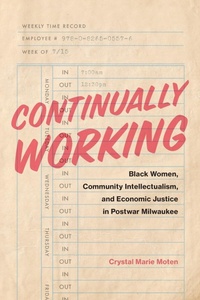
Continually Working
Black Women, Community Intellectualism, and Economic Justice in Postwar Milwaukee
Published on 15. March 2023
Book
Paperback/Softback
256 pages
978-0-8265-0557-6 (ISBN)
Description
Continually Working tells the stories of Black working women who resisted employment inequality in Milwaukee, Wisconsin, from the 1940s to the 1970s. The book explores the job-related activism of Black Midwestern working women and uncovers the political and intellectual strategies they used to critique and resist employment discrimination, dismantle unjust structures, and transform their lives and the lives of those in their community.
Moten emphasizes the ways in which Black women transformed the urban landscape by simultaneously occupying spaces from which they had been historically excluded and creating their own spaces. Black women refused to be marginalized within the historically white and middle-class Milwaukee Young Women's Christian Association (MYWCA), an association whose mission centered on supporting women in urban areas. Black women forged interracial relationships within this organization and made it, not without much conflict and struggle, one of the most socially progressive organizations in the city. When Black women could not integrate historically white institutions, they created their own. They established financial and educational institutions, such as Pressley School of Beauty Culture, which beautician Mattie Pressley Dewese opened in 1946 as a result of segregation in the beauty training industry. This school served economic, educational and community development purposes as well as created economic opportunities for Black women. Historically and contemporarily, Milwaukee has been and is still known as one of the most segregated cities in the nation. Black women have always contested urban segregation, by making space for themselves and others on the margins. In so doing, they have transformed both the urban landscape and urban history.
Moten emphasizes the ways in which Black women transformed the urban landscape by simultaneously occupying spaces from which they had been historically excluded and creating their own spaces. Black women refused to be marginalized within the historically white and middle-class Milwaukee Young Women's Christian Association (MYWCA), an association whose mission centered on supporting women in urban areas. Black women forged interracial relationships within this organization and made it, not without much conflict and struggle, one of the most socially progressive organizations in the city. When Black women could not integrate historically white institutions, they created their own. They established financial and educational institutions, such as Pressley School of Beauty Culture, which beautician Mattie Pressley Dewese opened in 1946 as a result of segregation in the beauty training industry. This school served economic, educational and community development purposes as well as created economic opportunities for Black women. Historically and contemporarily, Milwaukee has been and is still known as one of the most segregated cities in the nation. Black women have always contested urban segregation, by making space for themselves and others on the margins. In so doing, they have transformed both the urban landscape and urban history.
Reviews / Votes
Continually Working marks Black working women's struggles to improve their economic lives as intellectual work, as part and parcel of Black women's intellectual traditions, and as part of their institution- and organization-building and community-oriented activism."-Keona K. Ervin, author of Gateway to Equality: Black Women and the Struggle for Economic Justice in St. Louis"In Continually Working, Moten convincingly illuminates how Black women's open rebellion against white supremacy and discriminatory labor practices radically altered the urban metropolis, transforming our understanding of Black women's history and leaving audiences with innovative frameworks, intriguing stories, and new ways of discussing the Black freedom struggle."-LaShawn Harris, author of Sex Workers, Psychics, and Numbers Runners: Black Women in New York City's Underground Economy
More details
Series
Language
English
Place of publication
Tennessee
United States
Target group
Professional and scholarly
Illustrations
13 b&w images, 2 tables
Dimensions
Height: 229 mm
Width: 152 mm
Thickness: 15 mm
Weight
421 gr
ISBN-13
978-0-8265-0557-6 (9780826505576)
Copyright in bibliographic data and cover images is held by Nielsen Book Services Limited or by the publishers or by their respective licensors: all rights reserved.
Schweitzer Classification
Other editions
Additional editions
Crystal Marie Moten
Continually Working
Black Women, Community Intellectualism, and Economic Justice in Postwar Milwaukee
E-Book
03/2023
1st Edition
Vanderbilt University Press
€48.99
Available for download
Person
Crystal Marie Moten is a public historian, curator, and writer who focuses on the intersection of race, class, and gender to uncover the hidden histories of Black people in the Midwest.
Content
Acknowledgments
Prologue
Introduction
1. "More than a Job": Black Women's Midcentury Struggles at the Milwaukee Young Women's Christian Association
2. "A Credit to Our City as well as Our State": Black Beauticians' Professionalization, Progress, and Organization in Milwaukee, 1940s and 1950s
3. Working Toward a Remedy: Exposing the Experiences of Black Women during the Civil Rights Era
4. "What the Mothers Have to Say": Welfare Rights Activism in 1970s Milwaukee
5. "No Longer Marching": Dismantling the Jim Crow Jobs System in a Post-Civil Rights Era
Epilogue
Bibliography
Notes
Index
Prologue
Introduction
1. "More than a Job": Black Women's Midcentury Struggles at the Milwaukee Young Women's Christian Association
2. "A Credit to Our City as well as Our State": Black Beauticians' Professionalization, Progress, and Organization in Milwaukee, 1940s and 1950s
3. Working Toward a Remedy: Exposing the Experiences of Black Women during the Civil Rights Era
4. "What the Mothers Have to Say": Welfare Rights Activism in 1970s Milwaukee
5. "No Longer Marching": Dismantling the Jim Crow Jobs System in a Post-Civil Rights Era
Epilogue
Bibliography
Notes
Index