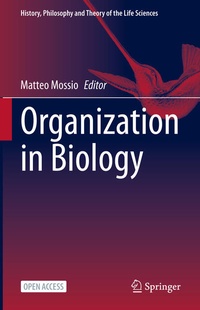
This open access book assesses the prospects of (re)adopting organization as a pivotal concept in biology. It shows how organization can nourish biological thinking and practice, by reconnecting with the idea of biology as the science of organized systems. The book provides a comprehensive state-of-the-art picture of the characterizations and uses of the concept of organization in both biological science and philosophy of biology. It also deals with a variety of themes - including evolution, organogenesis, heredity, cognition and ecology - with respect to which the concept of organization can guide the elaboration of original models and new experimental protocols. It will be of interest to biologists and scholars working in philosophy of science alike.
Series
Edition
Language
Place of publication
Publishing group
Springer International Publishing
Target group
Professional and scholarly
Illustrations
1 s/w Abbildung
VIII, 333 p. 1 illus.
Dimensions
Height: 241 mm
Width: 160 mm
Thickness: 25 mm
Weight
ISBN-13
978-3-031-38967-2 (9783031389672)
DOI
10.1007/978-3-031-38968-9
Schweitzer Classification
Matteo Mossio
is a philosopher of biology. He is
chargé de recherche
at the Centre National de la Recherche Scientifique (CNRS) and full member of the IHPST, in Paris, France. Matteo Mossio works mainly in the philosophy and theory of biological autonomy, and has focused on concepts as organization, agency, function, emergence, identity and heredity. He published numerous articles in international philosophical and scientific journals and, in 2015, he coauthored with Alvaro Moreno a full monograph on autonomy, which received substantial coverage in the literature. Matteo Mossio teaches in the Philosophy Program of the University of Paris 1 Panthéon - Sorbonne.
Part 1: Historical and Conceptual Foundations.- 'Organization': Its Conceptual History, Definition and Relationship to Other Fundamental Biological Concepts.- Varieties of Organicism - A Metacritique?.- Organization as Presupposition? On the Epistemological Implications in the Attitudinal Stance.- 'Dogmatic' vs 'Legitimate' Organicism: Organization as Explanans and Explanandum in Biology.- Does Organicism Really Need Organization?.- Part2: Origins of Life.- A Structuralist Revival for Studies on the Origins of Life and Developmental Evolution.- On the Evolutionary Development of Biological Organization from Complex Prebiotic Chemistry.- Development.- An Organizational View on Development, with a Focus on Life Cycles.- Modelling Mammary Organogenesis from Biological First Principles: Cells and Organization of Constraints.- Part 4: Evolution.- Extended Heredity and the Return of Organizational Thinking in Evolutionary Biology.- Collaboration and the Evolution of Biological Complexity: AnOrganizational Perspective.- Organisms: Between a Kantian Approach and a Liberal Approach.- Part 5: Ecology.- Individuating Ecosystems by Ascribing Functions to their Parts.- Ecological Functions and Environmental Ethics.- Part 6: Theoretical Biology.- Studying Functional Organization with Systems Theory.- Organizational Principles of Autonomy.- On Taking an Organizational Approach to Cognition.- Biological Organization at the Crossroads between Conservation and Innovation.