

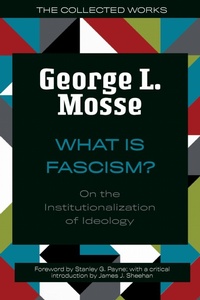
What Is Fascism?
On the Institutionalization of Ideology
Will be published approx. on 14. July 2026
Book
Paperback/Softback
326 pages
978-0-299-35834-1 (ISBN)
Description
In 1963, nearly two decades after the end of the most destructive war in human history, George L. Mosse assembled a group of interdisciplinary scholars from diverse backgrounds to answer a seemingly simple question: What is fascism? The landmark seminar that followed, held at Stanford University, came to define the intellectual conversation about European fascism throughout the postwar era. Mosse strove to better understand the legacy of fascism by debating its origins-often contentiously-with the sharpest minds of his generation.
In this volume, which collects Mosse's lectures as well as his peers' responses, Mosse and his colleagues wrestle with fascism's origins and impact. The straightforward question that launched the seminar quickly expands to deeper debates. What are the intellectual foundations of right-wing populist political movements? How had this particular movement risen to power so quickly and then left so much devastation in its wake? Were charismatic leaders like Hitler and Mussolini the driving forces, or did the various incarnations of fascism throughout Europe and beyond constitute a broader revolution? What was the relationship of religious and cultural institutions to fascism's rise and cataclysmic fall?
As the word "fascism" takes on new meaning in the twenty-first century, it is more urgent than ever to revisit the work of scholars who witnessed its birth-and its defeat. In the foreword, Stanley G. Payne situates the lively debate in its historical context, and in the critical introduction, James J. Sheehan shares his own memories of the seminar and reflects on how the experience drove Mosse's later work.
In this volume, which collects Mosse's lectures as well as his peers' responses, Mosse and his colleagues wrestle with fascism's origins and impact. The straightforward question that launched the seminar quickly expands to deeper debates. What are the intellectual foundations of right-wing populist political movements? How had this particular movement risen to power so quickly and then left so much devastation in its wake? Were charismatic leaders like Hitler and Mussolini the driving forces, or did the various incarnations of fascism throughout Europe and beyond constitute a broader revolution? What was the relationship of religious and cultural institutions to fascism's rise and cataclysmic fall?
As the word "fascism" takes on new meaning in the twenty-first century, it is more urgent than ever to revisit the work of scholars who witnessed its birth-and its defeat. In the foreword, Stanley G. Payne situates the lively debate in its historical context, and in the critical introduction, James J. Sheehan shares his own memories of the seminar and reflects on how the experience drove Mosse's later work.
Reviews / Votes
"Mosse's 1963 Stanford seminar anticipated almost all the fundamental ideas of his interpretation of National Socialism and of fascism in general." - Emilio Gentile, author of Fascination with the Persecutor: George L. Mosse and the Catastrophe of Modern ManMore details
Series
Language
English
Place of publication
Wisconsin
United States
Target group
College/higher education
Dimensions
Height: 229 mm
Width: 152 mm
Weight
454 gr
ISBN-13
978-0-299-35834-1 (9780299358341)
Copyright in bibliographic data and cover images is held by Nielsen Book Services Limited or by the publishers or by their respective licensors: all rights reserved.
Schweitzer Classification
Persons
George L. Mosse (1918-1999) was a legendary scholar, teacher, and mentor. A refugee from Nazi Germany, in 1955 he joined the Department of History at the University of Wisconsin-Madison, where he was both influential and popular. Mosse was an early leader in the study of modern European cultural and intellectual history, the study of fascism, and the history of sexuality and masculinity. Over his career, he authored more than two dozen books.
Stanley G. Payne is a professor emeritus of history at the University of Wisconsin-Madison. His many books include The Franco Regime: 1936-1975; Fascism: Comparison and Definition; and Spain's First Democracy: The Second Republic, 1931-1936.
James J. Sheehan is Dickason Professor in the Humanities, Emeritus, at Stanford University. His books include Making a Modern Political Order: The Problem of the Nation State.
Stanley G. Payne is a professor emeritus of history at the University of Wisconsin-Madison. His many books include The Franco Regime: 1936-1975; Fascism: Comparison and Definition; and Spain's First Democracy: The Second Republic, 1931-1936.
James J. Sheehan is Dickason Professor in the Humanities, Emeritus, at Stanford University. His books include Making a Modern Political Order: The Problem of the Nation State.
Content
Foreword by Stanley G. Payne
A Critical Introduction by James J. Sheehan
Seminar, October 7, 1963: What Is Fascism?
Seminar, October 14, 1963: The Peasant and the Ideology
Seminar, October 21, 1963: The Jewish Stereotype
Seminar, October 28, 1963: VOElkish Ideas and the Educational Establishment
Seminar, November 4, 1963: Conservatism
Seminar, November 11, 1963: Christian Churches and National Socialism
Seminar, November 18, 1963: The Problem of National Socialist Minority
Seminar, December 2, 1963: Adolf Hitler
Seminar, December 9, 1963: Fascism Once More
Appendix A: Participant Biographies
Appendix B: Participant Bibliography
Appendix C: Stanford Seminar Periodical Clippings
Appendix C: Gordon Craig Diary Entries
Notes
Index
A Critical Introduction by James J. Sheehan
Seminar, October 7, 1963: What Is Fascism?
Seminar, October 14, 1963: The Peasant and the Ideology
Seminar, October 21, 1963: The Jewish Stereotype
Seminar, October 28, 1963: VOElkish Ideas and the Educational Establishment
Seminar, November 4, 1963: Conservatism
Seminar, November 11, 1963: Christian Churches and National Socialism
Seminar, November 18, 1963: The Problem of National Socialist Minority
Seminar, December 2, 1963: Adolf Hitler
Seminar, December 9, 1963: Fascism Once More
Appendix A: Participant Biographies
Appendix B: Participant Bibliography
Appendix C: Stanford Seminar Periodical Clippings
Appendix C: Gordon Craig Diary Entries
Notes
Index