

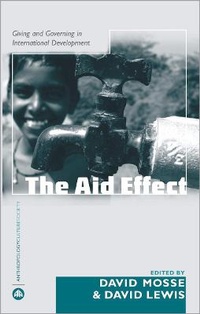
The Aid Effect
Giving and Governing in International Development
Published on 20. October 2005
Book
Hardback
232 pages
978-0-7453-2387-9 (ISBN)
Description
Today international development policy is converging around ideas of neoliberal reform, democratisation and poverty reduction. What does this mean for the local and international dimensions of aid relationships?
The Aid Effect demonstrates the fruitfulness of an ethnographic approach to aid, policy reform and global governance. The contributors provide powerful commentary on hidden processes, multiple perspectives or regional interests behind official aid policy discourses. The book raises important questions concerning the systematic social effects of aid relationships, the nature of sovereignty and the state, and the working of power inequalities built through the standardisations of a neoliberal framework.
The contributors take on new challenges to anthropology presented by a 'global aid architecture' which no longer operates through discrete projects but has moved on to sector wide approaches, budgetary support and other macro-level instruments of development; but they remain faithful to the fieldwork methodology that is anthropology's strength and the source of rare insight.
The Aid Effect demonstrates the fruitfulness of an ethnographic approach to aid, policy reform and global governance. The contributors provide powerful commentary on hidden processes, multiple perspectives or regional interests behind official aid policy discourses. The book raises important questions concerning the systematic social effects of aid relationships, the nature of sovereignty and the state, and the working of power inequalities built through the standardisations of a neoliberal framework.
The contributors take on new challenges to anthropology presented by a 'global aid architecture' which no longer operates through discrete projects but has moved on to sector wide approaches, budgetary support and other macro-level instruments of development; but they remain faithful to the fieldwork methodology that is anthropology's strength and the source of rare insight.
More details
Series
Language
English
Place of publication
London
United Kingdom
Target group
College/higher education
Professional and scholarly
Product notice
Library binding
Dimensions
Height: 215 mm
Width: 135 mm
Weight
443 gr
ISBN-13
978-0-7453-2387-9 (9780745323879)
Copyright in bibliographic data and cover images is held by Nielsen Book Services Limited or by the publishers or by their respective licensors: all rights reserved.
Schweitzer Classification
Other editions
Additional editions
E-Book
10/2005
1st Edition
Pluto Press
€83.69
Available for download
Persons
David Mosse is Professor of Social Anthropology at SOAS, University of London. He is author of The Rule of Water (Oxford University Press, 2003), Cultivating Development (Pluto, 2004) and The Aid Effect (Pluto, 2005).
David Lewis is Professor of Social Policy and Development in the Department of Social Policy, London School of Economics. He is the author of Bangladesh: Politics, Economy and Civil Society (CUP, 2012), co-author of Anthropology and Development (Pluto, 2015) and co-editor of The Aid Effect (Pluto, 2005).
David Lewis is Professor of Social Policy and Development in the Department of Social Policy, London School of Economics. He is the author of Bangladesh: Politics, Economy and Civil Society (CUP, 2012), co-author of Anthropology and Development (Pluto, 2015) and co-editor of The Aid Effect (Pluto, 2005).
Content
1. Introduction: The Ethnography of Donors and Neoliberal Policy by David Mosse
2. An Ethnography of 'Loan Arrangements' between the Bretton Woods Institutions and the Government of Malawi: Good Governance as Technology by Gerhard Anders
3. Timing, Scale and Style: Capacity as Governmentality in Tanzania by Jeremy Gould
4. The Reinvention of Ownership at the Dutch Ministry of Development Cooperation by Monique Nuijten and Jilles van Gastel
5. Who Owns the Gift? Donor-Recipient Relations and the National Elections in Bolivia by Rosalind Eyben and Rosario Leon
6. Interconnected and Interinfected: DOTS and the Stabilisation of the Tuberculosis Control Programme in Nepal by Ian Harper
7. The Worshippers of Rules: Defining the Right and Wrong in Local Project Applications in Estonia by Aet Annist
8. Unstating 'the Public': An Ethnography of Reform in an Urban Public Sector Utility in South India by Karen Coelho
9. The Disjuncture of Things: Some Remarks About a New Agenda for Studying Development by Philip Quarles van Ufford
2. An Ethnography of 'Loan Arrangements' between the Bretton Woods Institutions and the Government of Malawi: Good Governance as Technology by Gerhard Anders
3. Timing, Scale and Style: Capacity as Governmentality in Tanzania by Jeremy Gould
4. The Reinvention of Ownership at the Dutch Ministry of Development Cooperation by Monique Nuijten and Jilles van Gastel
5. Who Owns the Gift? Donor-Recipient Relations and the National Elections in Bolivia by Rosalind Eyben and Rosario Leon
6. Interconnected and Interinfected: DOTS and the Stabilisation of the Tuberculosis Control Programme in Nepal by Ian Harper
7. The Worshippers of Rules: Defining the Right and Wrong in Local Project Applications in Estonia by Aet Annist
8. Unstating 'the Public': An Ethnography of Reform in an Urban Public Sector Utility in South India by Karen Coelho
9. The Disjuncture of Things: Some Remarks About a New Agenda for Studying Development by Philip Quarles van Ufford