

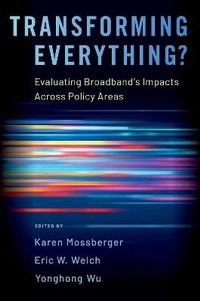
Transforming Everything?
Evaluating Broadband's Impacts Across Policy Areas
Published on 11. February 2022
Book
Hardback
260 pages
978-0-19-008287-1 (ISBN)
Description
Broadband, or high-speed internet, has been called the most important infrastructure challenge of the century. It has the potential to connect remote communities, streamline health care services, and support innovation across education, economics, and numerous other fields. Given the growing and widespread investments in broadband, how can citizens and policymakers determine whether the promise of broadband is being fulfilled?
Transforming Everything? offers a comprehensive guide to the complexities and possibilities of broadband as a social technology. It addresses challenges for evaluating broadband initiatives across diverse contexts and proposes guidance and methods for evaluation for policymakers and researchers. Contributors draw on pioneering research in program evaluation and information technology to explore broadband applications in health, education, and civic engagement. They also address key measurement and evaluation challenges in the field today, including issues in privacy and security and inadequate research methods for target populations. Collectively, the chapters in this volume raise important questions for improving research and evaluation in broadband use and producing actionable evidence in a highly dynamic environment.
Transforming Everything? prepares readers with a critical understanding of broadband technology and the necessary evidence to assess whether broadband programs and policy are truly empowering the communities they serve.
Transforming Everything? offers a comprehensive guide to the complexities and possibilities of broadband as a social technology. It addresses challenges for evaluating broadband initiatives across diverse contexts and proposes guidance and methods for evaluation for policymakers and researchers. Contributors draw on pioneering research in program evaluation and information technology to explore broadband applications in health, education, and civic engagement. They also address key measurement and evaluation challenges in the field today, including issues in privacy and security and inadequate research methods for target populations. Collectively, the chapters in this volume raise important questions for improving research and evaluation in broadband use and producing actionable evidence in a highly dynamic environment.
Transforming Everything? prepares readers with a critical understanding of broadband technology and the necessary evidence to assess whether broadband programs and policy are truly empowering the communities they serve.
Reviews / Votes
As the world invests in new broadband initiatives to meet unmet needs and foster innovation, this book demonstrates the importance of interdisciplinary evaluation tools for effective policy making. An essential read for anyone interested in a comprehensive policy approach accounting for diversity in broadband connectivity, adoption, and use. * Tithi Chattopadhyay, Princeton University * Broadband deployment and adoption have become one of the most pressing policy concerns both in the United States and internationally. This book provides researchers, policy makers, and students with vital insights on how to conduct sound policy evaluation, with contributions reflecting hard-won field experience. * Henning Schulzrinne, former US Federal Communications Commission Chief Technologist * Many discuss broadband impact, but this book provides actual evidence. Drawing on approaches ranging from experiments, surveys, and spatial analysis to ethnography, this volume provides the latest documentation on broadband's availability, use, and impact. I highly recommend it for all interested in getting the most out of digital connectivity. * Darrell West, Brookings Institution *More details
Language
English
Place of publication
New York
United States
Target group
Professional and scholarly
Illustrations
14 figures
Dimensions
Height: 159 mm
Width: 241 mm
Thickness: 18 mm
Weight
499 gr
ISBN-13
978-0-19-008287-1 (9780190082871)
Copyright in bibliographic data and cover images is held by Nielsen Book Services Limited or by the publishers or by their respective licensors: all rights reserved.
Schweitzer Classification
Other editions
Additional editions
Karen Mossberger | Eric W. Welch | Yonghong Wu
Transforming Everything?
Evaluating Broadband's Impacts Across Policy Areas
Book
04/2022
Oxford University Press Inc
€37.50
Shipment within 15-20 days
Karen Mossberger | Eric W. Welch | Yonghong Wu
Transforming Everything?
Evaluating Broadband's Impacts Across Policy Areas
E-Book
11/2021
OUP eBook
€16.49
Available for download
Karen Mossberger | Eric W. Welch | Yonghong Wu
Transforming Everything?
Evaluating Broadband's Impacts Across Policy Areas
E-Book
11/2021
OUP eBook
€16.49
Available for download
Persons
Karen Mossberger is the Frank and June Sackton Professor in the School of Public Affairs and Director of the Center on Technology, Data, and Society at Arizona State University. Her research includes digital inequality, digital government, impacts of technology use, and local government. Her co-authored books on technology include Digital Cities: The Internet and the Geography of Opportunity (2012, Oxford), Digital Citizenship: The Internet, Participation and Society (2008, MIT Press), and Virtual Inequality: Beyond the Digital Divide (2003, Georgetown University Press). She is an elected fellow in the National Academy of Public Administration.
Eric W. Welch is Professor in the School of Public Affairs at Arizona State University, where he teaches organization and network theory, institutional design, and science and innovation policy. He received his doctorate from the Syracuse University's Maxwell School of Citizenship and Public Affairs where he specialized in science
and environmental policy. Dr. Welch currently directs the Center for Science, Technology, and Environmental Policy Studies (C-STEPS) at ASU. He has published over 100 peer-reviewed articles, refereed proceedings, and book chapters.
Yonghong Wu is Professor in the Department of Public Administration at the University of Illinois at Chicago. He received his PhD from the Syracuse University's Maxwell School of Citizenship and Public Affairs where he specialized in public finance and science and technology policy. Dr. Wu's recent research has focused on state and local fiscal policy-making, public finance, and government funding of research and development. He has published one book and over 30 peer-reviewed articles, refereed proceedings, and book chapters.
Eric W. Welch is Professor in the School of Public Affairs at Arizona State University, where he teaches organization and network theory, institutional design, and science and innovation policy. He received his doctorate from the Syracuse University's Maxwell School of Citizenship and Public Affairs where he specialized in science
and environmental policy. Dr. Welch currently directs the Center for Science, Technology, and Environmental Policy Studies (C-STEPS) at ASU. He has published over 100 peer-reviewed articles, refereed proceedings, and book chapters.
Yonghong Wu is Professor in the Department of Public Administration at the University of Illinois at Chicago. He received his PhD from the Syracuse University's Maxwell School of Citizenship and Public Affairs where he specialized in public finance and science and technology policy. Dr. Wu's recent research has focused on state and local fiscal policy-making, public finance, and government funding of research and development. He has published one book and over 30 peer-reviewed articles, refereed proceedings, and book chapters.
Editor
Director of the Center on Technology, Data, and SocietyDirector of the Center on Technology, Data, and Society, Arizona State University
Director of the Center for Science, Technology, and Environmental Policy StudiesDirector of the Center for Science, Technology, and Environmental Policy Studies, Arizona State University
Professor in the Department of Public AdministrationProfessor in the Department of Public Administration, University of Illinois at Chicago
Content
- Acknowledgments
- Editors
- Contributors
- Introduction: Broadband as Experimentation and Policy Learning
- Karen Mossberger, Eric W. Welch, and Yonghong Wu
- PART I Evaluation In the Context of Broadband
- 1. The Changing Context for Broadband Evaluation
- William Lehr
- PART II Diverse Methods
- 2. Measuring Broadband and Its Impacts
- John B. Horrigan
- 3. Using Random Experiments to Measure the Impact of Computers, the Internet, and Other Forms of Technology on Educational Outcomes
- Robert Fairlie
- 4. Broadband Adoption and Ethnographic Approaches
- Jessica Crowell
- 5. Addressing Spatial Inequality in Broadband Use and Community- Level Outcomes
- Caroline J. Tolbert, Karen Mossberger, Natasha Gaydos, and Mattia Caldarulo
- PART III Asking the Right Questions
-
- 6. Broadband for Telemedicine and Health Services
- Sharon Strover
- 7. Opportunities and Challenges in Advancing Broadband- Enabled Government Services
- Alfred T. Ho
- 8. Digital Media's Impact on Civic Engagement: Challenges and Opportunities for Evaluation Research on Broadband Technologies, Young People, and Citizen Engagement
- Michael A. Xenos
- Conclusion: Evaluation for the Broadband Future
- Eric W. Welch
- Editors
- Contributors
- Introduction: Broadband as Experimentation and Policy Learning
- Karen Mossberger, Eric W. Welch, and Yonghong Wu
- PART I Evaluation In the Context of Broadband
- 1. The Changing Context for Broadband Evaluation
- William Lehr
- PART II Diverse Methods
- 2. Measuring Broadband and Its Impacts
- John B. Horrigan
- 3. Using Random Experiments to Measure the Impact of Computers, the Internet, and Other Forms of Technology on Educational Outcomes
- Robert Fairlie
- 4. Broadband Adoption and Ethnographic Approaches
- Jessica Crowell
- 5. Addressing Spatial Inequality in Broadband Use and Community- Level Outcomes
- Caroline J. Tolbert, Karen Mossberger, Natasha Gaydos, and Mattia Caldarulo
- PART III Asking the Right Questions
-
- 6. Broadband for Telemedicine and Health Services
- Sharon Strover
- 7. Opportunities and Challenges in Advancing Broadband- Enabled Government Services
- Alfred T. Ho
- 8. Digital Media's Impact on Civic Engagement: Challenges and Opportunities for Evaluation Research on Broadband Technologies, Young People, and Citizen Engagement
- Michael A. Xenos
- Conclusion: Evaluation for the Broadband Future
- Eric W. Welch