

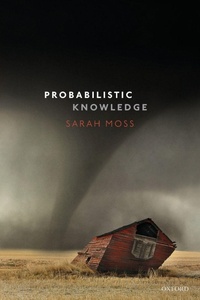
Probabilistic Knowledge
Published on 27. February 2020
Book
Paperback/Softback
280 pages
978-0-19-885809-6 (ISBN)
Description
Traditional philosophical discussions of knowledge have focused on the epistemic status of full beliefs. Sarah Moss argues that in addition to full beliefs, credences can constitute knowledge. For instance, your 0.4 credence that it is raining outside can constitute knowledge, in just the same way that your full beliefs can. In addition, you can know that it might be raining, and that if it is raining then it is probably cloudy, where this knowledge is not knowledge of propositions, but of probabilistic contents.
The notion of probabilistic content introduced in this book plays a central role not only in epistemology, but in the philosophy of mind and language as well. Just as tradition holds that you believe and assert propositions, you can believe and assert probabilistic contents. Accepting that we can believe, assert, and know probabilistic contents has significant consequences for many philosophical debates, including debates about the relationship between full belief and credence, the semantics of epistemic modals and conditionals, the contents of perceptual experience, peer disagreement, pragmatic encroachment, perceptual dogmatism, and transformative experience. In addition, accepting probabilistic knowledge can help us discredit negative evaluations of female speech, explain why merely statistical evidence is insufficient for legal proof, and identify epistemic norms violated by acts of racial profiling. Hence the central theses of this book not only help us better understand the nature of our own mental states, but also help us better understand the nature of our responsibilities to each other.
The notion of probabilistic content introduced in this book plays a central role not only in epistemology, but in the philosophy of mind and language as well. Just as tradition holds that you believe and assert propositions, you can believe and assert probabilistic contents. Accepting that we can believe, assert, and know probabilistic contents has significant consequences for many philosophical debates, including debates about the relationship between full belief and credence, the semantics of epistemic modals and conditionals, the contents of perceptual experience, peer disagreement, pragmatic encroachment, perceptual dogmatism, and transformative experience. In addition, accepting probabilistic knowledge can help us discredit negative evaluations of female speech, explain why merely statistical evidence is insufficient for legal proof, and identify epistemic norms violated by acts of racial profiling. Hence the central theses of this book not only help us better understand the nature of our own mental states, but also help us better understand the nature of our responsibilities to each other.
Reviews / Votes
Essential reading for philosophers of language, semanticists, and formal epistemologists. . . . Probabilistic Knowledge offers a persuasive case for a radical revision of some foundational ideas about the nature of content and communication. . . . rich and rewarding. * Daniel Greco, Journal of Philosophy * The title concept of this book, probabilistic knowledge, involves a radical revision of some central ideas of epistemology. But it ends up providing a more unified account of many phenomena of recent interest. Philosophers with an interest in the formal semantics of conditionals or epistemic modals, and epistemologists working on contextualism or the interaction of credence and belief, should probably read most or all of this book. And many other philosophers should also find a copy. * Kenny Easwaran, Notre Dame Philosophical Reviews *More details
Language
English
Place of publication
Oxford
United Kingdom
Target group
Professional and scholarly
Dimensions
Height: 234 mm
Width: 156 mm
Thickness: 15 mm
Weight
433 gr
ISBN-13
978-0-19-885809-6 (9780198858096)
Copyright in bibliographic data and cover images is held by Nielsen Book Services Limited or by the publishers or by their respective licensors: all rights reserved.
Schweitzer Classification
Other editions
Additional editions
Person
Sarah Moss is Associate Professor of Philosophy at the University of Michigan, Ann Arbor. She received her A.B. in Mathematics from Harvard University and her B.Phil. in Philosophy from Oxford University, where she studied as a Marshall Scholar. She received her Ph.D. in Philosophy with a minor in Linguistics from MIT in 2009.
Content
1: The case for probabilistic contents
2: The case for probabilistic assertion
3: Epistemic modals and probability operators
4: Indicative conditionals
5: The case for probabilistic knowledge
6: Factivity
7: Skepticism
8: Knowledge and belief
9: Knowledge and action
10: Knowledge and persons
Appendix: A formal semantics for epistemic vocabulary
2: The case for probabilistic assertion
3: Epistemic modals and probability operators
4: Indicative conditionals
5: The case for probabilistic knowledge
6: Factivity
7: Skepticism
8: Knowledge and belief
9: Knowledge and action
10: Knowledge and persons
Appendix: A formal semantics for epistemic vocabulary