

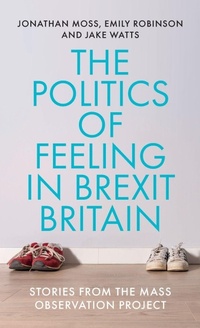
The Politics of Feeling in Brexit Britain
Stories from the Mass Observation Project
Published on 16. January 2024
Book
Hardback
272 pages
978-1-5261-5250-3 (ISBN)
Description
During Brexit, political questions were continually framed in emotional terms. The referendum was presented as a conflict between reason and resentment, fear and hope, heads and hearts. The Leave vote was interpreted as the triumph of passion over rationality, and its aftermath triggered concerns about the divisive impact of feelings on political culture. This book examines how these stories about feelings shaped public experiences and determined political possibilities.
The politics of feeling uses first-hand accounts to explore how 'ordinary' people understand their own feelings about the referendum, and how they reacted to the feelings of others. It shows how they drew on public narratives, while also rejecting and reworking them. The authors highlight a dangerous contradiction whereby feelings were simultaneously understood as dangerous and illegitimate, and as an authentic reflection of our inner selves. This had its own political consequences. -- .
The politics of feeling uses first-hand accounts to explore how 'ordinary' people understand their own feelings about the referendum, and how they reacted to the feelings of others. It shows how they drew on public narratives, while also rejecting and reworking them. The authors highlight a dangerous contradiction whereby feelings were simultaneously understood as dangerous and illegitimate, and as an authentic reflection of our inner selves. This had its own political consequences. -- .
Reviews / Votes
'Brexit was too often presented as a battle between "passionate leavers" and "rational remainers", but the Politics of feeling in Brexit Britain demonstrates through the real-time testimony of the Mass Observation Project that it was more complicated than that. Emotion is nothing new in politics, but this is a book that should make journalists, campaigners, politicians and pundits alike think again about how easy stereotypes shape collective political decision-making.'Peter Foster, author of What Went Wrong with Brexit
'The politics of feeling in Brexit Britain is a ground-breaking study of the work that feeling did - and was held to do - in the referendum of 2016. Using accounts from the Mass Observation Archive, it tells the story of Brexit from the ground up. Anyone who wants to understand Britain today should read this brilliantly insightful book.'
Claire Langhamer, Director, Institute of Historical Research
'With impressive clarity, this book invites us to bring emotional literacy to political analysis. A very important contribution to our understanding of Brexit.'
Stephen Coleman, author of How People Talk about Politics
'This book demonstrates the value of engaging with the direct voices of ordinary citizens. It advances our understanding of how both feelings and reason, often combined in nuanced ways, played influential roles in the way people responded to the politics of Brexit.'
Professor Gerry Stoker, Chair of Governance, University of Southampton
'This is not only a brilliant and dispassionate account of the role of feelings in Brexit. It is a reminder to political science of the importance of emotion in understanding and explaining the causes, consequences and meaning of major political developments.'
Tim Oliver, author of Understanding Brexit
'Roberts deserves huge credit for excavating such nuances from the mud heaped on them by Chartism's enemies, and enriching our understanding of the words and deeds of earlier radicals. He makes a persuasive case that 'popular radicalism often failed because it did not succeed in getting the right balance between the ascetic and the sentimental; or, in other words, displaying the right sort of feeling in the correct context' (p. 237), allowing the propertied classes to immure themselves in their ethical shelters, shutting out the voices of those clamouring for change with a clear conscience. In so doing, Democratic Passions demonstrates that paying attention to emotions can transform our understanding not just of the what, but also the why of the history of political culture.'
Simon J. Morgan, Cultural and Social History (The Journal of the Social History Society) -- .
More details
Language
English
Place of publication
Manchester
United Kingdom
Target group
College/higher education
Professional and scholarly
Dimensions
Height: 222 mm
Width: 145 mm
Thickness: 19 mm
Weight
513 gr
ISBN-13
978-1-5261-5250-3 (9781526152503)
Copyright in bibliographic data and cover images is held by Nielsen Book Services Limited or by the publishers or by their respective licensors: all rights reserved.
Schweitzer Classification
Other editions
Additional editions
Jonathan Moss | Emily Robinson | Jake Watts
The Politics of Feeling in Brexit Britain
Stories from the Mass Observation Project
E-Book
01/2024
1st Edition
Manchester University Press
€36.49
Available for download
Persons
Jonathan Moss is Senior Lecturer in Politics at the University of Sussex
Emily Robinson is Reader in British Studies at the University of Sussex
Jake Watts is an independent scholar -- .
Emily Robinson is Reader in British Studies at the University of Sussex
Jake Watts is an independent scholar -- .
Content
Introduction: using an 'archive of feeling' to understand Brexit Britain
Part I: Beyond 'heads vs hearts': personal feelings in political life
1 Voting decisions
2 Judgements and stereotypes
Part II: Stories of excessive emotions: political feelings in personal life
3 Moods
4 Relationships
Conclusion
Index -- .
Part I: Beyond 'heads vs hearts': personal feelings in political life
1 Voting decisions
2 Judgements and stereotypes
Part II: Stories of excessive emotions: political feelings in personal life
3 Moods
4 Relationships
Conclusion
Index -- .