

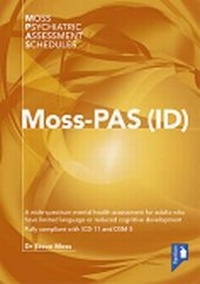
Moss-PAS (ID)
A Wide-Spectrum Mental Health Assessment for Adults Who Have Limited Language or Reduced Cognitive Development
2nd Edition
Published on 26. March 2019
Book
Spiral bound
66 pages
978-1-912755-20-2 (ISBN)
Description
The Moss-PAS (ID) provides a wide-spectrum mental health assessment primarily designed for clients who have limited language or reduced cognitive development. It is not a screening tool, but is a sophisticated assessment that uses a glossary of symptom definitions to guide the coding. Precise definitions of symptom severities give a high level of reliability, making it an excellent choice for measuring change, for example in response to treatment. Information from the Moss-PAS (ID) is also ideal for providing precise information on symptoms when conducting a full case formulation and diagnosis. The Moss-PAS (ID) can be used by staff who do not have a background in psychiatry or psychology. However, all users should receive appropriate training (available from Steve Moss, info@pasadd.co.uk).
The Moss-PAS (ID) can be used to collect symptom information directly from an informant via a semi-structured interview procedure, or can be completed by trained staff members on the basis of knowledge already possessed about the individual. The glossary definitions appears adjacent to their relevant interview questions, making it easy for the interviewer to keep the guidelines in mind while conducting the conversation. Question wordings have been refined over many years to provide a flexible yet precise and economical way of guiding the interviewer to determine presence and severity of symptoms.
Updated from the original Mini PAS-ADD, the Moss-PAS (ID) score form enables two different clinical episodes to be rated on the same form. This is important if the person has a fluctuating mood disorder, or if it is otherwise suspected that the individual has changed significantly from one time period to another.
The Moss-PAS (ID) can be used to collect symptom information directly from an informant via a semi-structured interview procedure, or can be completed by trained staff members on the basis of knowledge already possessed about the individual. The glossary definitions appears adjacent to their relevant interview questions, making it easy for the interviewer to keep the guidelines in mind while conducting the conversation. Question wordings have been refined over many years to provide a flexible yet precise and economical way of guiding the interviewer to determine presence and severity of symptoms.
Updated from the original Mini PAS-ADD, the Moss-PAS (ID) score form enables two different clinical episodes to be rated on the same form. This is important if the person has a fluctuating mood disorder, or if it is otherwise suspected that the individual has changed significantly from one time period to another.
More details
Series
Edition
2nd Adapted edition
Language
English
Place of publication
Hove
United Kingdom
Target group
Professional and scholarly
Edition type
Adapted edition
Dimensions
Height: 297 mm
Width: 218 mm
ISBN-13
978-1-912755-20-2 (9781912755202)
Copyright in bibliographic data and cover images is held by Nielsen Book Services Limited or by the publishers or by their respective licensors: all rights reserved.
Schweitzer Classification
Other editions
Previous edition
Steve Moss
The Mini Pas-Add Interview Handbook
Book
11/2016
3rd Edition
Pavilion Publishing and Media Ltd
€267.34
Shipment within 3-4 weeks
Person
Dr Steve Moss has worked for 30 years in disability research, initially in the fields of children with visual impairment and children's motor development, and subsequently in the areas of intellectual disability and mental health assessment.
His work on development of the PASADD system, now entitled MPAS (Moss Psychiatric Assessment), is particularly well known, and these assessments are now used in many countries throughout the world.
Dr Moss has published over 80 articles, chapters, books and assessments, and has trained several thousand people around the work in use of the MPAS (PAS-ADD) system.
He worked for 20 years at the Hester Adrian Research Centre, Manchester University, and later at the Institute of Psychiatry, King's College London, where he continues to have an honorary post.
His work on development of the PASADD system, now entitled MPAS (Moss Psychiatric Assessment), is particularly well known, and these assessments are now used in many countries throughout the world.
Dr Moss has published over 80 articles, chapters, books and assessments, and has trained several thousand people around the work in use of the MPAS (PAS-ADD) system.
He worked for 20 years at the Hester Adrian Research Centre, Manchester University, and later at the Institute of Psychiatry, King's College London, where he continues to have an honorary post.
Content
Fully compliant with DSM-5 and ICD-11, the MPAS-ID covers:
1. Depressive episode
2. Anxiety disorders
3. Manic episode
4. Obsessive compulsive disorder
5. Psychosis
6. Unspecified disorder (mostly dementia and other organic problems in the author's field-trial sample)
7. Autism
1. Depressive episode
2. Anxiety disorders
3. Manic episode
4. Obsessive compulsive disorder
5. Psychosis
6. Unspecified disorder (mostly dementia and other organic problems in the author's field-trial sample)
7. Autism