

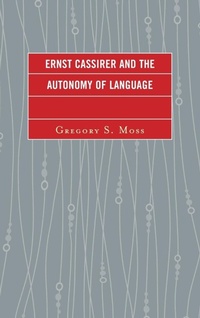
Ernst Cassirer and the Autonomy of Language
Published on 12. November 2014
Book
Hardback
274 pages
978-0-7391-8622-0 (ISBN)
Description
Ernst Cassirer and the Autonomy of Language examines the central arguments in Cassirer's first volume of the Philosophy of Symbolic Forms. Gregory Moss demonstrates both how Cassirer defends language as an autonomous cultural form and how he borrows the concept of the "concrete universal" from G. W. F. Hegel in order to develop a concept of cultural autonomy. While Cassirer rejected elements of Hegel's methodology in order to preserve the autonomy of language, he also found it necessary to incorporate elements of Hegel's method to save the Kantian paradigm from the pitfalls of skepticism. Moss advocates for the continuing relevanceof Cassirer's work on language by situating it within in the context of contemporary linguistics and contemporary philosophy. This book provides a new program for investigating Cassirer's work on the other forms of cultural symbolism in his Philosophy of Symbolic Forms, by showing how the autonomy of culture is one of the leading questions motivating Cassirer's philosophy of culture. With a thorough comparison of Cassirer's theory of symbolism to other dominant theories from the twentieth century, including Heidegger and Wittgenstein, this book provides valuable insight for studies in philosophy of language, semiotics, epistemology, pyscholinguistics, continental philosophy, Neo-Kantian philosophy, and German idealism.
Reviews / Votes
Gregory Moss . . . make[s] a further contribution . . . by focusing our attention on Cassirer's philosophy of language. . . .While Moss is motivated to distance Cassirer's account from a teleology of culture in order to resolve the tension between Verticalism and Horizontalism, it seems that Cassirer can hold that culture as a whole has the end of uniting human beings and building up a common world, while still acknowledging that each symbolic form is able to do this in its own unique way. . . .Moss's broad efforts to untangle this thorny issue remind us that this is a problem anyone interested in Cassirer's philosophy of language and culture must address. * Notre Dame Philosophical Reviews * It is a welcome event in Cassirer studies to see more work appear in English on the interpretation of The Philosophy of Symbolic Forms. Language as a symbolic form is, in many ways, a key to the other symbolic forms, as this interpretation by Gregory S. Moss emphasizes. Students and scholars concerned with the philosophy of language will find this work most useful. -- Donald Phillip Verene, Emory University Gregory S. Moss offers a careful and insightful treatment of Cassirer's account of language within his broader philosophy of culture. Special emphasis is given on the Kantian and Hegelian roots of Cassirer's philosophy of symbolic forms. This is particularly important since Kant and Hegel are indispensable for any deeper understanding of Cassirer. The book is an inspiring read not only for scholars of Cassirer's philosophy, but also for those interested in the philosophy of culture, and the history of continental philosophy in general. -- Guido Kreis, University of BonnMore details
Language
English
Place of publication
United States
Publishing group
Bloomsbury Publishing Plc
Target group
Professional and scholarly
Dimensions
Height: 235 mm
Width: 157 mm
Thickness: 21 mm
Weight
600 gr
ISBN-13
978-0-7391-8622-0 (9780739186220)
Copyright in bibliographic data and cover images is held by Nielsen Book Services Limited or by the publishers or by their respective licensors: all rights reserved.
Schweitzer Classification
Other editions
Additional editions
Gregory S. Moss
Ernst Cassirer and the Autonomy of Language
E-Book
11/2014
1st Edition
Lexington Books
€124.99
Available for download
Gregory S. Moss
Ernst Cassirer and the Autonomy of Language
E-Book
11/2014
1st Edition
Lexington Books
€124.99
Available for download
Person
Gregory Moss is a lecturer in philosophy at Clemson University.
Content
1. Hegelian Psycholinguistics
2. The Copy Theory of Language
3. Kant's Transcendental Turn
4. Humboldt's Philosophy of Language
5. Towards the Schematism: Hegel's Concrete Universal
6. The Concrete Universal: Symbolic Form
7. Mystical Alternatives: Heidegger and Wittgenstein
8. On the Way to Cultural Symbolism
9. Non-Human Communication
10. The A priori Synthetic Imagination
11. Symbolic Praegnanz
12. The Grammar of the Symbolic Function
13. The Logical Function of Language
14. Form as Movement: Language as Concrete Universal
15. Beyond Language: The Serial Form of Scientific Law
16. Language: the Vehicle of Self-Knowledge
2. The Copy Theory of Language
3. Kant's Transcendental Turn
4. Humboldt's Philosophy of Language
5. Towards the Schematism: Hegel's Concrete Universal
6. The Concrete Universal: Symbolic Form
7. Mystical Alternatives: Heidegger and Wittgenstein
8. On the Way to Cultural Symbolism
9. Non-Human Communication
10. The A priori Synthetic Imagination
11. Symbolic Praegnanz
12. The Grammar of the Symbolic Function
13. The Logical Function of Language
14. Form as Movement: Language as Concrete Universal
15. Beyond Language: The Serial Form of Scientific Law
16. Language: the Vehicle of Self-Knowledge