

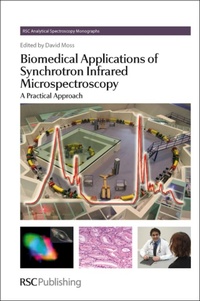
Biomedical Applications of Synchrotron Infrared Microspectroscopy
A Practical Approach
Will be published approx. on 15. December 2010
Book
Hardback
400 pages
978-0-85404-154-1 (ISBN)
Description
Publication of a multi-author textbook on the biomedical applications of synchrotron infrared microspectroscopy was a central element in the workplan of the EU project DASIM (Diagnostic Applications of Synchrotron Infrared Microspectroscopy). The project involved nearly 70 scientists and clinicians from 9 European countries, including all synchrotron facilities that have or are planning an infrared beamline. Together with its international associates from the USA, Canada and Australia, the project brought together essentially all recognized experts in the field. The project aims were to coordinate international research effort and to disseminate the relevant information amongst biological researchers and health care professionals and this multi-author textbook was conceived as the most important measure towards the aim of dissemination. The field of biomedical applications of synchrotron IR microspectroscopy, which has recently seen unprecedented growth, is extremely interdisciplinary, involving synchrotron physicists, spectroscopists, biologists and clinicians, with associated difficulties in getting these experts to understand each other. This multi-author book, from leading world experts, presents all aspects of the field in language that all the disparate experts involved can understand. It demystifies the subject both for clinicians and biologists who find synchrotron physics difficult to understand and for physicists who find medical/biological terminology incomprehensible. The book focuses specifically on biomedical IR spectroscopy using synchrotron light sources with particular emphasis on understandable presentation of necessary background knowledge, digestible summaries of research progress and above all as a practical 'how to do it' guide for those working in or wishing to enter the field of biomedical synchrotron IR microspectroscopy and imaging. Key features of the book include:- * a 'Fundamentals' section, explaining the basics of synchrotrons and FTIR spectroscopy as well as the needs of clinicians and biologists with respect to these technologies * a 'Technical Aspects' section, going into depth on optical issues, sample preparation and study design/data analysis * case studies bringing together these 2 elements through practical examples * Raman microspectroscopy, as an alternative approach, is explored in depth * the foreword is written by Henry Mantsch and Gwynn Williams, the two undisputed experts in the fields of biomedical FTIR spectroscopy and synchrotron IR microspectroscopy respectively
More details
Series
Language
English
Place of publication
Cambridge
United Kingdom
Target group
College/higher education
Professional and scholarly
Product notice
Unsewn / adhesive bound
Dimensions
Height: 240 mm
Width: 158 mm
Thickness: 20 mm
Weight
721 gr
ISBN-13
978-0-85404-154-1 (9780854041541)
Copyright in bibliographic data and cover images is held by Nielsen Book Services Limited or by the publishers or by their respective licensors: all rights reserved.
Schweitzer Classification
Other editions
Additional editions
E-Book
12/2010
1st Edition
Royal Society of Chemistry
€192.99
Available for download
Person
Dr David Moss has been staff scientist at Synchrotron Light Source ANKA, Karlsruhe Research Center since 2001 and is responsible for biological applications at the infrared spectroscopy and microspectroscopy beamline. His current research interests include biomolecular and biomedical applications of infrared spectroscopy; structure/function relationships and molecular mechanisms in proteins; synchrotron infrared microspectroscopy of single living cells and mechanism of charge separation in biomimetic nanosystems for artificial photosynthesis. Dr Moss received his BSc in biology from Imperial College London in 1981 and his PhD in biochemistry from Cambridge University in 1985. He has held postdoctoral positions in biochemistry/biophysics in the UK and Germany and since 1987 his main field of expertise has been in the biological applications of infrared spectroscopy. He has had his permanent position at the Karlsruhe Research Center (a German government research laboratory) since 1990. Dr Moss initiated and organized a workshop on "Biological Applications of Synchrotron Infrared in Europe" in Karlsruhe in 2003 and was the organizer of the "International Summer School on Synchrotron Infrared Microspectroscopy", June 2008 in Karlsruhe, Germany. He was also the coordinator of an EU project "Diagnostic Applications of Synchrotron Infrared Microspectroscopy" from 2005 - 2008 and has contributed to many journal articles and book chapters.
Content
Vibrational Spectroscopy: what does the clinician need?;
Mid-infrared Spectroscopy: The Basics;
Infrared synchrotron radiation beamlines: high brilliance tools for IR;
Spectromicroscopy;
Raman Microscopy: Complement or Competitor?;
Preparation of Tissues and Cells for Infrared and Raman Spectroscopy and Imaging;
Data Acquisition and Analysis in Biomedical Vibrational Spectroscopy;
Synchrotron Radiation as a Source for Infrared Microspectroscopic Imaging with 2D Multi-Element Detection;
Scattering in biomedical infrared spectroscopy;
Head and Neck Cancer: observations from synchrotron-sourced mid-infrared spectroscopy investigations;
Single Cell Analysis of TSE-infected Neurons;
Monitoring the effects of cisplatin uptake in rat glioma cells: A preliminary study using Fourier transform infrared synchrotron microspectroscopy;
Mid-Infrared Reflectivity of Mouse Atheromas: A Case Study
Mid-infrared Spectroscopy: The Basics;
Infrared synchrotron radiation beamlines: high brilliance tools for IR;
Spectromicroscopy;
Raman Microscopy: Complement or Competitor?;
Preparation of Tissues and Cells for Infrared and Raman Spectroscopy and Imaging;
Data Acquisition and Analysis in Biomedical Vibrational Spectroscopy;
Synchrotron Radiation as a Source for Infrared Microspectroscopic Imaging with 2D Multi-Element Detection;
Scattering in biomedical infrared spectroscopy;
Head and Neck Cancer: observations from synchrotron-sourced mid-infrared spectroscopy investigations;
Single Cell Analysis of TSE-infected Neurons;
Monitoring the effects of cisplatin uptake in rat glioma cells: A preliminary study using Fourier transform infrared synchrotron microspectroscopy;
Mid-Infrared Reflectivity of Mouse Atheromas: A Case Study