

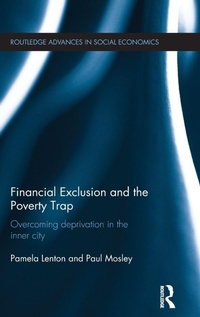
Financial Exclusion and the Poverty Trap
Overcoming Deprivation in the Inner City
1st Edition
Published on 19. October 2011
Book
Hardback
216 pages
978-0-415-46039-2 (ISBN)
Description
The persistence of poverty hurts us all, and attacking poverty is a major policy objective everywhere. In Britain, the main political parties have an anti-poverty mandate and in particular an agreed commitment to eliminate child poverty by 2020, but there is controversy over how this should be done. This book addresses one of the main causes of poverty, financial exclusion - the inability to access finance from the high-street banks. People on low or irregular incomes typically have to resort to loan sharks, 'doorstep lenders' and other informal credit sources, a predicament which makes escape from the poverty trap doubly difficult.
Over the last fifteen years, a strategy of breaking down the poverty trap has been implemented, known in the UK as community development financial institutions (CDFIs), typically non-profit lending institutions focussed on the financially excluded, and seeking to learn from the achievements of microfinance around the world. Focussing on the period 2007-09, during which the UK went into a global recession, this book investigates how CDFIs work and how well they have helped low-income people and businesses to weather that recession. Based on a study of eight CDFIs in four UK cities, we ask: what ideas for overcoming financial exclusion have worked well, and which have worked badly? What can we learn from the experience of these CDFIs which can help reduce poverty in this country and globally?
We assess the impact of CDFIs using a range of indicators (including income, assets, education, health) and ask what changes in policy by both CDFIs and government agencies (for example, benefits agencies) might be able to increase impact. Some of the key lessons are: CDFIs need to work with appropriate partners to build up savings capacity in their clients; the community environment is vital in determining who escapes from the poverty trap; and CDFIs can never function properly unless they learn how to control their overdue debts.
This book will be vital reading for those concerned with social policy, microfinance and anti-poverty policies in industrialised countries and around the world.
Over the last fifteen years, a strategy of breaking down the poverty trap has been implemented, known in the UK as community development financial institutions (CDFIs), typically non-profit lending institutions focussed on the financially excluded, and seeking to learn from the achievements of microfinance around the world. Focussing on the period 2007-09, during which the UK went into a global recession, this book investigates how CDFIs work and how well they have helped low-income people and businesses to weather that recession. Based on a study of eight CDFIs in four UK cities, we ask: what ideas for overcoming financial exclusion have worked well, and which have worked badly? What can we learn from the experience of these CDFIs which can help reduce poverty in this country and globally?
We assess the impact of CDFIs using a range of indicators (including income, assets, education, health) and ask what changes in policy by both CDFIs and government agencies (for example, benefits agencies) might be able to increase impact. Some of the key lessons are: CDFIs need to work with appropriate partners to build up savings capacity in their clients; the community environment is vital in determining who escapes from the poverty trap; and CDFIs can never function properly unless they learn how to control their overdue debts.
This book will be vital reading for those concerned with social policy, microfinance and anti-poverty policies in industrialised countries and around the world.
More details
Series
Language
English
Place of publication
London
United Kingdom
Publishing group
Taylor & Francis Ltd
Target group
College/higher education
Illustrations
18 s/w Abbildungen, 18 s/w Zeichnungen, 29 s/w Tabellen
29 Tables, black and white; 18 Line drawings, black and white; 18 Illustrations, black and white
Dimensions
Height: 240 mm
Width: 161 mm
Thickness: 17 mm
Weight
517 gr
ISBN-13
978-0-415-46039-2 (9780415460392)
Copyright in bibliographic data and cover images is held by Nielsen Book Services Limited or by the publishers or by their respective licensors: all rights reserved.
Schweitzer Classification
Other editions
Additional editions
Paul Mosley | Pamela Lenton
Financial Exclusion and the Poverty Trap
Overcoming Deprivation in the Inner City
Book
07/2014
1st Edition
Routledge
€78.40
Shipment within 10-20 days
Paul Mosley | Pamela Lenton
Financial Exclusion and the Poverty Trap
Overcoming Deprivation in the Inner City
E-Book
02/2012
Routledge
€72.49
Available for download
Paul Mosley | Pamela Lenton
Financial Exclusion and the Poverty Trap
Overcoming Deprivation in the Inner City
E-Book
02/2012
1st Edition
Routledge
€72.49
Available for download
Persons
Pamela Lenton is a Lecturer in Economics at the University of Sheffield, UK.
Paul Mosley is Professor of Economics at the University of Sheffield, UK.
Paul Mosley is Professor of Economics at the University of Sheffield, UK.
Content
Preface 1. Introduction 2. Scope and Method 3. Financial Performance of CDFIs 4. CDFI Clients: Impacts on Individuals 5. Community-level Impacts 6. Fiscal Impact 7. Where Next? Appendix: Transitions out of Poverty and their Correlates