

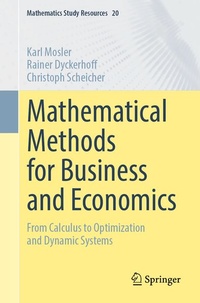
Mathematical Methods for Business and Economics
Description
This book introduces main concepts and techniques, enables students to read economic texts, understand economic models and apply optimization methods. It accompanies students throughout their bachelor's and master's studies and serves as a reference book. Numerous learning aids, worked examples, and exercises with short solutions facilitate self-study.
A special feature of the book is the close link between mathematical concepts and those of economics and operations research: To clarify the role of mathematical methods as part of the basic training in economics, production and utility functions are introduced early on, as are models of interest and growth of an economy.
The prerequisite for this textbook is high school mathematics, including introductory courses on real functions and differential calculus as well as algebraic operations, trigonometric functions and analytical geometry. Appendices provide summaries of specific material for short reference.
This book is a translation of the original German edition Mathematische Methoden für Ökonomen , 3rd edition, by Karl Mosler, Rainer Dyckerhoff and Christoph Scheicher, published by Springer-Verlag GmbH, DE in 2018. The translation was done with the help of an artificial intelligence machine translation tool. A subsequent human revision was done primarily in terms of content, so that the book will read stylistically differently from a conventional translation.
More details
Persons
Karl Mosler is professor emeritus of statistics and econometrics at the University of Cologne.
Rainer Dyckerhoff is teaching statistics and mathematics as a professor at the University of Cologne.
Christoph Scheicher is teaching mathematical methods for business and economics at the University of Cologne.
Content
Functions.- Matrices and vectors.- Sequences, series and continuous functions.- Differentiable functions of one variable.- Differentiable functions of several variables.- Optimization of functions of several variables.- Integral calculus.- Linear equations.- Fundamentals of linear algebra.- Determinants and eigenvalues of matrices.- Linear optimization.- Differential equations.- Difference Equations.- Appendices: Greek letters.- Sets.- Sums and products.- Combinatorics.- Complex Numbers.- Propositional logic.- Mathematical proofs.- Short solutions to the self-tests.- Short solutions to the exercises.