

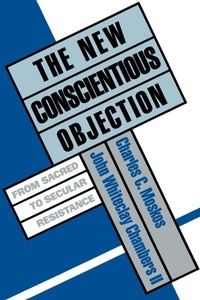
The New Conscientious Objection
From Sacred to Secular Resistance
Published on 10. June 1993
Book
Paperback/Softback
296 pages
978-0-19-507955-5 (ISBN)
Description
Conscientious objection to military service has grown rapidly in recent years-this is the first comprehensive and scholarly treatment of the subject. The book examines the changing motives and patterns of conscientious objection as well as state policies toward objectors in the western world.
Reviews / Votes
"It combines scrupulous scholarly detail with a degree of sophistication in analysis and general conceptualization not equaled elsewhere in the literature....The editors have compiled a highly useful reference source for scholars and activists, and on that basis alone have produced a work worthy of inclusion in any private or institutional library....The book's quality and usefulness are beyond question."--Peace & Change"A first-rate review of the current status of conscientious objection in the industrialized world, including excellent historical reviews of the evolution of the religious and philosophical bases behind the idea of conscientious objection....It will be an asset to all scholars, analysts, and policymakers who deal with the recruiting and maintaining of armed forcces, both in the United States and elsewhere."--Journal of Military History
"This is a fascinating exploration of the origins, nature, and significance of modern conscientious objection. Those of us who deal with conscientious objectors every day can confirm the authors' thesis that today's conscientious objection is more secular than religious, that it is widespread rather than marginal, and that principled refusal to bear arms can affect political and social events. This book will be an essential part of the library of anyone who
wants to understand conscientious objection."--Robert A. Seeley, Central Committee for Conscientious Objectors
"This book makes a serious contribution to the study of military institutions."--Contemporary Sociology
"The shift in the concept of citizenship from that of citizen soldier bearing arms to defend the state to that of the citizen server making the state and the world of which it is a part a more secure home for all peoples, is one of the least noticed but possibly most important developments of this century and the next. The Moskos-Chambers book is a remarkable documentation of this silent transformation and the role of conscientious objection in it. This is a
"must read" for strategic thinkers, peace researchers, policy planners and activists."--Elise Boulding, Dartmouth College
"It combines scrupulous scholarly detail with a degree of sophistication in analysis and general conceptualization not equaled elsewhere in the literature....The editors have compiled a highly useful reference source for scholars and activists, and on that basis alone have produced a work worthy of inclusion in any private or institutional library....The book's quality and usefulness are beyond question."--Peace & Change
"A first-rate review of the current status of conscientious objection in the industrialized world, including excellent historical reviews of the evolution of the religious and philosophical bases behind the idea of conscientious objection....It will be an asset to all scholars, analysts, and policymakers who deal with the recruiting and maintaining of armed forcces, both in the United States and elsewhere."--Journal of Military History
"This is a fascinating exploration of the origins, nature, and significance of modern conscientious objection. Those of us who deal with conscientious objectors every day can confirm the authors' thesis that today's conscientious objection is more secular than religious, that it is widespread rather than marginal, and that principled refusal to bear arms can affect political and social events. This book will be an essential part of the library of anyone who
wants to understand conscientious objection."--Robert A. Seeley, Central Committee for Conscientious Objectors
"This book makes a serious contribution to the study of military institutions."--Contemporary Sociology
"The shift in the concept of citizenship from that of citizen soldier bearing arms to defend the state to that of the citizen server making the state and the world of which it is a part a more secure home for all peoples, is one of the least noticed but possibly most important developments of this century and the next. The Moskos-Chambers book is a remarkable documentation of this silent transformation and the role of conscientious objection in it. This is a
"must read" for strategic thinkers, peace researchers, policy planners and activists."--Elise Boulding, Dartmouth College
"A comprehensive, scholarly collection of essays that will be obligatory reading for anyone interested in the subject."--Martin von Crevald, The Hebrew University of Jerusalem
"Charles Moskos is one of the most outstanding contributors to Military Sociology. The New Conscientious Objection is a World Class book."--Raymond Tanter, niv. of Michigan
"An excellent primer to an issue that is of interest--possibly urgency--to millions of young people."--Daniel Brown, California State University
"[A] useful collection of nation-by-nation essays."--Times Literary Supplement
More details
Language
English
Place of publication
New York
United States
Target group
Professional and scholarly
Illustrations
line drawings, tables
Dimensions
Height: 229 mm
Width: 152 mm
Thickness: 18 mm
Weight
490 gr
ISBN-13
978-0-19-507955-5 (9780195079555)
Copyright in bibliographic data and cover images is held by Nielsen Book Services Limited or by the publishers or by their respective licensors: all rights reserved.
Schweitzer Classification
Other editions
Additional editions
Charles C. Moskos | John Whiteclay Ii Chambers
The New Conscientious Objection
From Sacred to Secular Resistance
E-Book
04/1993
1st Edition
OUP eBook
€74.99
Available for download
Content
PART I: INTRODUCTION: THE SECULARIZATION OF CONSCIENCE
1: The Secularization of Conscience
PART II: THE UNITED STATES
2: The United States: COs and the State, from Colonial Times to the Present
3: The Dilemma of Conscientious Objection for Afro-Americans
4: Alternative Service in a Future Draft
PART III: INTERNATIONAL PERSPECTIVES
5: Britain: From Individual Conscience to Social Movement
6: France: A Statute but no Objectors
7: Federal Republic of Germany: Conscientious Objection as Social Welfare
8: Denmark: The Vanguard of Conscientious Objection
9: Norway: Toward Full Freedom Of Choice
10: South Africa: From Laager to Anti-Apartheid
11: Switzerland: Questioning the Citizen Soldier
12: Israel: Conscientious Objection in a Democracy Under Seige
13: Socialist Countries: The Old Orders Crumble
14: Democratic Republic of Germany: Dissedence that Prevailed
PART IV: CONCLUSION: THE SECULARIZATION OF CONSCIENCE RECONSIDERED
15: The Legal Aspects of Conscientious Objection: A Comparative Analysis
16: Conclusion
Index
1: The Secularization of Conscience
PART II: THE UNITED STATES
2: The United States: COs and the State, from Colonial Times to the Present
3: The Dilemma of Conscientious Objection for Afro-Americans
4: Alternative Service in a Future Draft
PART III: INTERNATIONAL PERSPECTIVES
5: Britain: From Individual Conscience to Social Movement
6: France: A Statute but no Objectors
7: Federal Republic of Germany: Conscientious Objection as Social Welfare
8: Denmark: The Vanguard of Conscientious Objection
9: Norway: Toward Full Freedom Of Choice
10: South Africa: From Laager to Anti-Apartheid
11: Switzerland: Questioning the Citizen Soldier
12: Israel: Conscientious Objection in a Democracy Under Seige
13: Socialist Countries: The Old Orders Crumble
14: Democratic Republic of Germany: Dissedence that Prevailed
PART IV: CONCLUSION: THE SECULARIZATION OF CONSCIENCE RECONSIDERED
15: The Legal Aspects of Conscientious Objection: A Comparative Analysis
16: Conclusion
Index