

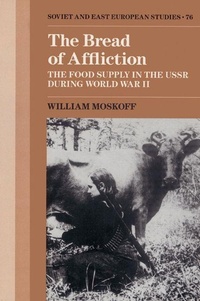
The Bread of Affliction
The Food Supply in the USSR during World War II
Published on 8. August 2002
Book
Paperback/Softback
276 pages
978-0-521-52283-0 (ISBN)
Description
This book tells how the Soviet Union fed itself after the invasion by the Germans during World War II. The author argues that central planning became much less important in feeding the population, and civilians were thereby forced to become considerably more self reliant in feeding themselves. A rationing system was instituted soon after the war began, but quickly became irrelevant because of the chronic food shortages. The breakdown in central supplies of food was accompanied by the diminished importance of the rouble, which in many places was replaced by bread and clothing as the medium of exchange. Although the Soviet army was given high precedence over civilians, the author also shows that the population living under German occupation was much worse off than were Soviet civilians living in the rear. In addition to extensive use of American and German archives from the war period, the author interviewed more than thirty Soviet emigres who survived the war.
Reviews / Votes
"This is the best book on the subject yet to appear in any language, and it is a delight to have it in print." W. Bruce Lincoln, Annals of the American Academy "...a very readable and interesting account of Soviet efforts to feed the Red Army and civilian population during the Second World War....Moskoff has written an important book, one that helps fill a glaring gap in the historical literature. He has utilized a wide array of sources, including interviews of Soviet emigres, in an effort to provide an informative account of this grim chapter of Soviet history." Thomas J. Greene, Canadian Slavonic Papers "William Moskoff has produced a very informative, logically organized, and carefully written account of a topic that is important....The Bread of Affiction is a major contribution to our understanding of the social and economic crises confronting the USSR during the war with Germany." Richard Bidlack, The Russian ReviewMore details
Series
Language
English
Place of publication
Cambridge
United Kingdom
Target group
Professional and scholarly
Interest Age: From 0 years
Product notice
Paperback (trade)
Illustrations
40 Tables, unspecified
Dimensions
Height: 229 mm
Width: 152 mm
Thickness: 16 mm
Weight
452 gr
ISBN-13
978-0-521-52283-0 (9780521522830)
Copyright in bibliographic data and cover images is held by Nielsen Book Services Limited or by the publishers or by their respective licensors: all rights reserved.
Schweitzer Classification
Person
Content
Acknowledgement; Abbreviations; Introduction; 1. On the eve of the War; 2. The desperate months of 1941: invasion and evacuation; 3. The German Occupation; 4. Producing food for the Unoccupied USSR: the factors of production; 5. Local food sources; 6. The first priority: feeding the armed forces; 7. Feeding the cities and towns: civilian rationing; 8. White and Black Markets: the safety valve for civilian food supply; 9. Crime and privilege; 10. Death's dominion: the Siege of Leningrad; 11. The newly liberated areas: restoring the food supply; 12. The wages of hunger: direct and indirect consequences of wartime food shortages; Conclusion; Bibliography.