

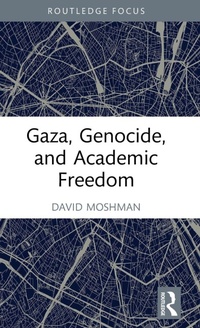
Gaza, Genocide, and Academic Freedom
1st Edition
Published on 11. May 2026
Book
Hardback
118 pages
978-1-041-16692-4 (ISBN)
Description
This book analyzes Israeli military actions in Gaza following the Hamas attacks of October 7, 2023, offering a rigorous assessment through the lens of genocide studies. Drawing on established theoretical frameworks, the author demonstrates how these events align with recognized definitions of genocide, challenging readers to confront difficult questions about collective violence and responsibility. The analysis explores how Israeli actions are shaped by historical trauma, particularly the Holocaust, and fears that Palestinian control of the same area would threaten Jewish existence.
Through meticulous research, the book reveals the mechanisms enabling mass violence: identity polarization, dehumanization, and psychological denial that preserves moral self-image. In a parallel investigation, the author documents widespread attempts to suppress academic and public discourse on Israel-Palestine relations. Through carefully documented case studies involving academic censorship, professional retaliation, deportations, and institutional interference, the book makes a powerful case for protecting free inquiry as essential to understanding and addressing complex geopolitical conflicts.
This volume will appeal to scholars specializing in genocide and related forms of group violence, students learning about these topics, and anyone interested in academic freedom issues and current events associated with Gaza.
Through meticulous research, the book reveals the mechanisms enabling mass violence: identity polarization, dehumanization, and psychological denial that preserves moral self-image. In a parallel investigation, the author documents widespread attempts to suppress academic and public discourse on Israel-Palestine relations. Through carefully documented case studies involving academic censorship, professional retaliation, deportations, and institutional interference, the book makes a powerful case for protecting free inquiry as essential to understanding and addressing complex geopolitical conflicts.
This volume will appeal to scholars specializing in genocide and related forms of group violence, students learning about these topics, and anyone interested in academic freedom issues and current events associated with Gaza.
Reviews / Votes
Happily for his readers-who with his new book, Gaza, Genocide, and Academic Freedom, should be legion-David Moshman's clarity of writing matches the breadth of his learning and the depth of his insight. And his intellectual candor is matched by his moral courage. The publication of this book is a major intervention in the public discourse about the crisis in Palestine/Israel. Moshman's dispassionate analysis will leave few readers unmoved, whether in sympathy or outrage. Gaza, Genocide, and Academic Freedom sets a high scholarly standard and will be the go-to book for years to come.--Roger Bergman, professor emeritus at Creighton University, founder and long-time director of its Justice & Peace Studies program,and author of Preventing Unjust War.
Gaza, Genocide, and Academic Freedom has taught me much about genocide, including the simple notion that a central feature of genocide is denial that there is indeed a genocide. In a lifetime of work, David links individual cognition and psychology to the larger civic and political world, promoting "collaborative dialogue" as a centerpiece of democracy that is so needed now to confront not only this genocide but all the issues of our day....We haven't stopped the madness of the genocide, even as it manifests differently from month to month. But this book helps us to keep working at it by speaking out, teaching about it, and resisting censorship.
--from the foreword by Mary Beth Tinker, plaintiff in Tinker v. Des Moines (1969) and lifelong advocate for student freedom of expression
More details
Series
Language
English
Place of publication
London
United Kingdom
Publishing group
Taylor & Francis Ltd
Target group
College/higher education
Postgraduate and Undergraduate Advanced
Dimensions
Height: 146 mm
Width: 224 mm
Thickness: 13 mm
Weight
278 gr
ISBN-13
978-1-041-16692-4 (9781041166924)
Copyright in bibliographic data and cover images is held by Nielsen Book Services Limited or by the publishers or by their respective licensors: all rights reserved.
Schweitzer Classification
Other editions
Additional editions
David Moshman
Gaza, Genocide, and Academic Freedom
E-Book
05/2026
1st Edition
Routledge
€31.49
Available for download
David Moshman
Gaza, Genocide, and Academic Freedom
E-Book
05/2026
1st Edition
Routledge
€31.49
Available for download
Person
David Moshman is a professor emeritus of educational psychology at the University of Nebraska-Lincoln, where he taught developmental and cognitive psychology. His research has focused on the development of reasoning and rationality, adolescent competence and rights, the intellectual freedom of students and teachers, the conceptualization of genocide, and the role of identity in group violence. He is the author of seven books including Liberty and Learning (2009), Adolescent Rationality and Development (third edition, 2011), Epistemic Cognition and Development (2015), and Reasoning, Argumentation, and Deliberative Democracy (2021).
Content
Foreword by Mary Beth Tinker Preface 1. Introduction and Overview 2. Defining Genocide 3. Genocide in Gaza 4. Denying the Gaza Genocide 5. Explaining the Gaza Genocide 6. Talking about the Gaza Genocide 7. Teaching and Learning about the Gaza Genocide 8. Conclusion References Author Index Subject Index