

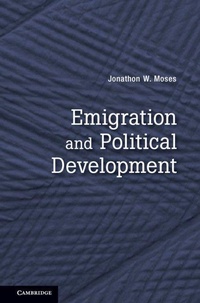
Emigration and Political Development
01st Edition
Published on 26. September 2011
Book
Hardback
302 pages
978-0-521-19543-0 (ISBN)
Description
While policy makers, international organizations and academics are increasingly aware of the economic effects of emigration, the potential political effects remain understudied. This book maps the nature of the relationship that links emigration and political development. Jonathon W. Moses explores the nature of political development, arguing that emigration influences political development. In particular, he introduces a new cross-national database of annual emigration rates and analyzes specific cases of international emigration (and out-migration within countries) under varying political and economic contexts.
Reviews / Votes
"This is, to my knowledge, the first work that systematically looks at the impact of emigration on political development. It is compelling in its sweeping scope and methodological rigor. Its central message that emigration is good for democracy in sending states is uncomfortable news for our restriction-minded liberal democracies."- Christian Joppke, University of Bern "Jonathon Moses has written an important and timely book. While the topic of migration is now one of the hot topics in comparative politics, most scholars have focused on the effects of immigration into the industrialized world. Of course, this is only half of the story. Moses' interesting and comprehensive analysis teaches us about the other half of the story: What are the effects of people leaving their homes on political and economic development? This book thus makes a significant contribution to the study of comparative politics."
- Sven Steinmo, European University Institute "Migration is generally considered to improve the economic well-being of the individual, though its broader effects on society and the polity are poorly understood. In this subtle analysis of emigration and political development, Jonathon Moses opens a new line of inquiry and his findings are original and provocative. Anyone interested in how mobility effects political change will want to read this book."
- James F. Hollifield, Professor of Political Science, Southern Methodist University
More details
Language
English
Place of publication
Cambridge
United Kingdom
Target group
Professional and scholarly
Illustrations
20 Tables, unspecified; 18 Line drawings, unspecified
Dimensions
Height: 235 mm
Width: 157 mm
Thickness: 23 mm
Weight
659 gr
ISBN-13
978-0-521-19543-0 (9780521195430)
Copyright in bibliographic data and cover images is held by Nielsen Book Services Limited or by the publishers or by their respective licensors: all rights reserved.
Schweitzer Classification
Other editions
Additional editions
Jonathon W. Moses
Emigration and Political Development
E-Book
11/2011
1st Edition
Cambridge University Press
€21.99
Available for download
Jonathon W. Moses
Emigration and Political Development
Book
09/2011
01st Edition
Cambridge University Press
€39.80
Shipment within 15-20 days
Jonathon W. Moses
Emigration and Political Development
E-Book
09/2011
Cambridge University Press
€21.99
Available for download
Person
Jonathon W. Moses is currently a professor of political science at the Norwegian University of Science and Technology, where he has taught since 1993. Moses has published several books including Ways of Knowing (2007), International Migration: Globalization's Last Frontier (2006) and Norwegian Catch-up: Development and Globalization before World War II (2005). He is a co-editor of European Political Science (EPS). Among his research interests are globalization, international migration, social democracy and the European Union. Among other places, his articles have appeared in the pages of World Development, the Journal of Common Market Studies and Politics and Society.
Content
1. Introduction; 2. Toward political development; 3. Linking emigration to political development; 4. Global connections; 5. The free migration regime before WWI; 6. Guest-worker programs after WWII; 7. Limited mobility in the world today; 8. Internal migration; 9. Fellow travellers; 10. Conclusion.