

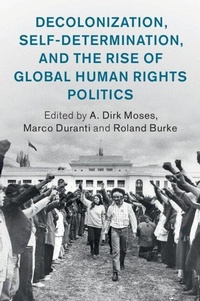
Decolonization, Self-Determination, and the Rise of Global Human Rights Politics
Published on 8. December 2022
Book
Paperback/Softback
448 pages
978-1-108-74970-1 (ISBN)
Description
This volume presents the first global history of human rights politics in the age of decolonization. The conflict between independence movements and colonial powers shaped the global human rights order that emerged after the Second World War. It was also critical to the genesis of contemporary human rights organizations and humanitarian movements. Anti-colonial forces mobilized human rights and other rights language in their campaigns for self-determination. In response, European empires harnessed the new international politics of human rights for their own ends, claiming that their rule, with its promise of 'development,' was the authentic vehicle for realizing them. Ranging from the postwar partitions and the wars of independence to Indigenous rights activism and post-colonial memory, this volume offers new insights into the history and legacies of human rights, self-determination, and empire to the present day.
Reviews / Votes
'Tracing the global debate over human rights from a world dominated by empires to that made up of nation states, this strikingly original collection of essays reveals a rich and unexpectedly innovative history.' Faisal Devji, University of Oxford 'This compelling collection of original essays highlights the transmutation of human rights languages and emancipatory policies as practiced by anti-colonial activists, defenders of new nations, and promoters of colonial and neoliberal policies through the second half of the twentieth century. The book's geographic and thematic focus overcomes a persistent Western bias in the literature and is a must read for our conflicted geopolitical age.' Jean H. Quataert, Distinguished Professor of History, Binghamton University 'This field-defining collection represents a breakthrough in the historiography of human rights, focused firmly on the human rights visions and experiences of the decolonizing world. The authors demonstrate that the emergence of global human rights after 1945 was inextricably entwined with the efforts of anticolonial movements and thinkers to imagine new states and citizens, as well as the determination of the colonial powers to contain them.' Brad Simpson, University of Connecticut '... scholars interested in indigenous rights, genocide, crimes against humanity, and other topics related to postcolonial history will find relevant chapters assembled and woven seamlessly together. The theoretical underpinnings of the work will benefit graduate students and scholars of Cold War history, decolonization, and human rights because the volume challenges the standard narrative of the development of human rights in the 20th century.' H. L. Katz, ChoiceMore details
Series
Language
English
Place of publication
Cambridge
United Kingdom
Target group
Professional and scholarly
Product notice
Paperback (trade)
Illustrations
Worked examples or Exercises
Dimensions
Height: 230 mm
Width: 156 mm
Thickness: 30 mm
Weight
624 gr
ISBN-13
978-1-108-74970-1 (9781108749701)
Copyright in bibliographic data and cover images is held by Nielsen Book Services Limited or by the publishers or by their respective licensors: all rights reserved.
Schweitzer Classification
Other editions
Additional editions
A. Dirk Moses | Marco Duranti | Roland Burke
Decolonization, Self-Determination, and the Rise of Global Human Rights Politics
Book
07/2020
Cambridge University Press
€165.50
Shipment within 15-20 days
Persons
Content
Introduction. Human rights, empire, and after Roland Burke, Marco Duranti and A. Dirk Moses; Part I. Anti-colonial struggles and the right to self-determination: 1. Seeking the political kingdom: universal human rights and the anti-colonial movement in Africa Bonny Ibhawoh; 2. Decolonizing the United Nations: Anti-colonialism and human rights in the French Empire Marco Duranti; 3. The French Red Cross, decolonization, and humanitarianism during the Algerian War Jennifer Johnson; 4. Connecting indigenous rights to human rights in the Anglo settler states: Another 1970s story Miranda Johnson; 5. Privileging the Cold War over decolonization: The US emphasis on political rights Mary Ann Heiss; Part II. Post-colonial statehood and global human rights norms: 6. Cutting out the ulcer and washing away the incubus of the past: genocide prevention through population transfer A. Dirk Moses; 7. Codifying minority rights: postcolonial constitutionalism in Burma, Ceylon, and India Cindy Ewing; 8. Between ambitions and caution: India, human rights, and self-determination at the United Nations Raphaelle Khan; 9. 'From this era of passionate self-discovery': Norman Manley, human rights, and the end of colonial rule in Jamaica Steven L. B. Jensen; 10. Re-entering histories of past imperial violence: Kenya, Indonesia, and the reach of transitional justice Michael Humphrey; Part III. Colonial and neo-colonial responses; 11. The inventors of human rights in Africa: Portugal, late colonialism, and the UN human rights regime Miguel Bandeira Jeronimo and Jose Pedro Monteiro; 12. 'A world made safe for diversity': Apartheid and the language of human rights, progress, and pluralism Roland Burke; 13. Between humanitarian rights and human rights: Rene Cassin, architect of universality, diplomat of French Empire Jay Winter; 14. The end of the Vietnam War and the rise of human rights Barbara Keys; 15. Decolonizing the Geneva Conventions: national liberation and the development of humanitarian law Eleanor Davey; 16. Liberte sans frontieres, French humanitarianism, and the neoliberal critique of Third Worldism Jessica Whyte.