

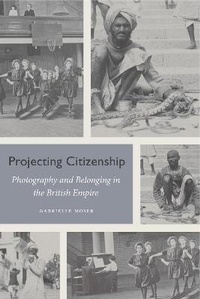
Projecting Citizenship
Photography and Belonging in the British Empire
Published on 11. January 2019
Book
Hardback
248 pages
978-0-271-08127-4 (ISBN)
Description
In Projecting Citizenship, Gabrielle Moser gives a comprehensive account of an unusual project produced by the British government's Colonial Office Visual Instruction Committee at the beginning of the twentieth century-a series of lantern slide lectures that combined geography education and photography to teach schoolchildren around the world what it meant to look and to feel like an imperial citizen.
Through detailed archival research and close readings, Moser elucidates the impact of this vast collection of photographs documenting the land and peoples of the British Empire, circulated between 1902 and 1945 in classrooms from Canada to Hong Kong, from the West Indies to Australia. Moser argues that these photographs played a central role in the invention and representation of imperial citizenship. She shows how citizenship became a photographable and teachable subject by tracing the intended readings of the images that the committee hoped to impart to viewers and analyzing how spectators may have used their encounters with these photographs for protest and resistance.
Interweaving political and economic history, history of pedagogy, and theories of citizenship with a consideration of the aesthetic and affective dimensions of viewing the lectures, Projecting Citizenship offers important insights into the social inequalities and visual language of colonial rule.
Through detailed archival research and close readings, Moser elucidates the impact of this vast collection of photographs documenting the land and peoples of the British Empire, circulated between 1902 and 1945 in classrooms from Canada to Hong Kong, from the West Indies to Australia. Moser argues that these photographs played a central role in the invention and representation of imperial citizenship. She shows how citizenship became a photographable and teachable subject by tracing the intended readings of the images that the committee hoped to impart to viewers and analyzing how spectators may have used their encounters with these photographs for protest and resistance.
Interweaving political and economic history, history of pedagogy, and theories of citizenship with a consideration of the aesthetic and affective dimensions of viewing the lectures, Projecting Citizenship offers important insights into the social inequalities and visual language of colonial rule.
Reviews / Votes
"Moser has provided an arresting account of how imperial citizenship was founded not in the undoing of colonialism but in its establishment. . . . Its contribution to the historiography of colonial citizenship and the methodology of the visual historian is decidedly momentous."-Peter K. Andersson English Historical Review "Studies such as Moser's have the merit of reminding us that the power to represent is far from an innocuous privilege in the hands of nationalist projects."
-Stephanie Hornstein History of Photography "Moser's nuanced, sophisticated, and data-rich analysis has much to offer art historians and scholars of photography, citizenship, and imperialism, and deserves to be very widely read."
-Jane Lydon CAA.Reviews "Brilliantly elucidates the inner photographic workings of the fraught historical and cultural processes that are at work whenever we see, or think we see, images of citizens. Moser's book adds important historical nuance to the burgeoning literature on photography and citizenship, demonstrating that the scenes of precarious spectatorship that came to structure concepts and practices of citizenship across the British Empire were often first produced by photography. The book also makes bold new theoretical claims. Its explorations of the disobedient gazes, experiences of photographic latency, and paradoxical desires that we continue to inherit from colonial visuality promise to enrich ongoing debates."
-Jennifer Bajorek, author of Counterfeit Capital: Poetic Labor and Revolutionary Irony "Projecting Citizenship contributes new thought and visual material to the field in a theoretically savvy manner and in dialogue with a number of theorists of photography and colonial projects. Moser lays out how colonial photography worked with other material to form a pedagogical mission to define 'imperial citizens.' This is a must-read not only for those interested in colonialism's use of photography in defining colonial subjects but also for those readers of photography and European imperialism who understand the intersubjective process as one fraught with anxieties, dangers, and promises but also containing the underpinnings of colonialism's eventual unmaking."
-Stephen Sheehi, author of The Arab Imago: A Social History of Portrait Photography, 1860-1910 "This assiduously researched book positions itself at the intersection of two expanding fields of scholarship: studies of the ideological processes of colonialism and the practice and significance of magic-lantern shows."
-Geoffrey Batchen The Art Bulletin
More details
Language
English
Place of publication
University Park
United States
Target group
Professional and scholarly
Product notice
sewn/stitched
Illustrations
64 Halftones, black and white
Dimensions
Height: 254 mm
Width: 178 mm
Thickness: 254 mm
Weight
748 gr
ISBN-13
978-0-271-08127-4 (9780271081274)
Copyright in bibliographic data and cover images is held by Nielsen Book Services Limited or by the publishers or by their respective licensors: all rights reserved.
Schweitzer Classification
Person
Gabrielle Moser is Assistant Professor of Art History at OCAD University.
Content
Contents
List of IllustrationsPreface: Archival Reconstructions
Acknowledgments
Introduction: Citizenship in and out of Sight
1. The Spectator: Projecting Imperial Citizens in England and India2. The Photographer: Looking Along
3. The Subject: Developing the Image of the Indentured Laborer
4. The Archive: Residues of Noncitizens in the COVIC Archive
ConclusionFrom Imperial to Global Citizens: Picturing Citizenship in the Present
Notes
Bibliography
Index
List of IllustrationsPreface: Archival Reconstructions
Acknowledgments
Introduction: Citizenship in and out of Sight
1. The Spectator: Projecting Imperial Citizens in England and India2. The Photographer: Looking Along
3. The Subject: Developing the Image of the Indentured Laborer
4. The Archive: Residues of Noncitizens in the COVIC Archive
ConclusionFrom Imperial to Global Citizens: Picturing Citizenship in the Present
Notes
Bibliography
Index