

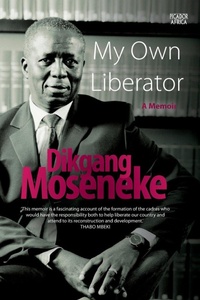
My Own Liberator
A Memoir
Published on 1. October 2016
Book
Paperback/Softback
400 pages
978-1-77010-508-9 (ISBN)
Description
In this memoir, the first of two, Dikgang Moseneke pays homage to the many people and places that have helped to define and shape him. These influences include his ancestry; his parents; his immediate and extended family; and his education both in school and on Robben Island as a 15-year-old prisoner. These people and places played a significant role in forming his principled stance in life and his proud defiance of all forms of injustice. Robben Island became a school not only in politics but an opportunity for dedicated studies towards a law degree that would provide the bedrock for a long and fruitful career. The book charts Moseneke' s rise as one of the country's top legal minds, who not only helped to draft the Constitution, but for 15 years acted as a guardian of it for all South Africans. Not only did Moseneke assist in shaping our new Constitution, he has helped to make it a living document for many South Africans over the past 15 years.
More details
Language
English
Place of publication
Johannesburg
South Africa
Publishing group
Pan Macmillan South Africa
Target group
College/higher education
Professional and scholarly
Reading Age: From 16 to 99 years, Interest Age: From 16 to 99 years
Product notice
Paperback (UK-trade)
Dimensions
Height: 234 mm
Width: 156 mm
Thickness: 22 mm
Weight
626 gr
ISBN-13
978-1-77010-508-9 (9781770105089)
Copyright in bibliographic data and cover images is held by Nielsen Book Services Limited or by the publishers or by their respective licensors: all rights reserved.
Schweitzer Classification
Other editions
Additional editions
Person
Dikgang Moseneke was born in Pretoria in December 1947 and went to school there. He joined the Pan-Africanist Congress (PAC) at the age of 14. The following year he was arrested, detained and convicted of participating in anti-apartheid activity. He spent ten years as a prisoner on Robben Island, where he met and befriended Nelson Mandela and other leading activists. While imprisoned he obtained a Bachelor of Arts in English and political science and a B.Iuris degree, and would later complete a Bachelor of Laws, all from the University of South Africa. He also served on the disciplinary committee of the prisoners' self-governed association football body, Makana F.A. Moseneke started his professional career as an attorney's clerk at Klagbruns Inc in Pretoria in 1976. He was admitted as an attorney in 1978 and practised for five years at Maluleke, Seriti and Moseneke. In 1983 he was called to the Pretoria Bar. His application had sparked a dispute within the Bar which culminated in its abolishing its 'whites-only' membership rule. Moseneke practised as an advocate in Johannesburg and Pretoria and was awarded senior counsel status ten years later. Moseneke worked underground for the PAC during the 1980s and became its Deputy President when it was unbanned in 1990. Moseneke also served on the technical committee that drafted the interim constitution of 1993. In 1994 he was appointed Deputy Chairperson of the Independent Electoral Commission, which conducted the first democratic elections in South Africa. In September 1994, while practising as a silk, Moseneke accepted an acting appointment to the Transvaal Provincial Division. Between 1995 and 2001, however, Moseneke left the Bar to pursue a full-time corporate career, most famously as the chair of Telkom. In November 2001 Moseneke was appointed to the High Court in Pretoria, his hometown, by then President Thabo Mbeki. A year later he was made a judge in the Constitutional Court and, in June 2005, became Deputy Chief Justice. On 4 November 2013, Moseneke was appointed Acting Chief Justice during the long-term leave of Mogoeng Mogoeng. Moseneke is regarded as one of the strongest judges on South Africa's Constitutional Court. For example, he has been praised for his 'towering legal mind' and 'commitment to fairness and justice' and described as 'a most independent-minded and imaginative jurist'. He retired in May 2016 from his position as Deputy Chief Justice.