

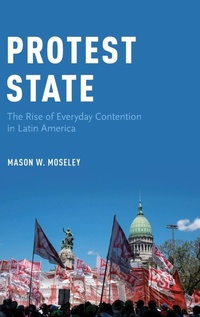
Protest State
The Rise of Everyday Contention in Latin America
Published on 7. June 2018
Book
Hardback
264 pages
978-0-19-069400-5 (ISBN)
Description
Why is social protest a normal, almost routine form of political participation in certain Latin American democracies, but not others? In light of surging protests in countries like Argentina, Brazil, and Peru, this book answers this question through a focus on recent trends in the quality of governance and socioeconomic development in the region. Specifically, it argues that increasingly engaged citizenries -- forged by economic growth and technological advances -- coupled with dysfunctional political institutions have fueled more radical modes of participation in Latin America, as citizens' demands for government responsiveness have overwhelmed many regimes' capacity to provide it. Where weak institutions and politically engaged citizenries collide, countries can morph into "protest states," where contentious participation becomes so common as to render it a conventional characteristic of everyday political life.
Drawing on cross-national surveys from Latin America and a case study of Argentina, which includes a rich dataset of protest events and dozens of interviews with political elites and citizen activists, Mason W. Moseley tests his explanation against other leading theories in the contentious politics literature. But rather than emphasizing how worsening economic conditions and mounting grievances fuel protest, this book builds the case that it is actually the improvement of economic conditions amidst low quality political institutions that lies at the root of surging contention in the region. Protest State offers a comprehensive study of one of the most intriguing puzzles in Latin American politics today: in the midst of an unprecedented era of democratic governments and economic prosperity, why are so many people protesting?
Drawing on cross-national surveys from Latin America and a case study of Argentina, which includes a rich dataset of protest events and dozens of interviews with political elites and citizen activists, Mason W. Moseley tests his explanation against other leading theories in the contentious politics literature. But rather than emphasizing how worsening economic conditions and mounting grievances fuel protest, this book builds the case that it is actually the improvement of economic conditions amidst low quality political institutions that lies at the root of surging contention in the region. Protest State offers a comprehensive study of one of the most intriguing puzzles in Latin American politics today: in the midst of an unprecedented era of democratic governments and economic prosperity, why are so many people protesting?
Reviews / Votes
Protest State is an important book. It provides rich empirical data to support a creative theory about a regime where protest becomes so quotidian as to become part of everyday political life. ...The book is a must-read for scholars interested in the region, social movements, and contentious politics in the Global South. * Mariela Daby, Perspectives in Politics *More details
Language
English
Place of publication
New York
United States
Target group
Professional and scholarly
Dimensions
Height: 240 mm
Width: 161 mm
Thickness: 19 mm
Weight
558 gr
ISBN-13
978-0-19-069400-5 (9780190694005)
Copyright in bibliographic data and cover images is held by Nielsen Book Services Limited or by the publishers or by their respective licensors: all rights reserved.
Schweitzer Classification
Other editions
Additional editions
E-Book
05/2018
1st Edition
OUP eBook
€33.99
Available for download
E-Book
05/2018
1st Edition
OUP eBook
€43.49
Available for download
Person
Mason W. Moseley is Assistant Professor of Political Science at the John D. Rockefeller IV School of Policy and Politics at West Virginia University. His research interests lie in comparative political behavior and public opinion, and he has published on topics like protest, clientelism, and civic engagement, particularly in Latin America.
Content
Acknowledgments
Chapter 1: Introduction
Chapter 2: The Rise of the Protest State: Theory and Hypotheses
Chapter 3: Contentious Engagement: Evidence from Latin American Democracies
Chapter 4: Protest from the Top Down: How Elites Marshal Contention in the Protest State
Chapter 5: Tracing the Roots of the Protest State in Argentina
Chapter 6: Narrowing the Focus: The Protest State at the Subnational Level in Argentina
Chapter 7: Uneven Democracy and Contentious Politics: An Analysis of Protest across Argentine Provinces
Chapter 8: Democracy in the Protest State: The Wave of the Future in Latin America?
Appendix
Notes
References
Index
Chapter 1: Introduction
Chapter 2: The Rise of the Protest State: Theory and Hypotheses
Chapter 3: Contentious Engagement: Evidence from Latin American Democracies
Chapter 4: Protest from the Top Down: How Elites Marshal Contention in the Protest State
Chapter 5: Tracing the Roots of the Protest State in Argentina
Chapter 6: Narrowing the Focus: The Protest State at the Subnational Level in Argentina
Chapter 7: Uneven Democracy and Contentious Politics: An Analysis of Protest across Argentine Provinces
Chapter 8: Democracy in the Protest State: The Wave of the Future in Latin America?
Appendix
Notes
References
Index