

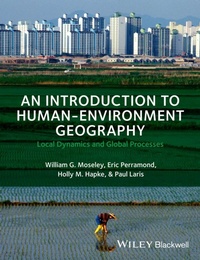
An Introduction to Human-Environment Geography
Local Dynamics and Global Processes
1st Edition
Published on 23. August 2013
Book
Paperback/Softback
416 pages
978-1-4051-8931-6 (ISBN)
Description
This introductory level text explores various theoretical approaches to human-environment geography, demonstrating how local dynamics and global processes influence how we interact with our environments.
Introduces students to fundamental concepts in environmental geography and science
Explores the core theoretical traditions within the field, along with major thematic issues such as population, food and agriculture, and water resources
Offers an engaging and unique view of the spatial relationships between humans and their environment across geographical locations around the world
Includes a variety of real-world policy questions and emphasizes geography's strong tradition of field work by featuring prominent nature-society geographers in guest field notes
Introduces students to fundamental concepts in environmental geography and science
Explores the core theoretical traditions within the field, along with major thematic issues such as population, food and agriculture, and water resources
Offers an engaging and unique view of the spatial relationships between humans and their environment across geographical locations around the world
Includes a variety of real-world policy questions and emphasizes geography's strong tradition of field work by featuring prominent nature-society geographers in guest field notes
Reviews / Votes
"This is a great textbook, which introduces students to fundamental concepts in environmental geography and science. . . It is warmly recommended to bachelor students in human ecology and to master degree students in environmental sciences and geography." (International Journal Environment & Pollution, 1 October 2014)"Contributes a much-needed geographic perspective to the burgeoning, interdisciplinary field of environmental studies.... Where many environmental science texts operate from the assumption that nature is a place without humans, this book demonstrates that even forests and soils have a human history.... Well-suited to beginning undergraduates. Chapters contain clear learning objectives, summaries, and end-of-chapter questions. Scientific and social scientific concepts are explained with a minimum of technical terminology. Geography students will find it provides a solid foundation for future studies in human-environment interactions... fills an important niche by adding a distinctly geographical voice to the environmental studies conversation." (Journal of Geography, September 2014)
"As a primer on the sort of ideas that should be considered, this is a useful addition." (Ecogeog, 1 May 2014)
"Summing Up: Recommended. Lower-division undergraduate and graduate readers." (Choice, 1 May 2014)
More details
Language
English
Place of publication
Hoboken
United Kingdom
Publishing group
John Wiley and Sons Ltd
Target group
College/higher education
Product notice
Paperback (trade)
sewn/stitched
Dimensions
Height: 248 mm
Width: 192 mm
Thickness: 22 mm
Weight
798 gr
ISBN-13
978-1-4051-8931-6 (9781405189316)
Copyright in bibliographic data and cover images is held by Nielsen Book Services Limited or by the publishers or by their respective licensors: all rights reserved.
Schweitzer Classification
Other editions
Additional editions

William G. Moseley | Eric Perramond | Holly M. Hapke
An Introduction to Human-Environment Geography
Local Dynamics and Global Processes
Book
08/2013
1st Edition
Wiley
€97.74
Shipment within 3-4 weeks
William G. Moseley | Eric Perramond | Holly M. Hapke
An Introduction to Human-Environment Geography
Local Dynamics and Global Processes
E-Book
08/2013
Wiley-Blackwell
€35.99
Available for download
William G. Moseley | Eric Perramond | Holly M. Hapke
An Introduction to Human-Environment Geography
Local Dynamics and Global Processes
E-Book
08/2013
Wiley-Blackwell
€35.99
Available for download
Persons
William G. Moseley is Professor in the Department of Geography at Macalester College, St. Paul, Minnesota. He is the author of over 60 peer-reviewed articles and book chapters, as well as four edited volumes.
Eric Perramond is Associate Professor in both the Environmental Science and Southwest Studies programs at the Colorado College. He is the author of Political Ecologies of Cattle Ranching in Northern Mexico: Private Revolutions (2010) and a former Fulbright-Garcia Robles fellow to Mexico.
Holly M. Hapke is Associate Professor in the Department of Geography at East Carolina University. She has published articles in various journals and is a contributing author to World Regional Geography: Global Patterns, Local Lives, 5th edition (2010).
Paul Laris is Professor and Chair of the Department of Geography at California State University, Long Beach.
Eric Perramond is Associate Professor in both the Environmental Science and Southwest Studies programs at the Colorado College. He is the author of Political Ecologies of Cattle Ranching in Northern Mexico: Private Revolutions (2010) and a former Fulbright-Garcia Robles fellow to Mexico.
Holly M. Hapke is Associate Professor in the Department of Geography at East Carolina University. She has published articles in various journals and is a contributing author to World Regional Geography: Global Patterns, Local Lives, 5th edition (2010).
Paul Laris is Professor and Chair of the Department of Geography at California State University, Long Beach.
Content
Notes on the Authors ix
Preface and Acknowledgments xi
Part I: Fundamentals of Human-Environment Geography 1
1 Introduction: A Geographic Perspective on Human-Environment Interactions 3
2 The Politics of Nature 31
3 The Biophysical Environment 47
Part II: Contemporary Perspectives in Human-Environment Geography 87
4 Cultural and Political Ecology: Local Human-Environment Interactions in a Global Context 89
5 Environmental History 111
6 Hazards Geography and Human Vulnerability 137
7 Environmental Justice: The Uneven Distribution of People,
Pollution, and Environmental Opportunity 157
Part III: Thematic Issues in Human-Environment Geography 189
8 Climate, Atmosphere, and Energy 191
9 The Population-Consumption-Technology Nexus 227
10 Agriculture and Food Systems 255
11 Biodiversity, Conservation, and Protected Areas 285
12 Water Resources and Fishing Livelihoods 309
Part IV: Bridging Theory and Practice 341
13 Geographic Research 343
14 Conclusion: Making a Difference 375
Index 389
Preface and Acknowledgments xi
Part I: Fundamentals of Human-Environment Geography 1
1 Introduction: A Geographic Perspective on Human-Environment Interactions 3
2 The Politics of Nature 31
3 The Biophysical Environment 47
Part II: Contemporary Perspectives in Human-Environment Geography 87
4 Cultural and Political Ecology: Local Human-Environment Interactions in a Global Context 89
5 Environmental History 111
6 Hazards Geography and Human Vulnerability 137
7 Environmental Justice: The Uneven Distribution of People,
Pollution, and Environmental Opportunity 157
Part III: Thematic Issues in Human-Environment Geography 189
8 Climate, Atmosphere, and Energy 191
9 The Population-Consumption-Technology Nexus 227
10 Agriculture and Food Systems 255
11 Biodiversity, Conservation, and Protected Areas 285
12 Water Resources and Fishing Livelihoods 309
Part IV: Bridging Theory and Practice 341
13 Geographic Research 343
14 Conclusion: Making a Difference 375
Index 389