

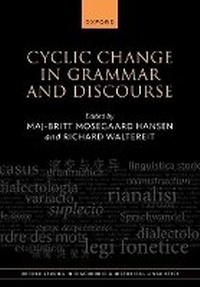
Cyclic Change in Grammar and Discourse
Published on 5. September 2025
Book
Hardback
528 pages
978-0-19-893905-4 (ISBN)
Description
This is an open access title available under the terms of a CC BY-NC-ND 4.0 International licence. It is free to read at Oxford Academic and offered as a free PDF download from OUP and selected open access locations.
This volume explores the long-held assumption in linguistics that language change may proceed in a cyclical fashion. Cyclic change has recently attracted renewed interest, most notably with respect to the evolution of negation across a range of languages, but also in relation to a wide range of other phenomena. The chapters in this book take as their point of departure the hypothesis that cyclic change is pragmatically driven, and analyse forms of this change in morphosyntax, the lexicon, and semantics and pragmatics - as well as the interaction between these levels - across a range of mainly Indo-European languages and language families, but also including Semitic, Sinitic, and Austronesian languages. They also discuss the epistemological status of cycles; explore their relationship with other recognized forms of change; examine the limits of the notion of a cycle in language change; and discuss cyclicity from a cognitive-pragmatic and sociopragmatic perspective.
This volume explores the long-held assumption in linguistics that language change may proceed in a cyclical fashion. Cyclic change has recently attracted renewed interest, most notably with respect to the evolution of negation across a range of languages, but also in relation to a wide range of other phenomena. The chapters in this book take as their point of departure the hypothesis that cyclic change is pragmatically driven, and analyse forms of this change in morphosyntax, the lexicon, and semantics and pragmatics - as well as the interaction between these levels - across a range of mainly Indo-European languages and language families, but also including Semitic, Sinitic, and Austronesian languages. They also discuss the epistemological status of cycles; explore their relationship with other recognized forms of change; examine the limits of the notion of a cycle in language change; and discuss cyclicity from a cognitive-pragmatic and sociopragmatic perspective.
More details
Series
Language
English
Place of publication
Oxford
United Kingdom
Target group
Professional and scholarly
College/higher education
Product notice
sewn/stitched
Cloth over boards
With dust jacket
Dimensions
Height: 234 mm
Width: 156 mm
Thickness: 29 mm
Weight
903 gr
ISBN-13
978-0-19-893905-4 (9780198939054)
Copyright in bibliographic data and cover images is held by Nielsen Book Services Limited or by the publishers or by their respective licensors: all rights reserved.
Schweitzer Classification
Persons
Maj-Britt Mosegaard Hansen has been Professor of Linguistics and Pragmatics at the University of Manchester since 2007. She received her PhD and her Higher Doctorate from the University of Copenhagen in 1996 and 2008 respectively. She is a member of the Academia Europaea and a fellow of the Royal Danish Academy of Sciences. Her book The Structure of Modern French: A Student Grammar was published by OUP in 2016.
Richard Waltereit has been Professor of Romance Linguistics (French) at the Humboldt-University Berlin since 2017, having previously held positions at the University of Tuebingen and Newcastle University. He was awarded his PhD in 1997 from the Freie Universitaet Berlin and his Habilitation in 2002 from Tuebingen. His many publications include Reflexive Marking in the History of French (Benjamins, 2012).
Richard Waltereit has been Professor of Romance Linguistics (French) at the Humboldt-University Berlin since 2017, having previously held positions at the University of Tuebingen and Newcastle University. He was awarded his PhD in 1997 from the Freie Universitaet Berlin and his Habilitation in 2002 from Tuebingen. His many publications include Reflexive Marking in the History of French (Benjamins, 2012).
Content
1: Maj-Britt Mosegaard Hansen;Richard Waltereit: Cyclic change in grammar and discourse: An introduction
PART I Cyclic Change in Grammar
2: Johan van der Auwera;Daniel Van Olmen: Additive negation in Dutch, from synchrony to diachrony, cyclical and noncyclical
3: Chiara Fedriani;Piera Molinelli: The role of pragmatics in the cyclical renewal and reinforcement of demonstratives from Latin to Italian
4: Urd Vindenes: Conflicting mechanisms in cycles of similative demonstrative reinforcement
5: Ittamar Erb;Mira Ariel: Prototypicalization in cyclic change
6: Ljuba Veselinova;Anastasia Panova: The Continuative Cycle
7: Ezra la Roi: The counterfactual life cycle: Cyclicity, pragmatics, and modality
8: Yueh Hsin Kuo: Bidirectional cycles of indirectness in Mandarin
9: Haiping Long;Jian Wang: Morphological coordination in Sinitic languages as a form of cyclic change
10: Mira Ariel;Caterina Mauri: 'Or' cycles
PART II Cyclic Change in Discourse
11: Maj-Britt Mosegaard Hansen: A new look at grammaticalization versus pragmaticalization in the rise of pragmatic markers: A typology of linear and non-linear forms of evolution
12: Giulio Scivoletto: A typology of cyclicity: Waves and spirals, constructions and features
13: Ruti Bardenstein: Clines and cycles of meaning change
14: Sandra Paoli: The rise and fall of Occitan be(n) and pla(n): A semantic-pragmatic cycle?
15: Luisa Ferrari: The role of reanalysis in the renewal of contrast: A cyclical evolution from simultaneity to opposition in Brazilian Portuguese
16: Adria Pardo Llibrer: Spanish approximators en plan and rollo between two centuries: Microdiachrony of a pragmatic cycle?
17: Chiara Ghezzi: Weakening of pragmatic force and socio-cultural factors: The pragmaticalization cycle of Italian grammatical deference
18: Ana Llopis Cardona: Pragmatic cycles in Spanish farewell routines
PART I Cyclic Change in Grammar
2: Johan van der Auwera;Daniel Van Olmen: Additive negation in Dutch, from synchrony to diachrony, cyclical and noncyclical
3: Chiara Fedriani;Piera Molinelli: The role of pragmatics in the cyclical renewal and reinforcement of demonstratives from Latin to Italian
4: Urd Vindenes: Conflicting mechanisms in cycles of similative demonstrative reinforcement
5: Ittamar Erb;Mira Ariel: Prototypicalization in cyclic change
6: Ljuba Veselinova;Anastasia Panova: The Continuative Cycle
7: Ezra la Roi: The counterfactual life cycle: Cyclicity, pragmatics, and modality
8: Yueh Hsin Kuo: Bidirectional cycles of indirectness in Mandarin
9: Haiping Long;Jian Wang: Morphological coordination in Sinitic languages as a form of cyclic change
10: Mira Ariel;Caterina Mauri: 'Or' cycles
PART II Cyclic Change in Discourse
11: Maj-Britt Mosegaard Hansen: A new look at grammaticalization versus pragmaticalization in the rise of pragmatic markers: A typology of linear and non-linear forms of evolution
12: Giulio Scivoletto: A typology of cyclicity: Waves and spirals, constructions and features
13: Ruti Bardenstein: Clines and cycles of meaning change
14: Sandra Paoli: The rise and fall of Occitan be(n) and pla(n): A semantic-pragmatic cycle?
15: Luisa Ferrari: The role of reanalysis in the renewal of contrast: A cyclical evolution from simultaneity to opposition in Brazilian Portuguese
16: Adria Pardo Llibrer: Spanish approximators en plan and rollo between two centuries: Microdiachrony of a pragmatic cycle?
17: Chiara Ghezzi: Weakening of pragmatic force and socio-cultural factors: The pragmaticalization cycle of Italian grammatical deference
18: Ana Llopis Cardona: Pragmatic cycles in Spanish farewell routines