

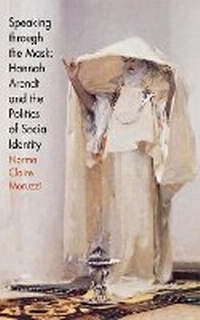
Speaking Through the Mask
Hannah Arendt and the Politics of Social Identity
Published on 31. January 2001
Book
Hardback
224 pages
978-0-8014-3785-4 (ISBN)
Description
Hannah Arendt was famously resistant to both psychoanalysis and feminism. Nonetheless, psychoanalytic feminist theory can offer a new interpretive strategy for deconstructing her equally famous opposition between the social and the political.
Supplementing critical readings of Arendt's most significant texts (including The Human Condition, On Revolution, Rahel Varnhagen, The Origins of Totalitarianism, Eichmann in Jerusalem, and The Life of the Mind) with the insights of contemporary psychoanalytic, feminist, and social theorists, Norma Claire Moruzzi reconstitutes the relationship in Arendt's texts between constructed social identity and political agency.
Moruzzi uses Julia Kristeva's writings on abjection to clarify the textual dynamic in Arendt's work that constructs the social as a natural threat; Joan Riviere's and Mary Ann Doane's work on feminine masquerade amplify the theoretical possibilities implicit in Arendt's own discussion of the public, political mask.
In a bold interdisciplinary synthesis, Moruzzi develops the social applications of a concept (the mask) Arendt had described as limited to the strictly political realm: a new conception of (political) agency as (social) masquerade, traced through the marginal but emblematic textual figures who themselves enact the politics of social identity.
Supplementing critical readings of Arendt's most significant texts (including The Human Condition, On Revolution, Rahel Varnhagen, The Origins of Totalitarianism, Eichmann in Jerusalem, and The Life of the Mind) with the insights of contemporary psychoanalytic, feminist, and social theorists, Norma Claire Moruzzi reconstitutes the relationship in Arendt's texts between constructed social identity and political agency.
Moruzzi uses Julia Kristeva's writings on abjection to clarify the textual dynamic in Arendt's work that constructs the social as a natural threat; Joan Riviere's and Mary Ann Doane's work on feminine masquerade amplify the theoretical possibilities implicit in Arendt's own discussion of the public, political mask.
In a bold interdisciplinary synthesis, Moruzzi develops the social applications of a concept (the mask) Arendt had described as limited to the strictly political realm: a new conception of (political) agency as (social) masquerade, traced through the marginal but emblematic textual figures who themselves enact the politics of social identity.
Reviews / Votes
Speaking through the Mask is a thoughtful, closely reasoned work... It succeeds as a thoroughgoing feminist reading of Arendt, written as much to show how feminist theory challenges Arendt's blind spots as to illustrate what Arendt has to teach feminism... This is an original and important book, one that manages at once to talk back to Hannah Arendt and to make it plain why so many feminists are talking about her.(The Journal of Politics) ... complex and interesting....
(Choice) Moruzzi provides a compelling case for using feminist psychoanalytic insights to enrich Arendt's concept of political agency.
(Women and Politics)
More details
Series
Language
English
Place of publication
Ithaca
United States
Target group
College/higher education
Professional and scholarly
Product notice
Paper over boards
Dimensions
Height: 229 mm
Width: 152 mm
Thickness: 22 mm
Weight
907 gr
ISBN-13
978-0-8014-3785-4 (9780801437854)
Copyright in bibliographic data and cover images is held by Nielsen Book Services Limited or by the publishers or by their respective licensors: all rights reserved.
Schweitzer Classification
Other editions
Additional editions
E-Book
09/2018
1st Edition
Cornell University Press
€162.99
Available for download
Person
Norma Claire Moruzzi is Associate Professor of Political Science and Gender and Women's Studies at the University of Illinois at Chicago.