

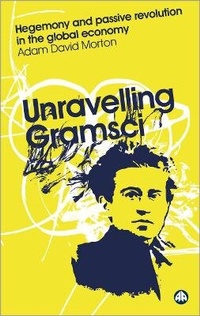
Unravelling Gramsci
Hegemony and Passive Revolution in the Global Political Economy
Published on 20. February 2007
Book
Hardback
272 pages
978-0-7453-2385-5 (ISBN)
Description
'Powerful and clarifying ... The book's combination of careful argument and cogent illustration will make this a landmark volume in Gramscian studies.' John Agnew, University of California, Los Angeles, and author of Hegemony: The New Shape of Global Power
'Morton draws upon an impressive knowledge of Gramsci's writings to provide new insights into key processes in today's world order.' Anne Showstack Sassoon, Emeritus Professor, Kingston University and Visiting Professor, Birkbeck College, University of London
Unravelling Gramsci makes extensive use of Antonio Gramsci's writings, including his much-overlooked pre-prison journalism, prison letters, as well as his prison notebooks, to provide a fresh approach to understanding his contemporary relevance in the current neoliberal world order. Adam Morton examines in detail the themes of hegemony, passive revolution and uneven development to provide a useful way of analysing the contemporary global political economy, the project of neoliberalism, processes of state formation, and practices of resistance. The book explores the theoretical and practical limitations of how Gramsci's ideas can be used today, offering a broad insight into state formation and the international factors shaping hegemony within a capitalist framework.
'Morton draws upon an impressive knowledge of Gramsci's writings to provide new insights into key processes in today's world order.' Anne Showstack Sassoon, Emeritus Professor, Kingston University and Visiting Professor, Birkbeck College, University of London
Unravelling Gramsci makes extensive use of Antonio Gramsci's writings, including his much-overlooked pre-prison journalism, prison letters, as well as his prison notebooks, to provide a fresh approach to understanding his contemporary relevance in the current neoliberal world order. Adam Morton examines in detail the themes of hegemony, passive revolution and uneven development to provide a useful way of analysing the contemporary global political economy, the project of neoliberalism, processes of state formation, and practices of resistance. The book explores the theoretical and practical limitations of how Gramsci's ideas can be used today, offering a broad insight into state formation and the international factors shaping hegemony within a capitalist framework.
Reviews / Votes
'A landmark volume in Gramscian studies' -- John Agnew, UCLA (author of Hegemony: The New Shape of Global Power, 2005). 'Giving prominence to the often neglected concept of passive revolution, and engaging with debates about uneven development and the relationship between national and international perspectives, Adam Morton draws upon an impressive knowledge of Antonio Gramsci's writings to provide new insights into key processes in today's world order' -- Anne Showstack Sassoon, Emeritus Professor of Politics, Kingston University and Visiting Professor of Politics, Birkbeck, University of LondonMore details
Series
Language
English
Place of publication
London
United Kingdom
Target group
College/higher education
Professional and scholarly
Product notice
Library binding
Illustrations
5 b&w figures
Dimensions
Height: 215 mm
Width: 135 mm
Weight
464 gr
ISBN-13
978-0-7453-2385-5 (9780745323855)
Copyright in bibliographic data and cover images is held by Nielsen Book Services Limited or by the publishers or by their respective licensors: all rights reserved.
Schweitzer Classification
Other editions
Additional editions
Adam David Morton
Unravelling Gramsci
Hegemony and Passive Revolution in the Global Political Economy
E-Book
02/2007
1st Edition
Pluto Press
€83.69
Available for download
Person
Adam David Morton is Professor in Political Economy at the University of Sydney. He is the author of Unravelling Gramsci (Pluto, 2007) and Revolution and State in Modern Mexico (Rowman & Littlefield, 2011).
Content
Acknowledgements
Abbreviations
List of figures
1. Introduction: the North/South question of uneven development
PART I: ENGAGING GRAMSCI
2. Historicising Gramsci: situating ideas in and beyond their context
3. State Formation, Passive Revolution and the International System
4. A Return to Gramsci: 'the moment of hegemony'
PART II: GRAMSCI, WORLD ORDER AND RESISTANCE
5. Hegemony and World Order: neo-Gramscian Perspectives and the
Global Political Economy
6. The Global Political Economy of Uneven Development
7. Globalisation and Resistance: the power of the powerless
References
Index
Abbreviations
List of figures
1. Introduction: the North/South question of uneven development
PART I: ENGAGING GRAMSCI
2. Historicising Gramsci: situating ideas in and beyond their context
3. State Formation, Passive Revolution and the International System
4. A Return to Gramsci: 'the moment of hegemony'
PART II: GRAMSCI, WORLD ORDER AND RESISTANCE
5. Hegemony and World Order: neo-Gramscian Perspectives and the
Global Political Economy
6. The Global Political Economy of Uneven Development
7. Globalisation and Resistance: the power of the powerless
References
Index