

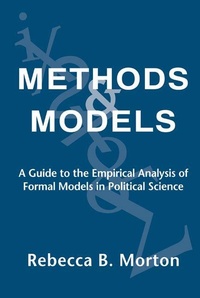
Methods and Models
A Guide to the Empirical Analysis of Formal Models in Political Science
Published on 28. August 1999
Book
Hardback
340 pages
978-0-521-63300-0 (ISBN)
Description
At present much of political science consists of a large body of formal mathematical work that remains largely unexplored empirically and an expanding use of sophisticated statistical techniques. While there are examples of noteworthy efforts to bridge the gap between these, there is still a need for much more cooperative work between formal theorists and empirical researchers in the discipline. This book explores how empirical analysis has, can, and should be used to evaluate formal models in political science. The book is intended to be a guide for active and future political scientists who are confronting the issues of empirical analysis with formal models in their work and as a basis for a needed dialogue between empirical and formal theoretical researchers in political science. These developments, if combined, are potentially a basis for a new revolution in political science.
More details
Language
English
Place of publication
Cambridge
United Kingdom
Target group
Professional and scholarly
Dimensions
Height: 235 mm
Width: 157 mm
Thickness: 25 mm
Weight
703 gr
ISBN-13
978-0-521-63300-0 (9780521633000)
Copyright in bibliographic data and cover images is held by Nielsen Book Services Limited or by the publishers or by their respective licensors: all rights reserved.
Schweitzer Classification
Other editions
Additional editions
Rebecca B. Morton
Methods and Models
A Guide to the Empirical Analysis of Formal Models in Political Science
E-Book
01/2005
1st Edition
Cambridge University Press
€27.99
Available for download
Person
Content
Part I. Introduction: 1. Political science's dilemma; Part II. Formal Models in Political Science: 2. What makes a model formal?; 3. The variety of formal models; Part III. Empirical Evaluation of Formal Models: 4. Fundamentals of empirical evaluation; 5. Evaluating assumptions; 6. Evaluating predictions: equilibria, disequilibria, and multiequilibria; 7. Evaluating relationship predictions; 8. Evaluating alternative models; Part IV. A Second Revolution: 9. The present and the future; 10. References.