

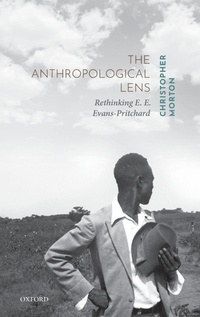
The Anthropological Lens
Rethinking E. E. Evans-Pritchard
Published on 9. February 2020
Book
Hardback
244 pages
978-0-19-881291-3 (ISBN)
Description
Sir Edward Evan Evans-Pritchard (1902-1973) is widely considered the most influential British anthropologist of the twentieth century, known to generations of students for his seminal works on South Sudanese ethnography Witchcraft, Oracles and Magic Among the Azande (OUP 1937) and The Nuer (OUP 1940). In these works, now classics in the anthropological literature, Evans-Pritchard broke new ground on questions of rationality, social accountability, kinship, social and political organization, and religion, as well as influentially moving the discipline in Britain away from the natural sciences and towards history. Yet despite much discussion about his theoretical contributions to anthropology, no study has yet explored his fieldwork in detail in order to get a better understanding of its historical contexts, local circumstances or the social encounters out of which it emerged. This book then is just such an exploration, of Evans-Pritchard the fieldworker through the lens of his fieldwork photography. Through an engagement with his photographic archive, and by thinking with it alongside his written ethnographies and other unpublished evidence, the book offers a new insight into the way in which Evans-Pritchard's theoretical contributions to the discipline were shaped by his fieldwork and the numerous local people in Africa with whom he collaborated. By writing history through field photographs we move back towards the fieldwork experiences, exploring the vivid traces, lived realities and local presences at the heart of the social encounter that formed the basis of Evans-Pritchard's anthropology.
Reviews / Votes
Morton offers a fresh perspective on an extraordinary career * Adam Kuper, Wall Street Journal * Morton offers a sophisticated account ... this rereading sharpens our understanding of the complex object of ethnography: a co-production of knowledge by engagement between indigenous lives and categories and the life and understanding of the anthropologist. This is a good historical study with wide implications. * Timothy Jenkins, Journal of the Royal Anthropological Institute *More details
Language
English
Place of publication
Oxford
United Kingdom
Target group
Professional and scholarly
Illustrations
89 black and white illustrations
Dimensions
Height: 240 mm
Width: 161 mm
Thickness: 18 mm
Weight
534 gr
ISBN-13
978-0-19-881291-3 (9780198812913)
Copyright in bibliographic data and cover images is held by Nielsen Book Services Limited or by the publishers or by their respective licensors: all rights reserved.
Schweitzer Classification
Other editions
Additional editions
E-Book
02/2020
1st Edition
OUP eBook
€9.99
Available for download
E-Book
02/2020
1st Edition
OUP eBook
€9.99
Available for download
Person
Christopher Morton is Curator of Photograph and Manuscript Collections at the University of Oxford's Pitt Rivers Museum, and a Fellow of Linacre College, Oxford. He trained in history at the University of East Anglia before completing a DPhil in Social and Cultural Anthropology at St. Antony's College, Oxford, in 2002, based on long-term fieldwork in Botswana. He has published widely on the interconnecting histories of photography and anthropology, co-editing volumes such as Photography, Anthropology, and History: Expanding the Frame (2009), Photographs, Museums, Collections: Between Art and Information (2015), and The African Photographic Archive: Research and Curatorial Strategies (2015).
Content
1: Photographs are to think with: historicizing anthropology
2: Survivals, surveys, and struggles: first fieldwork
3: Visuality and textuality: encountering Zande ritual
4: Double alienation: fieldwork and photography between two worlds
5: Image, archive, and monograph: dangerous liaisons
6: Akobo realism: conversations with the Anuak
7: The participant-photographer: encountering Nuer ritual
8: The poet, the missionary, and the sacred spears
2: Survivals, surveys, and struggles: first fieldwork
3: Visuality and textuality: encountering Zande ritual
4: Double alienation: fieldwork and photography between two worlds
5: Image, archive, and monograph: dangerous liaisons
6: Akobo realism: conversations with the Anuak
7: The participant-photographer: encountering Nuer ritual
8: The poet, the missionary, and the sacred spears