

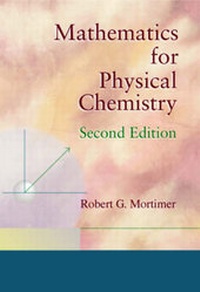
Mathematics for Physical Chemistry
2nd Edition
Published on 15. April 1999
Book
Paperback/Softback
444 pages
978-0-12-508340-9 (ISBN)
Description
Mathematics for Physical Chemistry is the ideal textbook for upper-level undergraduates or graduate students who want to sharpen their mathematics skills while they are enrolled in a physical chemistry course. Solved examples and problems, interspersed throughout the presentation and intended to be worked when met in the text, encourage self-study by students new to the material. The author provides readers with a review of calculus and differential equations that will enable them to succeed in a physical chemistry course. An ideal reference text for practicing chemists as well.
More details
Edition
2nd Revised edition
Language
English
Place of publication
San Diego
United States
Publishing group
Elsevier Science Publishing Co Inc
Target group
Professional and scholarly
Edition type
Revised edition
Illustrations
b&w illustrations
Dimensions
Height: 254 mm
Width: 175 mm
Weight
753 gr
ISBN-13
978-0-12-508340-9 (9780125083409)
Copyright in bibliographic data and cover images is held by Nielsen Book Services Limited or by the publishers or by their respective licensors: all rights reserved.
Schweitzer Classification
Other editions
New editions
Robert G. Mortimer | S.M. Blinder
Mathematics for Physical Chemistry
Book
03/2023
5th Edition
Elsevier
€62.50
Available immediately
Robert G. Mortimer
Mathematics for Physical Chemistry
Book
07/2005
3rd Edition
Academic Press
€48.35
Article exhausted; check for reprint
Previous edition

Robert G. Mortimer
Mathematics for Physical Chemistry
Book
07/1981
Macmillan USA
€69.54
Article exhausted; check for reprint
Person
Robert Mortimer has been a professor of chemistry at Rhodes College since 1981. He is the recipient of a Woodrow Wilson National Fellowship as well as a National Science Foundation Predoctoral Fellowship.
Content
Numbers, Measurements, Mathematics, and Problem Solving. Mathematical Variables and Operations. Mathematical Functions and Differential Calculus. Integral Calculus Calculus with Several Independent Variables. Mathematical Series and Transforms. Differential Equations. Operators, Matrices, and Group Theory. The Solution of Algebraic Equations. The Treatment of Experimental Data. Using Computers in Physical Chemistry.