

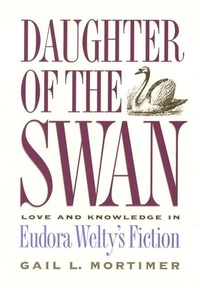
Daughter of the Swan
Love and Knowledge in Eudora Welty's Fiction
Will be published approx. on 1. October 1994
Book
Hardback
232 pages
978-0-8203-1633-8 (ISBN)
Description
Readers of Eudora Welty's stories often encounter a protective and domelike nighttime sky, the moon and constellations beckoning a character to venture beyond the familiar, visible world. This striking metaphor for the human need to seek out the unknown serves as an anchoring image in Daughter of the Swan, Gail L. Mortimer's study of Welty's lifelong inquiry into the nature and contexts of knowledge.
Mortimer argues that Welty's views on epistemology and the elusiveness of certainty lie at the heart of this writer's subtle and revelatory work. Employing the psychoanalytic object-relations theories of Nancy Chodorow and Carol Gilligan, she reveals how Welty uses assumptions about relationships to shape her characters' consciousnesses. Mortimer also contrasts Welty's world with William Faulkner's; each elucidates the other's remarkably different ways of perceiving humanity, relationships, and approaches to the unknown.
The author then turns to Welty's childhood to consider her evolving sense of what--and how--things can be known. Her childhood with adults created impressions of a benign, wondrous, orderly world. As Mortimer observes, Welty eventually replaced these impressions with the realization that adults frequently distort and withhold the truth. Welty's own family's conception of love as a kind of shield, and her resistance to this protection, finds its way into much of her fiction.
For many Welty characters, this protective love becomes an obstacle to fuller understanding. Mortimer invokes two of the writer's most beguiling images, the circle and the labyrinth, to demonstrate that "the perceiver" who is "both an insider and an outsider" is best able to recognize and assimilate new knowledge. In The Golden Apples Welty contemplates the difficulty and fascination implicit in this quest for knowledge, given the ambiguous nature of what we know--and given our language's surfaces, and of masks, myths, and falsities to create benevolent illusions. Ultimately, Mortimer concludes, Welty comes to see the concept of protective love as a limited one and, in The Optimist's Daughter, for instance, she advocates instead the courage to face even the harshest realities.
Recognizing the richness of Welty's artistry, Mortimer views her through the lens of various literary traditions, including that of Shelley and Yeats. The latter's poem "Among School Children," from which the title of Mortimer's study is borrowed, summons the image of the swan to reflect the solitary human soul in search of knowledge. In that same spirit of wonder and curiosity, Eudora Welty's fiction illuminates the conditions of that search.
Mortimer argues that Welty's views on epistemology and the elusiveness of certainty lie at the heart of this writer's subtle and revelatory work. Employing the psychoanalytic object-relations theories of Nancy Chodorow and Carol Gilligan, she reveals how Welty uses assumptions about relationships to shape her characters' consciousnesses. Mortimer also contrasts Welty's world with William Faulkner's; each elucidates the other's remarkably different ways of perceiving humanity, relationships, and approaches to the unknown.
The author then turns to Welty's childhood to consider her evolving sense of what--and how--things can be known. Her childhood with adults created impressions of a benign, wondrous, orderly world. As Mortimer observes, Welty eventually replaced these impressions with the realization that adults frequently distort and withhold the truth. Welty's own family's conception of love as a kind of shield, and her resistance to this protection, finds its way into much of her fiction.
For many Welty characters, this protective love becomes an obstacle to fuller understanding. Mortimer invokes two of the writer's most beguiling images, the circle and the labyrinth, to demonstrate that "the perceiver" who is "both an insider and an outsider" is best able to recognize and assimilate new knowledge. In The Golden Apples Welty contemplates the difficulty and fascination implicit in this quest for knowledge, given the ambiguous nature of what we know--and given our language's surfaces, and of masks, myths, and falsities to create benevolent illusions. Ultimately, Mortimer concludes, Welty comes to see the concept of protective love as a limited one and, in The Optimist's Daughter, for instance, she advocates instead the courage to face even the harshest realities.
Recognizing the richness of Welty's artistry, Mortimer views her through the lens of various literary traditions, including that of Shelley and Yeats. The latter's poem "Among School Children," from which the title of Mortimer's study is borrowed, summons the image of the swan to reflect the solitary human soul in search of knowledge. In that same spirit of wonder and curiosity, Eudora Welty's fiction illuminates the conditions of that search.
More details
Language
English
Place of publication
Georgia
United States
Target group
College/higher education
Professional and scholarly
Product notice
sewn/stitched
Cloth over boards
Illustrations
Illustrations
Dimensions
Height: 235 mm
Width: 158 mm
Thickness: 25 mm
Weight
549 gr
ISBN-13
978-0-8203-1633-8 (9780820316338)
Copyright in bibliographic data and cover images is held by Nielsen Book Services Limited or by the publishers or by their respective licensors: all rights reserved.
Schweitzer Classification
Person
GAIL L. MORTIMER is a professor of English at the University of Texas at El Paso.