

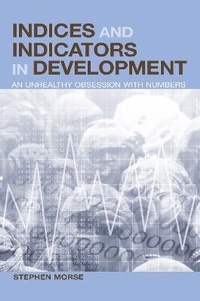
Indices and Indicators in Development
An Unhealthy Obsession with Numbers
1st Edition
Will be published approx. on 1. October 2004
Book
Hardback
224 pages
978-1-84407-012-1 (ISBN)
Description
The use of numbers to condense complex systems into easily digested 'bites' of information is very much in fashion. At one level they are intended to enhance transparency, accountability and local democracy, while at another they provide a means of enhancing performance. However, all indicators suffer from the same basic problem that, ironically, is also their biggest advantage - condensing something highly complex into a few simple numbers. Love them or hate them, there is no denying that people use indicators to make decisions.
Indices and Indicators explores the use of indicators within the field of human development. Part I provides a brief outline of the contested meaning of 'development' and how indices and indicators have been used as means of testing the realization of these development visions in practice in a range of institutional contexts. Part II discusses the limitations of such indices and indicators and illustrates how they are dependent upon the vision of development adopted. The book also suggests how indices and indicators can best be employed and presented.
Given our overwhelming reliance on indices and indicators for measuring progress, directing policy and allocating resources, this book is essential core reading for academics, undergraduate and post-graduate students in social science, economics, geography and development studies as well as development practitioners, policy-makers and donor and international funding agencies.
Indices and Indicators explores the use of indicators within the field of human development. Part I provides a brief outline of the contested meaning of 'development' and how indices and indicators have been used as means of testing the realization of these development visions in practice in a range of institutional contexts. Part II discusses the limitations of such indices and indicators and illustrates how they are dependent upon the vision of development adopted. The book also suggests how indices and indicators can best be employed and presented.
Given our overwhelming reliance on indices and indicators for measuring progress, directing policy and allocating resources, this book is essential core reading for academics, undergraduate and post-graduate students in social science, economics, geography and development studies as well as development practitioners, policy-makers and donor and international funding agencies.
More details
Language
English
Place of publication
London
United Kingdom
Publishing group
Taylor & Francis Ltd
Target group
College/higher education
Dimensions
Height: 234 mm
Width: 156 mm
Weight
520 gr
ISBN-13
978-1-84407-012-1 (9781844070121)
Copyright in bibliographic data and cover images is held by Nielsen Book Services Limited or by the publishers or by their respective licensors: all rights reserved.
Schweitzer Classification
Other editions
Additional editions
E-Book
06/2013
Routledge
€52.49
Available for download
E-Book
06/2013
1st Edition
Routledge
€52.49
Available for download
Book
10/2004
1st Edition
Earthscan Ltd
€69.51
Article not available at the moment
Person
Stephen Morse is Reader in Development Studies at the University of Reading and co-author of Sustainability Indicators (1999) and Measuring Sustainability (2003).
Content
Preface * Simplifying Complexity: Why Do We Need Indicators? * Development Indicators: Economics * Development Indicators: Poverty * Integrating Development Indicators * The Precarious Art of Simplifying Complexity * Taking Care with Development Indicators * A Comparative Indicatorology * Notes * References * Appendix 1: Factor Analysis: a Brief Introduction * Index