

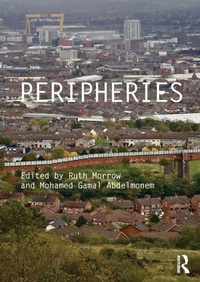
Peripheries
1st Edition
Published on 31. October 2012
Book
Paperback/Softback
296 pages
978-0-415-64030-5 (ISBN)
Description
Architects are now more than ever part of an interdisciplinary context. The emergence of creative art-based practices, film making, post-disaster designs and slum management, as part of the architecture discourse and curriculum, is an indication of how broad architecture has become, and the extent to which it has already merged peripheral practices into its core.
This new volume in the AHRA Critiques Series is a statement about how broad, complex, influential, and, ironically central, architecture has become in the contemporary culture, economy and society, despite the marginal position the profession currently occupies. Peripheries questions and challenges the boundaries of architectural research by bringing together subjects and relevant streams of investigation, some of which rarely feature in architectural research and practice titles.
Divided into four themes, Places of Formation and Insight, Practices at the Edge, People on the Margins and Edge Readings, each section presents a selection of high calibre interdisciplinary research papers, from a range of renowned contributors including Stephen Walker, Gerry Adler, Dana Vais and author Glen Patterson. The volume also includes a Dialogue between Murray Fraser, Christine Boyer and Kim Dovey. Each section interrogates a peripheral aspect of the built environment, and brings to the fore peripheral case studies. Chapters discuss architecture in United States, Lebanon, Egypt, Japan, Romania, and Europe. Hence, the book takes Architectural humanities discussions to new cultures, societies and practices and towards a global level of influence and impact.
This new volume in the AHRA Critiques Series is a statement about how broad, complex, influential, and, ironically central, architecture has become in the contemporary culture, economy and society, despite the marginal position the profession currently occupies. Peripheries questions and challenges the boundaries of architectural research by bringing together subjects and relevant streams of investigation, some of which rarely feature in architectural research and practice titles.
Divided into four themes, Places of Formation and Insight, Practices at the Edge, People on the Margins and Edge Readings, each section presents a selection of high calibre interdisciplinary research papers, from a range of renowned contributors including Stephen Walker, Gerry Adler, Dana Vais and author Glen Patterson. The volume also includes a Dialogue between Murray Fraser, Christine Boyer and Kim Dovey. Each section interrogates a peripheral aspect of the built environment, and brings to the fore peripheral case studies. Chapters discuss architecture in United States, Lebanon, Egypt, Japan, Romania, and Europe. Hence, the book takes Architectural humanities discussions to new cultures, societies and practices and towards a global level of influence and impact.
More details
Series
Language
English
Place of publication
London
United Kingdom
Publishing group
Taylor & Francis Ltd
Target group
College/higher education
Professional and scholarly
Illustrations
58 s/w Abbildungen
58 Illustrations, black and white
Dimensions
Height: 246 mm
Width: 174 mm
Thickness: 16 mm
Weight
528 gr
ISBN-13
978-0-415-64030-5 (9780415640305)
Copyright in bibliographic data and cover images is held by Nielsen Book Services Limited or by the publishers or by their respective licensors: all rights reserved.
Schweitzer Classification
Other editions
Additional editions
Ruth Morrow | Mohamed Abdelmonem
Peripheries
Book
11/2012
1st Edition
Routledge
€237.70
Shipment within 15-20 days
Persons
Ruth Morrow is Professor of Architecture at SPACE: School of Planning, Architecture and Civil Engineering at Queen's University Belfast.
Mohamed Gamal Abdelmonem is an architect and lecturer in Architecture at SPACE: School of Planning, Architecture and Civil Engineering at Queen's University Belfast.?
Mohamed Gamal Abdelmonem is an architect and lecturer in Architecture at SPACE: School of Planning, Architecture and Civil Engineering at Queen's University Belfast.?
Content
1. Introduction: Transcending the boundaries of architecture 2. Peripheries dialogue: a roundtable debate on architecture Part I: Peripheral Places of Formation and Insight 3. Shadows in the farthest corners: the pursuit of national identity in Japanese architectural aesthetics 4. Identity in peripheries: Barking and its others 5. Centre or periphery? The architecture of the travelling street fair 6. Designing bare essentials: ALDI and the architectures of cheapness Intervention A: Is this central? Part II: Practices at the Edge 7. The degree zero of space: Romanian urban periphery interpreted through Andrea Branzi's theory 8. Obsolete industrial space in the expanded field 9. Inhabiting the edge: architecture and transport Infrastructure Intertwined 10. Heritage at the periphery: the York Street Vaults, the Roman baths, Bath Intervention B: The Kevin Kieran Award Part III: People on the Margins 11. Re-imaging the periphery: the reproduction of space in Cairo 12. Homogenic love in the city: CR Ashbee's new Dublin 13. Energising the building edge: Siegfried Ebeling, Bauhaus bioconstructivist Intervention C: 'We want to make really good buildings and we just happen to be on the edge' Part IV: Edge Readings 14. Metropolitan narratives on peripheral contexts: buildings and constructs in Algarve (South Portugal), c. 1950 15. Positions of periphery to centre: the Festival of Britain 16. The strange case of the speaking walls: the testimony of architecture in the contemporary crime novel murder scene 17. This is how stories of conflict circulate and resonate Epilogue: Lessons from the Peripheral