

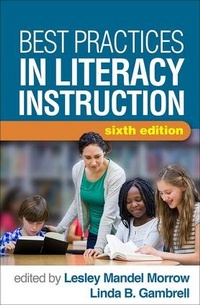
Best Practices in Literacy Instruction, Sixth Edition
6th Edition
Published on 5. December 2018
Book
Hardback
460 pages
978-1-4625-3678-8 (ISBN)
Description
*Established, influential text and PreK-12teacher resource with over 80,000 in print: 35% new material includes four new chapters.
*New topics: developmental word study and the physiological, emotional, and behavioral foundations of literacy.
*Engagement activities in every chapter are an appealing feature for teacher professional development.
*Increased attention to ELLs throughout.
*New topics: developmental word study and the physiological, emotional, and behavioral foundations of literacy.
*Engagement activities in every chapter are an appealing feature for teacher professional development.
*Increased attention to ELLs throughout.
Reviews / Votes
. -Recommended for literacy teachers of all skill levels. (on the fourth edition)--Choice Reviews, 01/02/2012More details
Edition
6th edition
Language
English
Place of publication
New York
United States
Publishing group
Guilford Publications
Target group
Professional and scholarly
Professional Practice & Development
Dimensions
Height: 229 mm
Width: 152 mm
Weight
896 gr
ISBN-13
978-1-4625-3678-8 (9781462536788)
Copyright in bibliographic data and cover images is held by Nielsen Book Services Limited or by the publishers or by their respective licensors: all rights reserved.
Schweitzer Classification
Other editions
New editions
Lesley Mandel Morrow | Linda B. Gambrell
Best Practices in Literacy Instruction, Seventh Edition
Book
07/2023
7th Edition
Guilford Press
€84.00
Shipment within 15-20 days
Additional editions
Lesley Mandel Morrow | Linda B. Gambrell
Best Practices in Literacy Instruction, Sixth Edition
Book
12/2018
6th Edition
Guilford Press
€69.51
Article exhausted; check for reprint
Previous edition
Linda B. Gambrell | Lesley M. Morrow
Best Practices in Literacy Instruction, Fifth Edition
Book
03/2015
5th Edition
Guilford Press
€100.46
Article exhausted; check for reprint
Persons
Lesley Mandel Morrow, PhD, is Distinguished Professor of Literacy and Director of the Center for Literacy Development at the Graduate School of Education at Rutgers, The State University of New Jersey. Her research deals with early literacy development and the organization and management of language arts programs and literacy-rich environments. Dr. Morrow has published more than 300 journal articles, chapters, and books. Her work has been recognized with awards including the Outstanding Teacher Educator in Reading Award and the William S. Gray Citation of Merit, both from the International Literacy Association (ILA), and the Oscar S. Causey Award for outstanding contributions to reading research from the Literacy Research Association. Dr. Morrow is past president of the ILA and is a member and past president of the Reading Hall of Fame.
Linda B. Gambrell, PhD, is Professor Emerita in the Eugene T. Moore School of Education at Clemson University. Her major research interests are in the areas of reading comprehension, literacy motivation, and the role of discussion in teaching and learning. Dr. Gambrell has published numerous books and articles on reading instruction, comprehension strategy instruction, and literacy motivation. She is a recipient of the Outstanding Teacher Educator in Reading Award from the International Literacy Association (ILA), the Laureate Award from the Association of Literacy Educators and Researchers (ALER), and both the Albert J. Kingston Award and the Oscar S. Causey Award from the Literacy Research Association (LRA). Dr. Gambrell is past president of the ILA, LRA, and ALER, and is a member of the Reading Hall of Fame.
Linda B. Gambrell, PhD, is Professor Emerita in the Eugene T. Moore School of Education at Clemson University. Her major research interests are in the areas of reading comprehension, literacy motivation, and the role of discussion in teaching and learning. Dr. Gambrell has published numerous books and articles on reading instruction, comprehension strategy instruction, and literacy motivation. She is a recipient of the Outstanding Teacher Educator in Reading Award from the International Literacy Association (ILA), the Laureate Award from the Association of Literacy Educators and Researchers (ALER), and both the Albert J. Kingston Award and the Oscar S. Causey Award from the Literacy Research Association (LRA). Dr. Gambrell is past president of the ILA, LRA, and ALER, and is a member of the Reading Hall of Fame.
Content
I. Perspectives on Best Practices
1. Evidence-Based Best Practices for Developing Literate Communities, Jacquelynn A. Malloy, Barbara A. Marinak, & Linda B. Gambrell
2. Current Issues and Best Practices in Literacy Instruction, Christina L. Madda, Vicki B. Griffo, P. David Pearson, & Taffy E. Raphael
3. Best Practices for Motivating Students to Read, John T. Guthrie & Ana Taboada Barber
II. Best Practices for All Students
4. Best Practices in Early Literacy: Preschool, Kindergarten, and First Grade, Lesley Mandel Morrow, Susan M. Dougherty, & Diane H. Tracey
5. Best Practices to Change the Trajectory of Struggling Readers, Victoria J. Risko & Doris Walker-Dalhouse
6. Best Practices for Teaching Dual-Language Learners: Leveraging Everyday Literacies, Michael Dominguez & Kris D. Gutierrez
7. Best Practices in Adolescent Literacy Instruction, Douglas Fisher & Nancy Frey
III. Evidence-Based Strategies for Literacy Learning and Teaching
8. Best Practices for Developmental Word Study in Phonics, Vocabulary, and Spelling, Donald R. Bear
9. Best Practices in Vocabulary Instruction, Kathy Ganske
10. Best Practices in Narrative Text Comprehension Instruction, Janice F. Almasi & Susan J. Hart
11. Best Practices in Informational Text Comprehension Instruction, Nell K. Duke & Nicole M. Martin
12. Best Practices in Fluency Instruction, Melanie Kuhn, Timothy Rasinski, & Chase Young
13. Best Practices in Teaching Writing, Troy Hicks
14. Best Practices in Reading Assessment, Peter Afflerbach, Byeong-Young Cho, Maria Elliker Crassas, & Jong-Yun Kim
IV. Perspectives on Special Issues
15. Best Practices in Teaching the New Literacies of Online Research and Comprehension, Lisa Zawilinski, Elena Forzani, Nicole Timbrell, & Donald J. Leu
16. Organizing Effective Literacy Instruction: Differentiating Instruction to Meet Student Needs, D. Ray Reutzel & Sarah K. Clark
17. Best Practices in the Physiological, Emotional, and Behavioral Foundations of Literacy Achievement, Diane H. Tracey
18. Building Strong Home, School, and Community Partnerships through Culturally Relevant Teaching, Jeanne R. Paratore, Patricia A. Edwards, & Lisa M. O'Brien
19. Best Practices in Professional Learning for Improving Literacy Instruction in Schools, Sharon Walpole, John Z. Strong, & Cary B. Riches
Index
1. Evidence-Based Best Practices for Developing Literate Communities, Jacquelynn A. Malloy, Barbara A. Marinak, & Linda B. Gambrell
2. Current Issues and Best Practices in Literacy Instruction, Christina L. Madda, Vicki B. Griffo, P. David Pearson, & Taffy E. Raphael
3. Best Practices for Motivating Students to Read, John T. Guthrie & Ana Taboada Barber
II. Best Practices for All Students
4. Best Practices in Early Literacy: Preschool, Kindergarten, and First Grade, Lesley Mandel Morrow, Susan M. Dougherty, & Diane H. Tracey
5. Best Practices to Change the Trajectory of Struggling Readers, Victoria J. Risko & Doris Walker-Dalhouse
6. Best Practices for Teaching Dual-Language Learners: Leveraging Everyday Literacies, Michael Dominguez & Kris D. Gutierrez
7. Best Practices in Adolescent Literacy Instruction, Douglas Fisher & Nancy Frey
III. Evidence-Based Strategies for Literacy Learning and Teaching
8. Best Practices for Developmental Word Study in Phonics, Vocabulary, and Spelling, Donald R. Bear
9. Best Practices in Vocabulary Instruction, Kathy Ganske
10. Best Practices in Narrative Text Comprehension Instruction, Janice F. Almasi & Susan J. Hart
11. Best Practices in Informational Text Comprehension Instruction, Nell K. Duke & Nicole M. Martin
12. Best Practices in Fluency Instruction, Melanie Kuhn, Timothy Rasinski, & Chase Young
13. Best Practices in Teaching Writing, Troy Hicks
14. Best Practices in Reading Assessment, Peter Afflerbach, Byeong-Young Cho, Maria Elliker Crassas, & Jong-Yun Kim
IV. Perspectives on Special Issues
15. Best Practices in Teaching the New Literacies of Online Research and Comprehension, Lisa Zawilinski, Elena Forzani, Nicole Timbrell, & Donald J. Leu
16. Organizing Effective Literacy Instruction: Differentiating Instruction to Meet Student Needs, D. Ray Reutzel & Sarah K. Clark
17. Best Practices in the Physiological, Emotional, and Behavioral Foundations of Literacy Achievement, Diane H. Tracey
18. Building Strong Home, School, and Community Partnerships through Culturally Relevant Teaching, Jeanne R. Paratore, Patricia A. Edwards, & Lisa M. O'Brien
19. Best Practices in Professional Learning for Improving Literacy Instruction in Schools, Sharon Walpole, John Z. Strong, & Cary B. Riches
Index