

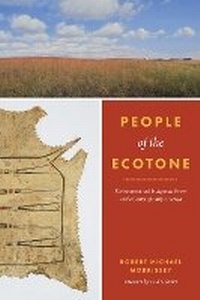
People of the Ecotone
Environment and Indigenous Power at the Center of Early America
Published on 1. November 2022
Book
Hardback
294 pages
978-0-295-75087-3 (ISBN)
Description
Winner of the 2023 Hal K. Rothman Book Prize for best book in western environmental history from the Western History Association
Indigenous power in a significant cultural and ecological borderland
In People of the Ecotone, Robert Morrissey weaves together a history of Native peoples with a history of an ecotone to tell a new story about the roots of the Fox Wars, among the most transformative and misunderstood events of early American history. To do this, he also offers the first comprehensive environmental history of some of North America's most radically transformed landscapes-the former tallgrass prairies-in the period before they became the monocultural "corn belt" we know today.
Morrissey situates the complex rise and fall of the Illinois, Meskwaki, and Myaamia peoples from roughly the collapse of Cahokia (thirteenth to fourteenth century CE) to the mid-eighteenth century in the context of millennia-long environmental shifts, as changes to the climate shifted bison geographies and tribes adapted their cultures to become pedestrian bison hunters. Tracing dynamic chains of causation from microscopic viruses to massive forces of climate, from the deep time of evolution to the specific events of human lifetimes, from local Illinois village economies to market forces an ocean away, People of the Ecotone offers new insight on Indigenous power and Indigenous logics.
Indigenous power in a significant cultural and ecological borderland
In People of the Ecotone, Robert Morrissey weaves together a history of Native peoples with a history of an ecotone to tell a new story about the roots of the Fox Wars, among the most transformative and misunderstood events of early American history. To do this, he also offers the first comprehensive environmental history of some of North America's most radically transformed landscapes-the former tallgrass prairies-in the period before they became the monocultural "corn belt" we know today.
Morrissey situates the complex rise and fall of the Illinois, Meskwaki, and Myaamia peoples from roughly the collapse of Cahokia (thirteenth to fourteenth century CE) to the mid-eighteenth century in the context of millennia-long environmental shifts, as changes to the climate shifted bison geographies and tribes adapted their cultures to become pedestrian bison hunters. Tracing dynamic chains of causation from microscopic viruses to massive forces of climate, from the deep time of evolution to the specific events of human lifetimes, from local Illinois village economies to market forces an ocean away, People of the Ecotone offers new insight on Indigenous power and Indigenous logics.
Reviews / Votes
"Morrissey clearly conveys the benefits that a new materialist perspective can give to his audience. Perhaps Morrissey's book will encourage further collaboration between theoretical philosophy and history. With this refreshing environment-history-philosophy hybrid approach, readers can reflect on how much autonomy human communities have had, or have not had, throughout history when actors like bison, climate, plants, and other non-human entities were in play."(World History Encyclopedia) "A compelling book...People of the Ecotone shines as an example of how focusing on "the place where they lived" enables new histories about Indigenous peoples before, during, and after colonial encounters. It is a must read for historians of the colonial Mississippi valley and definitely a should read for other environmental historians, early Americanists, and Indigenous studies scholars."
(H-Environment) "Morrissey's excellent book traces the deep history of the ecotone and asks profoundly interdisciplinary questions about the contingencies, choices, and interactions that shaped Indigenous worlds of the late seventeenth and early eighteenth centuries."
(William and Mary Quarterly) "Morrissey reveals the intersection of ecological forces that shaped an icredible, dynamic interplay of people and tall grass prairie and forest ecosystems in the Indigenous borderlands of the Midwest. Morrissey focuses his well-crafted narrative on the ecological relationships that shaped the lives of the Illini, Miami, Meskwaki peoples."
- Western History Association Hal K. Rothman Book Prize committee "People of the Ecotone is a captivating analysis of the ways in which the peculiar environmental characteristics of the Illinois River Valley and the larger prairie peninsula redefined Native American societies after the fall of Cahokia . . . I highly recommend this book for those interested in the complexities of Midwestern colonial and Native American histories."
- Stephen Warren, University of Iowa (Western Historical Quarterly) "People of the Ecotone will interest a wide audience of readers across historically oriented fields of Native American studies, as well as critical scholars of Native and Indigenous studies concerned with issues of representation and historical memory. Morrissey's critical approach to the ecotone as unit for geographical analysis will also serve as mode of departure for others who wish to interrogate the spatial logics of colonialism and their possible alternatives."
(Native American and Indigenous Studies Journal) "This book should alert environmental historians and historians of borderlands and Native American history to new ways of thinking about cross-cultural interactions in the entangled environments of North America and beyond. As historians continue to integrate works of environmental history with interpretations of cross-cultural dynamics in early America and beyond, Morrissey's work should serve as a lodestar to future methods and understandings."
(American Historical Review) "It is impossible to do justice to Morrissey's subtle and complicated arguments in a brief review. This book is dense but elegantly written, a masterful argument for why historians need to look at place first, understanding how environment shapes human relations in order to appreciate the logic of Native adaptations and cultural constructs, even dark ones. It is this complex interplay between environment and culture that illuminates very human choices and indigenous agency, even when the violence of settler colonialism seems an easier answer."
(Pacific Historical Review)
More details
Series
Language
English
Place of publication
Seattle
United States
Target group
Professional and scholarly
Illustrations
20 b&w illus., 5 maps
Dimensions
Height: 229 mm
Width: 152 mm
Weight
606 gr
ISBN-13
978-0-295-75087-3 (9780295750873)
Copyright in bibliographic data and cover images is held by Nielsen Book Services Limited or by the publishers or by their respective licensors: all rights reserved.
Schweitzer Classification
Other editions
Additional editions
Robert Michael Morrissey
People of the Ecotone
Environment and Indigenous Power at the Center of Early America
E-Book
11/2022
1st Edition
University of Washington Press
from
€72.99
Available for download